- やさしい日本語
- ひらがなをつける
- Language
We provide multilingual content through machine translation. Translation accuracy is not 100%. About the multilingualization of the JAC website





- Home
- JAC Magazine
- JAC Initiatives and Activities Report
- Report on the "Foreign Coexistence Course 2025" for Japan employees Plain Japanese Lecture (Application (1))
- Home
- JAC Magazine
- JAC Initiatives and Activities Report
- Report on the "Foreign Coexistence Course 2025" for Japan employees Plain Japanese Lecture (Application (1))

Report on the "Foreign Coexistence Course 2025" for Japan employees Plain Japanese Lecture (Application (1))
I wrote the article!
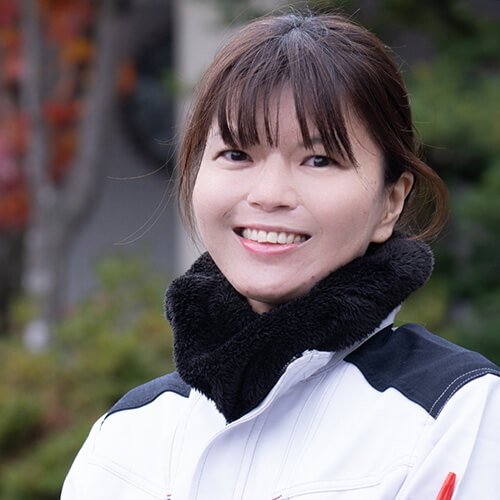

Japan Association for Construction Human Resources
Chief of Research and Development Department / Administration Department / Public Relations Department
Motoko Kano
(Kano Motoko)
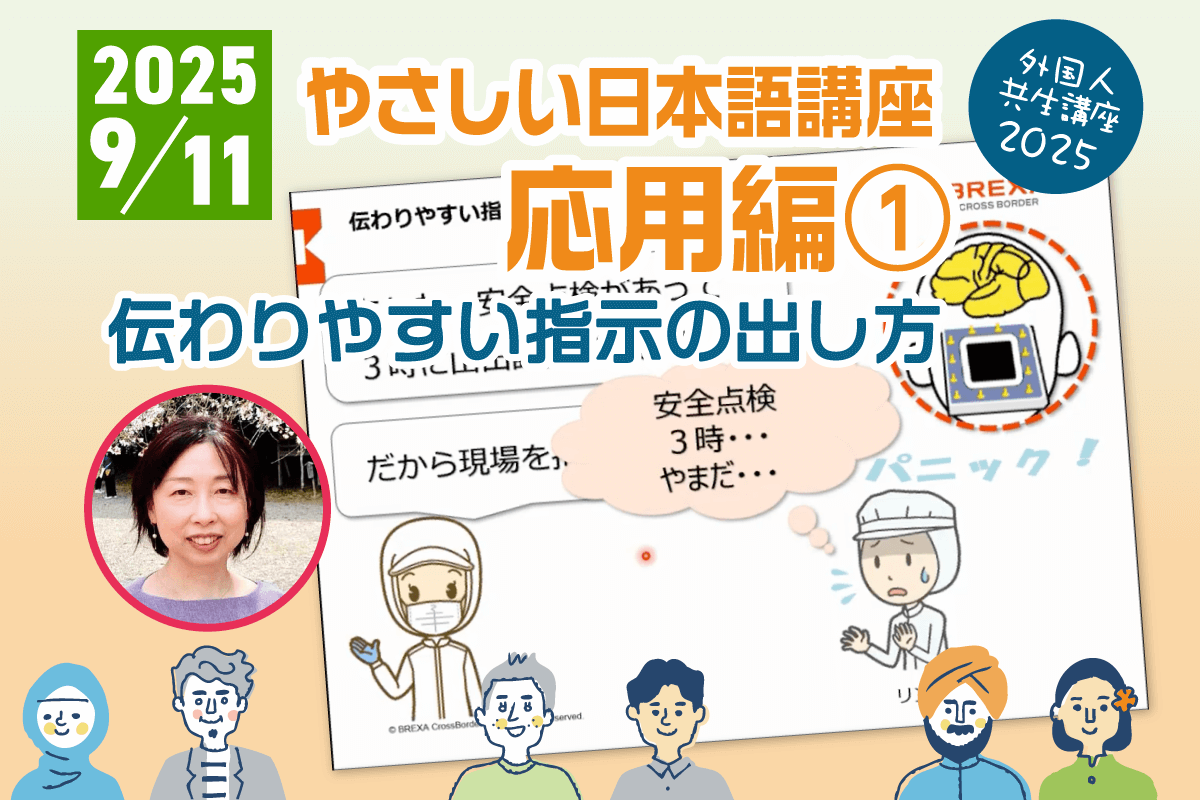
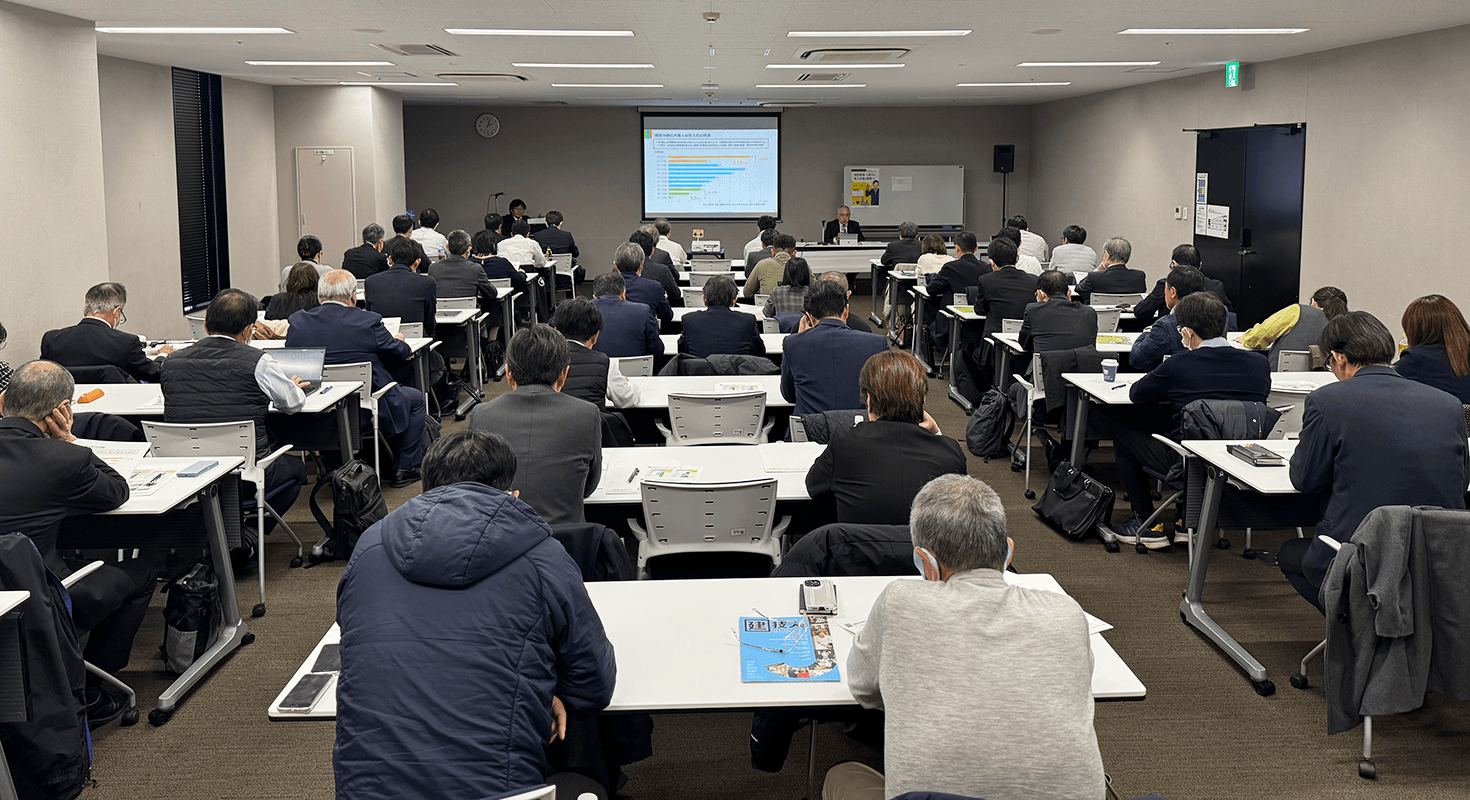
JAC has been holding a total of six seminars for Japan employees since May 2025.
Following the "Basics" of the previous "Plain Japanese Course", "Applied Edition (1)" was held online on Thursday, September 11, 2025.
The lecturer was Mr. Shiraishi from BREXA CrossBorder Co., Ltd.
In "Advanced Part 1," the course focused on the theme of "how to give instructions that are easy to understand," and included practical work.
First, let's review the "Basics"!
In the previous "Basics", I studied the "law of scissors", which is important for making Plain Japanese.
Speak clearly and concisely until the very end
Here are some key points:
- Do not use katakana words, onomatopoeia, masculine language, dialects, or abbreviations because they are difficult to understand.
- Expressions such as "desu," "masu," and "kudasai" that are the same as those in Japanese textbooks are easy for foreigners to understand.
- Remove unnecessary information and simplify your sentences
Teaching technical terms from the "concept"
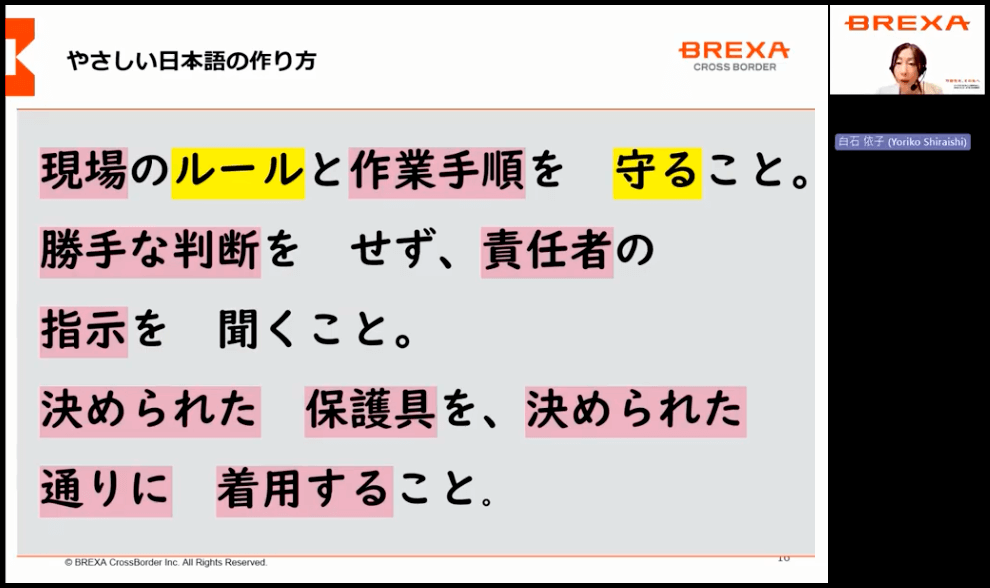
For Japanese language learners at the N5 level, the "technical terms" we use on a daily basis (e.g., the pink on the slide) are not included in textbooks.
Many companies use alternative words instead of technical terms, but prohibited words are particularly dangerous, so they need to be taught consistently.
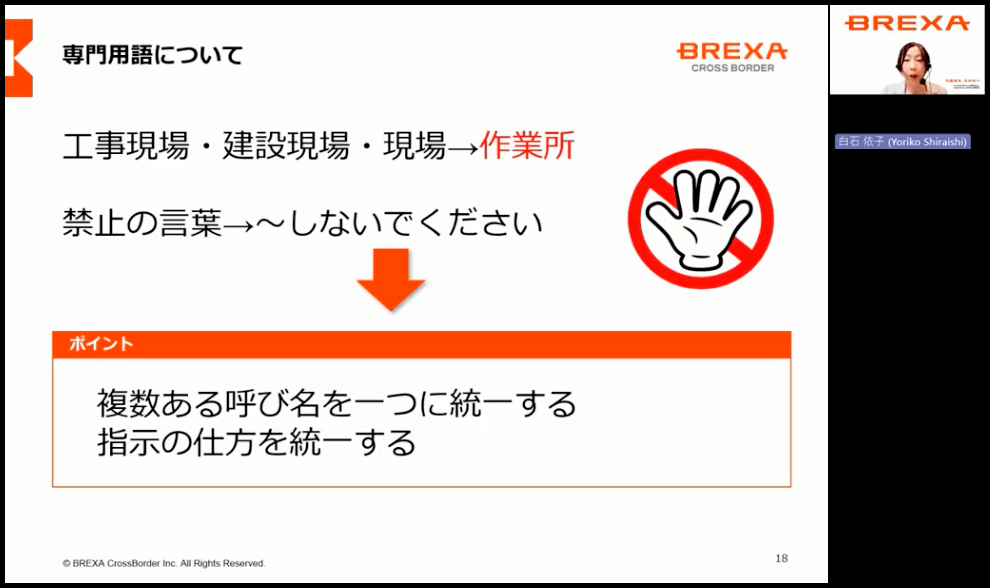
When teaching, it is important to convey the "concept of the word" and "purpose" together and take time to deepen understanding.
Why do we need to change Japanese?

Some Japanese employees may feel anxious or reluctant to use words that are not Japanese that they normally use.
However, it is also necessary to change the awareness of Japanese people.
First, by engaging in meaningful conversation, we make it easier for foreigners to get into Japanese and give them the successful experience of being able to communicate in Japanese.
Then, gradually change to regular Japanese and you will be able to have natural conversations.
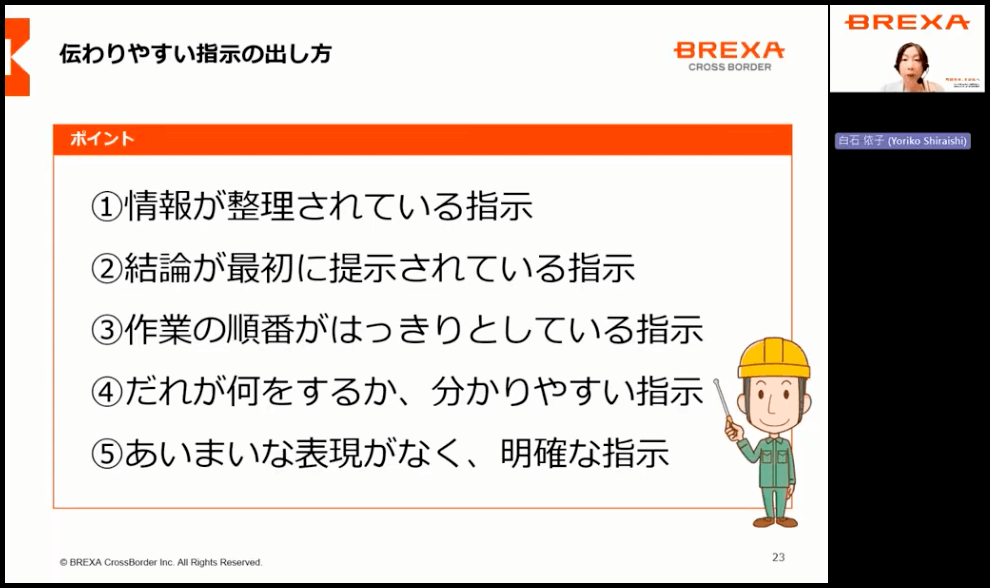
Organize instructions into five points
One of the purposes of "Plain Japanese" is to ensure that people work safely and reliably.
There is a clear pattern for giving instructions to prevent problems at the site.
- Instructions that keep information organized
- Instructions in which the conclusion is presented first
- Instructions with a clear order of work
- Clear instructions on who does what
- No ambiguity, clear instructions
Practical work example
This is an example of how to give clear instructions about who should do what.

Summary: A form of "coexistence" that starts with us
The misunderstanding of "not following instructions" because you don't understand Japanese can strain your relationships and, in the worst case, isolate foreign employees from society.
This can be avoided by communicating with "Plain Japanese".
To make foreigners think, "The Japanese of the people in the company is easy to understand." This is the first and most important step towards understanding and achieving results as a team working together.
Guest Corner: Learn from our guests! Pre-arrival education and success stories
We invited Mr. Shahrir, an Indonesian, as our guest and he shared his valuable thoughts about Japanese language education before sending his students off to their jobs.
Shahrir is the deputy head of Japanese language training at an Indonesian sending agency.
Before coming to Japan, we were given an introduction to the types of classes offered.
In addition to Japanese language education, the curriculum also incorporates cross-cultural education such as rules for daily life in Japan and public manners, with the aim of reducing problems and culture shock. It seems that they are also making sure to explain the differences between Indonesia and Japan, including how to report, communicate, and consult and how to separate garbage.
Also, since most of the staff are high school graduates, they also provide adult education, such as explaining the differences between students and working adults.
No matter where you work, if you act like a student you are likely to get into trouble, so I think this is an important education.
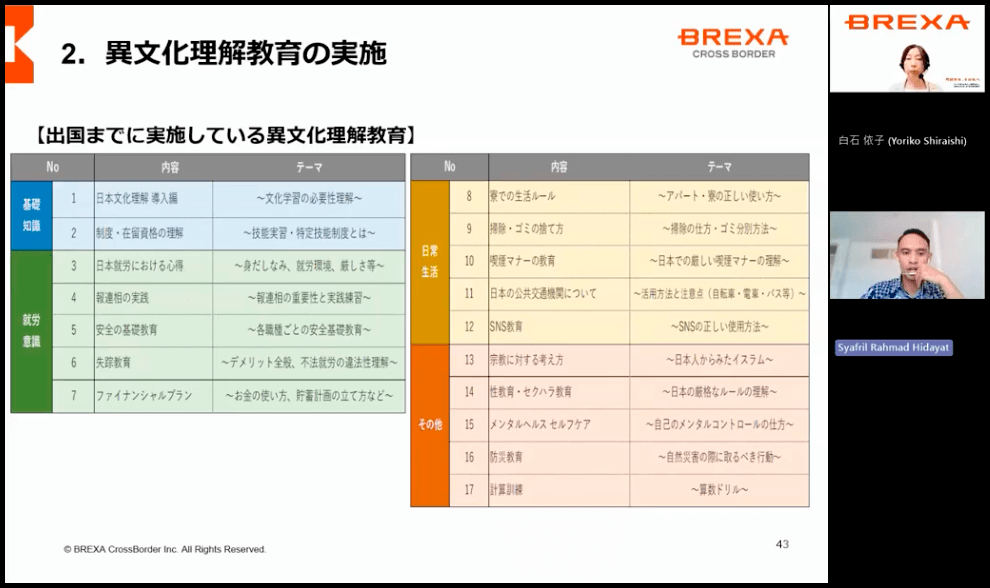
They want to teach a lot of things, but because the training period is short, they seem to prioritize their education.
Shiraishi asked about maintaining motivation to study after arriving in Japan. He said that he encourages students to set long-term goals, such as attaining N3 level between the time they arrive in Japan and the time they return home, and that he also tells them that the N4 level they have studied is not enough for life or work, so that they should study more in Japan.
After listening to Shafril's explanation, the course helped me understand the dispatching agencies.
At JAC, we offer a "Foreign Cooperation Course" for Japanese employees.
This course will help you acquire the knowledge and responsiveness necessary for coexisting with foreign talent, such as cross-cultural understanding and Plain Japanese that are easily understood by foreigners.
We also have a Q&A session, so please join us!
For more details about the course, please visit the 'Foreigner Coexistence Course' page below.
Missed episodes and materials from past courses are also available.
"Foreign Residents Coexistence Course" for Japanese Employees
The operation of this course has been entrusted to BREXA CrossBorder Co., Ltd.
This article is a report on the "Plain Japanese Course Application (1)" of the "Foreign Symbiosis Course 2025" for Japan employees held on Thursday, September 11, 2025.
Seminar Video
Seminar Materials
Seminar Materials_Plain Japanese Lecture (1) Basic Edition 250911.pdf
Q&A_Plain Japanese Lecture (1) Basic Edition 250911.pdf
Report on the "Foreigner Coexistence Seminar" for Japanese Employees
- Report on the "Cross-Cultural Understanding Seminar (1)" for Japanese Employees [1]
- Report on the "Cross-Cultural Understanding Seminar (2) Islam" for Japanese Employees [2]
- For Japan employees [3] "Plain Japanese Course (Basics)" Report
- For Japan employees [4] "Plain Japanese Course (Application (1))" Report
- For Japan employees [5] "Plain Japanese Lecture (Application (2))" Report
- Report on the "Lifestyle/Transportation Guidance Course" for Japanese Employees (6)
The author of this article
Japan Association for Construction Human Resources
Chief of Research and Development Department / Administration Department / Public Relations Department
Motoko Kano
(Kano Motoko)


Born in Aichi Prefecture.
He is in charge of public relations, research and investigation, and is the person behind social media.
We update our social media accounts daily with the desire to make people fall in love with Japan, to spread the appeal of construction from Japan to the world, and to ensure that Japan's construction industry continues to be the industry of choice around the world.
He is also engaged in research into the feasibility of implementing skills evaluation exam in Asian countries, and is conducting interviews with local organizations in each country.
Related articles
Report on the "Foreign Workplace Coexistence Seminar 2026" for Japanese Employees: Basic Knowledge of Employing Foreign Workers
Report on the "2026 Seminar on Coexistence with Foreign Employees": Intercultural Understanding Seminar ② - Vietnam & India Edition
Report on the "Foreigner Coexistence Seminar 2026" for Japanese Employees: Intercultural Understanding Seminar ① Indonesia and Islam.
Specified Skilled Worker Recruitment 10 Questions from Construction Companies - FY2025 System Briefing Session Report (Omiya, Saitama)