- やさしい日本語
- ひらがなをつける
- Language
We provide multilingual content through machine translation. Translation accuracy is not 100%. About the multilingualization of the JAC website




- Home
- JAC Magazine
- Working with foreign workers
- What is the Japanese level of Specified Skilled Worker? Precautions and measures after acceptance
- Home
- JAC Magazine
- Working with foreign workers
- What is the Japanese level of Specified Skilled Worker? Precautions and measures after acceptance

What is the Japanese level of Specified Skilled Worker? Precautions and measures after acceptance
I wrote the article!


Japan Association for Construction Human Resources
Public Relations Department/Administration Department
Tsubasa Yoshioka
(Tsubasa Yoshioka)

Hello, this is Yoshioka from JAC (Japan Association for Construction Human Resources).
Many companies are considering accepting Specified Skilled Worker, but are worried about what to do if they can't communicate well in the Japanese.
Being able to communicate well in Japanese is a very important point for smooth work.
In this article, we will explain the Japanese level of Specified Skilled Worker.
We will also introduce precautions and communication techniques, so if you are considering accepting Specified Skilled Worker, please take a look.

Foreigners with a status of residence "Specified Skills" have a certain Japanese ability or more
In order for a foreigner to work in the residence status "Specified Skills", as a rule, he must prove his Japanese abilities.
This is to ensure that you understand the Japanese language necessary for work and daily life and can communicate smoothly.
Therefore, when you can obtain a Specified Skills status of residence, you can judge that you have a certain level of Japanese ability.
Before checking the specific Japanese level, let's first introduce the main exams that foreigners take to obtain a status of residence.
Major exams to prove Japanese language proficiency
There are two typical exams that foreigners take to prove their Japanese language proficiency:
- Japanese Language Proficiency Test (JLPT)
- Japan Foundation Test for Basic Japanese(JFT-Basic)
Japanese Language Proficiency Test (JLPT)
The Japanese Proficiency Test is a test that measures how well you can understand Japanese, focusing on "reading skills" and "listening skills".
Japan Foundation and Japan Educational Exchanges and Services are organizing.
It is a method in which the candidate chooses a level and applies.
The levels are divided into five levels, from the most difficult N1 to the easiest N5.
Therefore, checking what level they have passed will help you determine how well the person you plan to accept will be able to communicate in the workplace.
Japan Foundation Test for Basic Japanese(JFT-Basic)
Japan Foundation Test for Basic Japanese is a test that measures the basic abilities of Japanese mainly for foreigners who come to Japan for work, and is conducted by Japan Foundation.
It determines whether you have the ability to have daily conversations to some extent and not interfere with your life.
Based on the Common European Framework of Reference (CEFR), it is rated on a 6-point scale from the easiest A1 to the most difficult C2.
By the way, foreigners who have successfully completed the status of residence "Technical Intern Training" No. 2 are exempted from the Japanese ability test if they want to move to Specified Skilled Worker (i).
This is because it is considered that you have already acquired certain Japanese abilities during the 3-year Technical Intern Training period.
Japanese level of ability that Specified Skilled Worker has

The "Japanese Proficiency Test (JLPT)" and "Japan Foundation Test for Basic Japanese (JFT-Basic)" are the certification guidelines required to obtain Specified Skills status of residence.
Japanese Language Proficiency Test (JLPT)
As mentioned above, the Japanese Language Proficiency Test is divided into five levels, from N1 to N5.
The level guidelines are as follows:
- N1: A level where you can understand business conversations, honorific language, and polite language, and can hold discussions on an equal footing
- N2: Able to handle everyday conversations and understand business conversations and explanatory materials to a certain extent
- N3: Able to understand everyday conversation to some extent
- N4: Able to understand slow conversations and simple sentences
- N5: Able to understand basic words, short sentences, and simple characters.
Specified Skilled Worker (i) requires a Japanese ability of N4 or higher.
The N4 level is considered to be a level where you can read familiar sentences written using basic vocabulary and kanji, and can understand most of the content of everyday conversations spoken slowly.
Specifically, it demonstrates the following abilities:
[Reading ability]
- Able to read and understand texts on familiar topics written using basic vocabulary and kanji
[Listening skills]
- Able to understand most conversations that are spoken slowly in everyday situations
* Source: Japanese Language Proficiency Test (JLPT) "N1 to N5: Certification Guidelines"
The Japanese Language Proficiency Test measures reading and listening skills, but for foreigners at the N4 level, speaking and writing skills are considered to be at the following levels.
[Speaking ability]
- Able to explain in simple words how one feels, such as surprise or happiness, and the reasons for it.
- Able to talk about familiar and everyday topics (e.g. hobbies, weekend plans)
[Writing ability]
- I can write simple notes to friends and colleagues about everyday matters.
- I can write simple letters or emails to friends to ask or invite them
Japan Foundation Test for Basic Japanese(JFT-Basic)
As we told you, Japan Foundation Test for Basic Japanese is divided into 6 levels, from A1 to C2.
The approximate level is as follows:
- C2: Able to understand words at the same level as Japanese people and express themselves accurately
- C1: Able to understand and express long sentences and conversations, as well as highly specialized content.
- B2: Able to understand and explain specialized topics and abstract content
- B1: Able to handle familiar topics and moderately complex conversations
- A2: Able to carry out simple daily and work-related interactions
- A1: Can understand slow conversations and can have simple exchanges
Specified Skilled Worker (i) requires Japanese ability at A2 level or higher.
A2 level is defined as "the ability to have a certain level of everyday conversation and not have any problems in daily life."
Specifically, you will demonstrate the following abilities:
[Understanding ability in everyday life]
- Able to understand familiar sentences and expressions related to basic personal information, family, shopping, local events, work, etc.
[Communication skills]
- Able to exchange information about familiar matters within a simple, everyday range.
- Be able to explain in simple terms your background, your immediate surroundings, and the requirements of your job
* Reference: JFT-Basic Japan Foundation Test for Basic Japanese "What is JFT-Basic?"
We will introduce specific examples of conversations that show what kind of communication is actually possible at each level.
【N5(A1)】
If you speak slowly, you can understand basic instructions and schedules.
example:
Japanese employee: There will be a meeting tomorrow at 9 o'clock. Please don't be late.
You will also be able to introduce yourself and talk about simple things such as your favorite foods.
example:
Foreign employee: I'm from Vietnam. I love pho.
【N4(A2)】
If you speak a little slowly, you can generally understand everyday conversations.
example:
Japanese employee: Tomorrow is the company anniversary party. Please wear a suit.
Foreign employee: Do you wear a tie?
You can also express your feelings and reasons in short sentences.
example:
Foreign employee: I was surprised when there was an earthquake yesterday. There are no earthquakes in Vietnam.
What to keep in mind when measuring Specified Skilled Worker Japanese levels
When accepting Specified Skilled Worker, it is important to be careful not to judge Japanese ability based solely on exam results.
Communication skills for exams and practical work are considered separate things.
The Japanese Proficiency Test (JLPT) and Japan Foundation Test for Basic Japanese (JFT-Basic) are mainly conducted using the mark sheet method and the computer method (CBT).
These tests can measure grammar, vocabulary, reading comprehension, and listening comprehension, but they cannot adequately measure the "conversational skills" that are essential in practice.
Some people have enough knowledge of grammar and vocabulary to get a high score on the exam, but when it comes to actual conversation, they cannot speak or are not good at listening.
On the other hand, some people are not good at writing or reading exams, but are good at verbal communication in everyday conversation and at work.
Judging from the interview is also important
The level required for the exam is only the minimum standard for obtaining Specified Skills status of residence.
Therefore, communication in interviews is important to more accurately assess Japanese proficiency.
During the interview, it is a good idea to check the following points:
- Do you understand the question properly?
- Do you have the ability to express your opinions accurately?
- Do you see a willingness to communicate smoothly?
- Can you use polite language?
In addition, it is important to use the technical terms and instructions you will use in your actual work and check whether they can be understood.
Specified Skills is a system that accepts human resources who can play an active role immediately.
Therefore, it is necessary to check whether you understand the language related to work.
In particular, make sure you understand the words related to safety.
For example, the words "bikaru" (to hit) and "hasamareru" (to be caught) that are often used on construction sites correspond to the N3 level of the Japanese Language Proficiency Test.
These words may be difficult to understand at the N4 level, but they are essential to know in order to work safely.
For more information on what you want to check during an interview for Specified Skilled Worker, please refer to the following column.
Specified Skilled Worker What questions should I ask in a job interview? Introducing examples of questions and precautions
Japanese language study is still necessary after acceptance
Even Japan people may find it difficult to use technical terms related to work.
Although Specified Skilled Worker is an immediate ability, the Japanese is a very large part that you actually learn through living and working in Japan.
Even after obtaining a Specified Skills status of residence, it is important to have a system in place to teach Japanese.
It is one of the obligations of the host company to provide Japanese learning opportunities for the Specified Skilled Worker.
Examples of support provided by host companies include:
- Creating a glossary of technical terms required for business
- Creating a system to support communication in Japanese
- Support for attending Japanese language classes
It is important not to focus solely on test scores, but to assess practical communication skills and to provide ongoing support for Japanese language learning even after acceptance.
If you are worried about Japanese communication with Specified Skilled Worker
Smoother communication with Specified Skilled Worker requires understanding, ingenuity, and effort from both Japan employees and Specified Skilled Worker.
For example, you can do the following.
- Use "Plain Japanese"
- Communicate using illustrations and gestures
- Use translation tools
- Increase communication opportunities through events, etc.
- Use external training and courses
"Plain Japanese" is a Japanese that has been converted to make it easier for foreigners to understand, and uses short sentences, sentences with few kanji, and grammar with low difficulty.
Please take a look at the details here.
What is Plain Japanese? Introducing example sentences and how they were born
JAC also holds the following courses to deepen understanding between Japan employees and Specified Skilled Worker!
JAC's course for Japanese employees
JAC holds a "Foreign Symbiosis Course" for Japan employees of companies that employ Specified Skilled Worker.
Foreigner Symbiosis Course
We will deepen our learning about the important "Plain Japanese" in communicating with foreign employees, as well as the cultures of various countries and religions, and consider tips for creating a comfortable working environment for both Japan and foreign employees.
If you missed any past lectures, you can watch them here.
Report, missed broadcast and materials for the "Foreigner Coexistence Seminar" for Japanese employees
JAC Courses for Specified Skilled Worker
For foreigners working in Japan, we hold "Japanese Language Courses".
Specified Skills Acceptance support service "JAC Japanese Course"
The following foreign nationals are eligible:
- Foreigners with "Status of Residence: Specified Skilled Worker (i)" who are working for a company engaged in construction work
- Technical Intern Training students who are employed by the same company as the foreigner mentioned above and are willing to move to Specified Skilled Worker (i)
Depending on the needs and level of the student, they can learn more useful content, from Japanese necessary for daily life to practical Japanese that can be used on construction sites.
Some companies provide ongoing Japanese language learning opportunities while encouraging employees to take advantage of these courses, and even offer incentives to employees who improve their Japanese language skills on Japanese language tests.
This can be said to be an effective initiative in retaining foreign talent and improving their motivation.
For more tips on communicating with foreign workers, check out these!
What measures can be taken to ensure smooth communication with foreign workers?
Summary: Determine your Specified Skilled Worker Japanese level with exams and interviews
Since proof of Japanese ability is required to work under the status of residence "Specified Skills", it can be said that foreigners with Specified Skills status of residence have a certain Japanese ability.
There are two typical exams that foreigners take to prove their Japanese abilities: the Japanese Proficiency Test (JLPT) and the Japan Foundation Test for Basic Japanese (JFT-Basic).
In order to obtain Specified Skills status of residence, you must have a level of N4 or higher in the Japanese Proficiency Test (JLPT) and an A2 or higher in the Japan Foundation Test for Basic Japanese (JFT-Basic).
However, since the exam is a mark sheet and CBT method, it is difficult to measure how much conversation level you actually have based on the test results alone.
Regarding your personal Japanese ability, let's judge it by the content of the interview.
It is also important to provide support for learning Japanese after acceptance so that communication can be smoother.
If you are worried about communicating with foreign employees, it is important to make efforts on both Japan and foreign employees by taking advantage of training and courses.
JAC is here to answer a variety of questions about the acceptance of Specified Skilled Worker in the construction industry.
If you are a company that is considering accepting Specified Skilled Worker in the construction industry, please feel free to contact JAC!
*This article is based on information as of September 2025.
The author of this article
Japan Association for Construction Human Resources
Public Relations Department/Administration Department
Tsubasa Yoshioka
(Tsubasa Yoshioka)
Born in Tokyo.
I am involved in work as a public relations officer.
We mainly interview companies that accept Specified Skilled Worker and disseminate information about acceptance support services.
We hope to support companies considering hiring Specified Skilled Worker for the first time, and to contribute to creating a workplace where foreigners can work with peace of mind.
We are working to realize this through daily communication.
Related articles
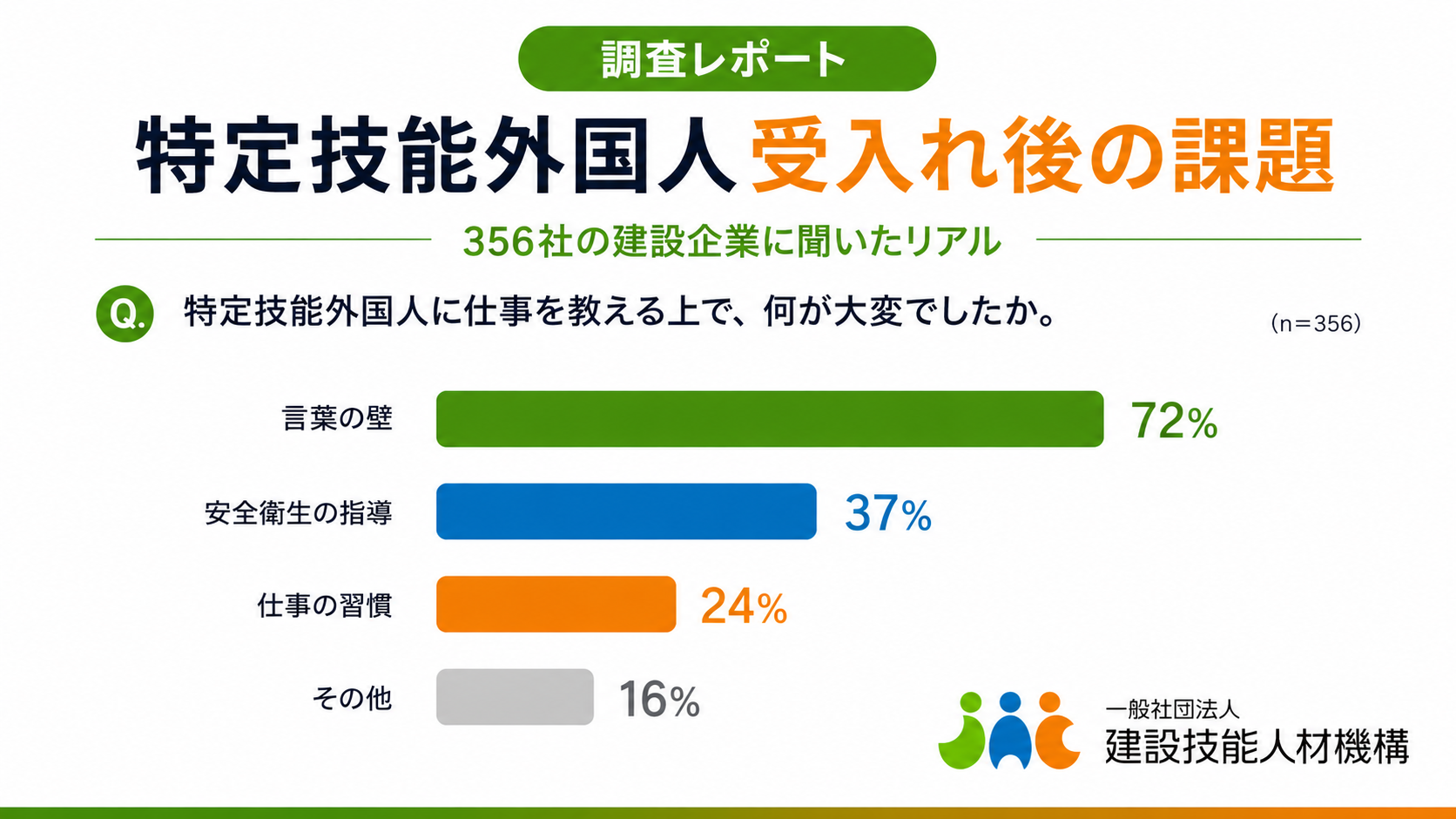
[Survey Report] Viewing from the Survey Perspective! Specified Skilled Worker Challenges After Acceptance
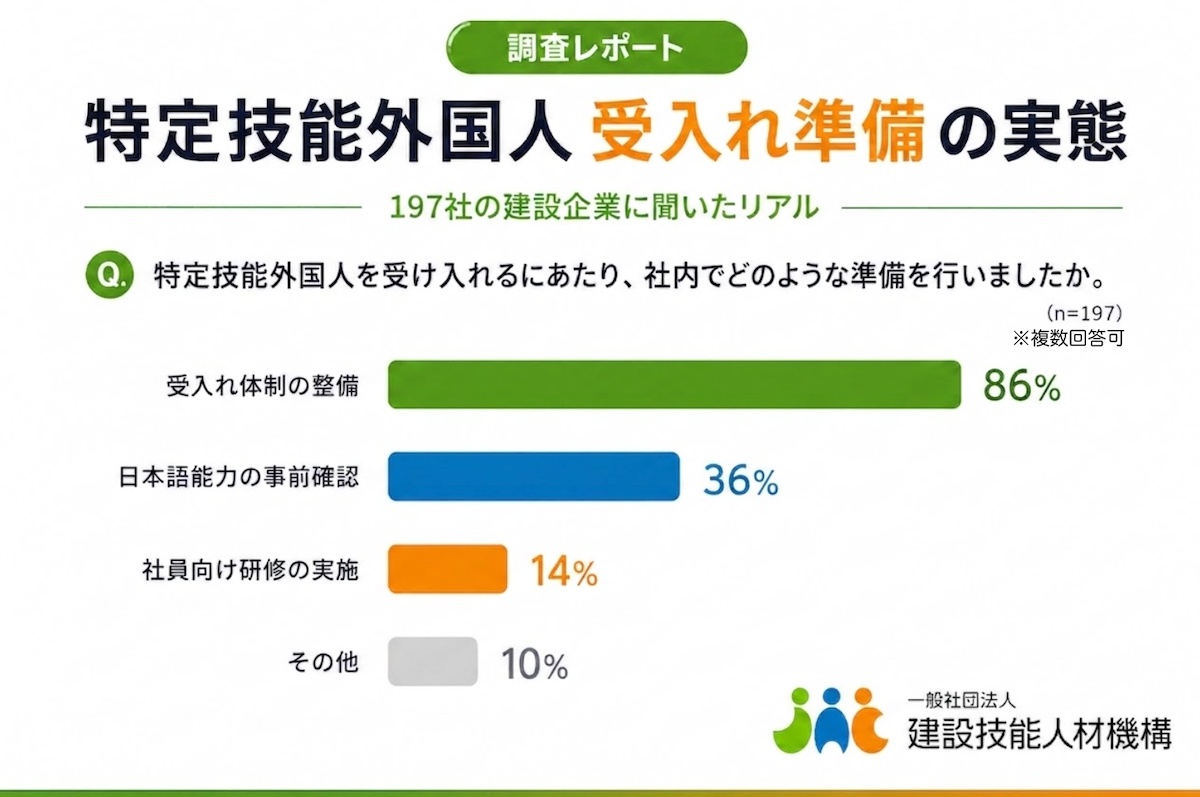
[Survey Report] Insights from Surveys! Specified Skilled Worker The Realities of Acceptance Preparation

Considering "Japanese language education" for foreign workers: What are the necessities and teaching methods?

What makes a workplace welcoming to foreigners? Key points for creating a workplace that companies should implement.