- やさしい日本語
- ひらがなをつける
- Language
We provide multilingual content through machine translation. Translation accuracy is not 100%. About the multilingualization of the JAC website





- Home
- JAC Magazine
- JAC Initiatives and Activities Report
- Report on the "Foreigner Coexistence Course 2025" Lifestyle/Transportation Guidance Course for Japanese Employees
- Home
- JAC Magazine
- JAC Initiatives and Activities Report
- Report on the "Foreigner Coexistence Course 2025" Lifestyle/Transportation Guidance Course for Japanese Employees

Report on the "Foreigner Coexistence Course 2025" Lifestyle/Transportation Guidance Course for Japanese Employees
I wrote the article!
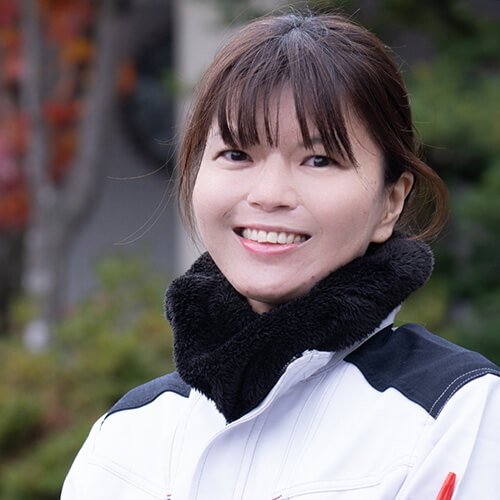

Japan Association for Construction Human Resources
Chief of Research and Development Department / Administration Department / Public Relations Department
Motoko Kano
(Kano Motoko)

JAC has been holding a series of six "Foreigner Coexistence Courses" for Japanese employees since May 2025. The sixth and final "Lifestyle/Transportation Guidance Course" was held online on Thursday, December 11th.
In this course, we invited Mr. Shiraishi of BREXA CrossBorder Co., Ltd. as the lecturer, and started by reviewing "how to make Plain Japanese, how to give instructions, and what the company can do". In the main story, we took a little deeper into how to give practical instructions, using lifestyle and traffic rules in Japan as examples.
The always popular guest corner was extended, with three members of BREXA CROSS BORDER's multinational team taking to the stage. They shared real-life examples from the relief efforts and valuable insights based on differences in lifestyles compared to their home countries.
Ensure safety with clear instructions! "How to give clear instructions"
Convincing reasoning and risk communication
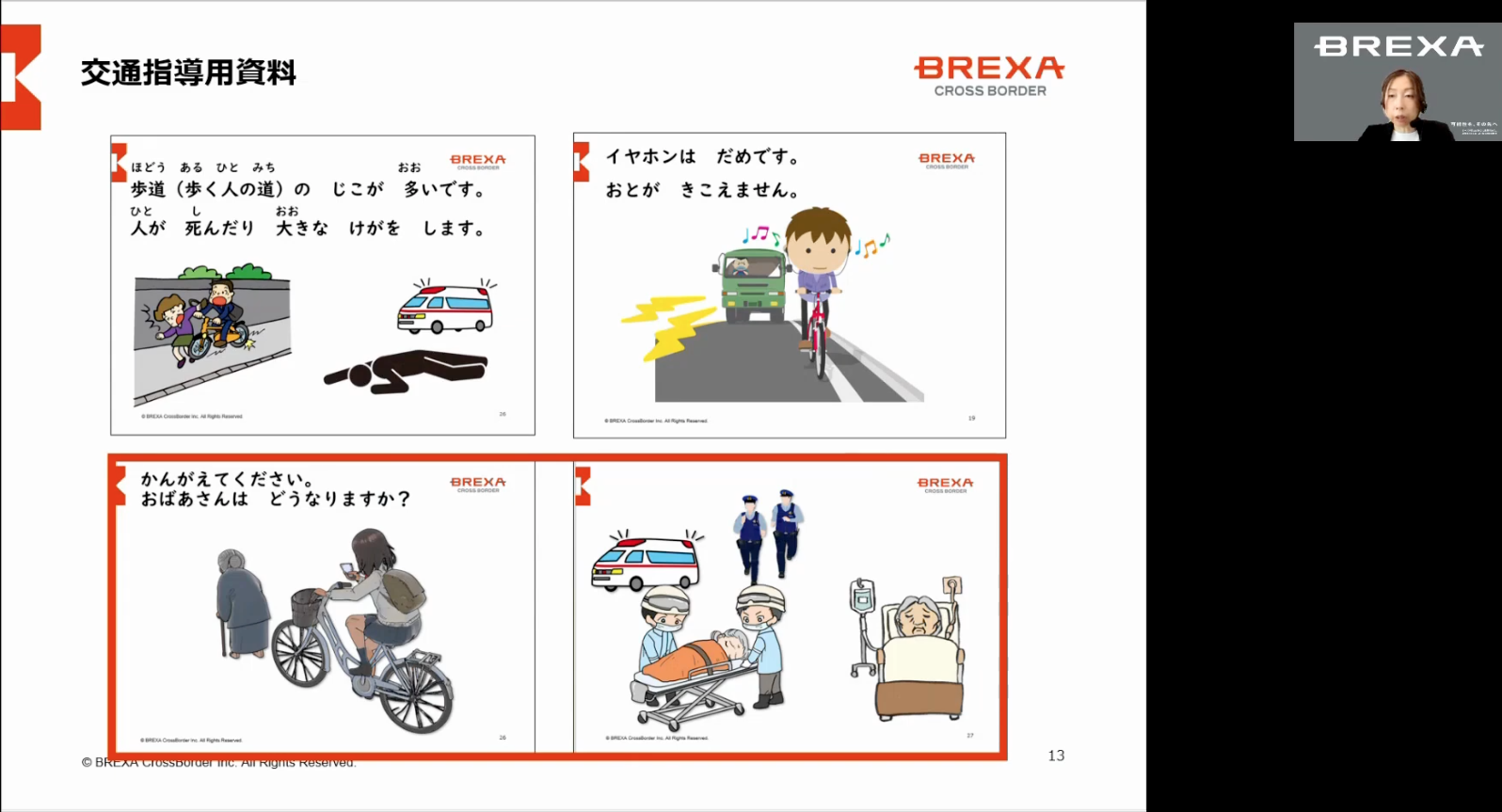
To increase the persuasiveness of instructions, it is important to clearly communicate the reasons for actions and the potential risks. Visualizing risks, such as using videos that recreate traffic accidents, is particularly effective.
Reaffirming "No"
The expression "you can't do this" has different meanings depending on the context, and can be difficult for foreign workers to understand, so care must be taken. We replaced it with more specific expressions such as "please do this" and "don't do this," and reaffirmed that instructions are clear from the perspective of foreigners.
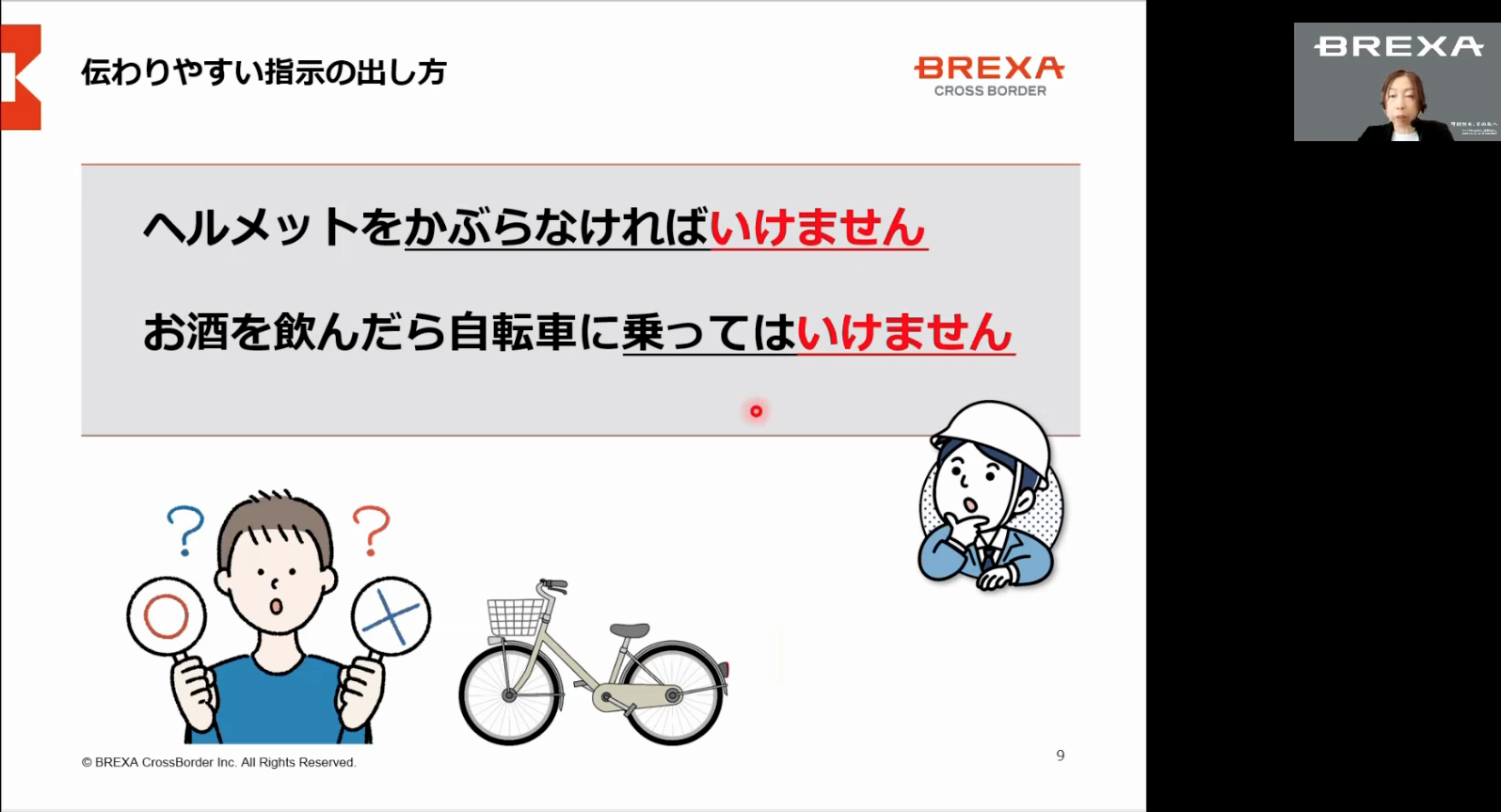
Key points for teaching bicycle rules that are getting stricter every year
Many people come to Japan from countries where bicycle riding is not a custom, so when teaching them traffic rules, giving them too much information at once can cause confusion.
- We will gradually increase the amount of information on situations where bicycles are used, such as commuting to work.
- Incorporate elements that encourage self-thinking.
- In cases where situational judgment is required, safe and easy-to-understand practical instruction is provided, such as actually riding a bicycle together.
We have prepared instructional materials for you to use.
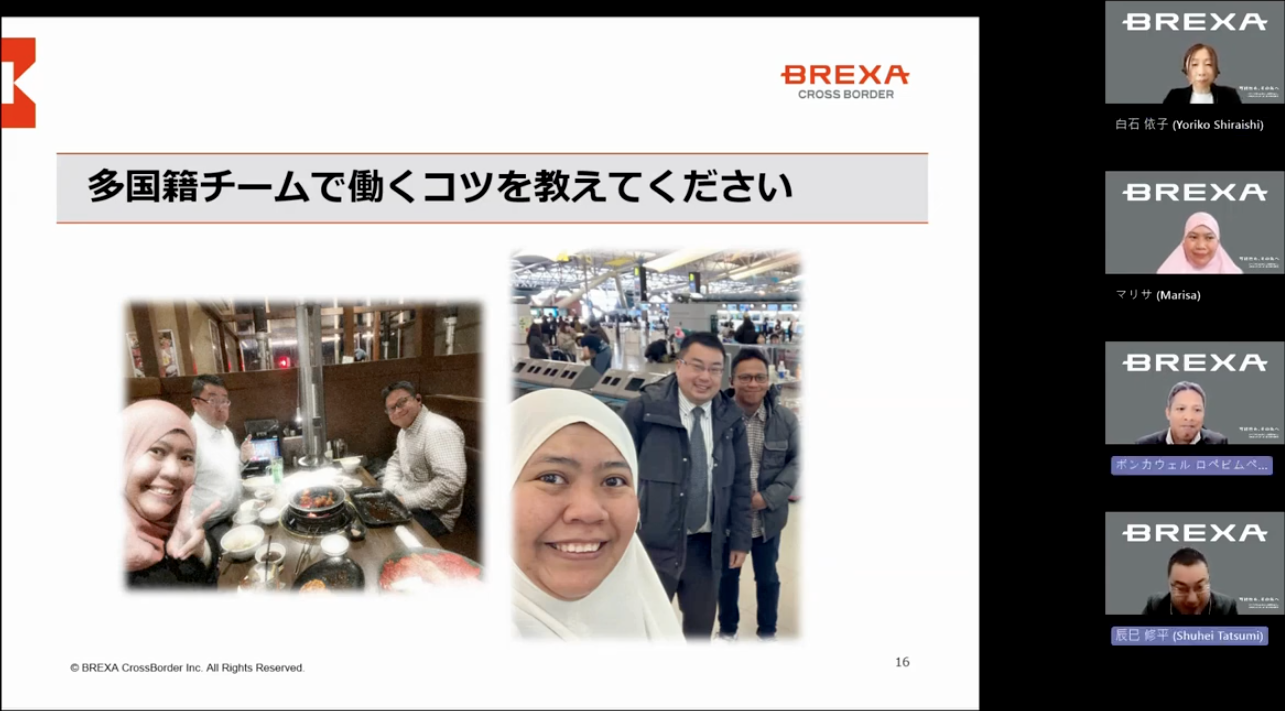
Guest Corner: Real voices from a multinational team
This time, three members of the multinational team, Mr. Tatsumi (Japanese), Mr. Ben (Filipino), and Ms. Marisa (Indonesian), took the stage as guest speakers to talk about the secrets to working smoothly in a multinational team.
The secret to smooth teamwork
- An environment where there is thorough communication within the team and no inconvenience is felt.
- Build a relationship of trust where you can say anything to each other. Accept the hardships as something for your own good.
- Be conscious of using positive words such as "praise" and "acknowledge."
- They accept that things will not go well and have the generosity to leave it up to the other person.
Differences between Technical Intern Training students and Specified Skills employees
- Technical Intern Training Students often seek help from support organizations for daily life, such as how to get to the hospital or receive mail, based on their Japanese level and experience.
- Specified Skills Employees tend to have more in-depth life consultations tailored to their stage of life, such as marriage and child-rearing, although the frequency of consultations decreases as their Japanese level increases and their experience increases.
Issues companies should be aware of regarding the "life" and "support" of foreign employees
The participants were introduced to lifestyle topics that companies often ask about, specific measures being taken by support organizations, and differences in lifestyle habits from their home countries.
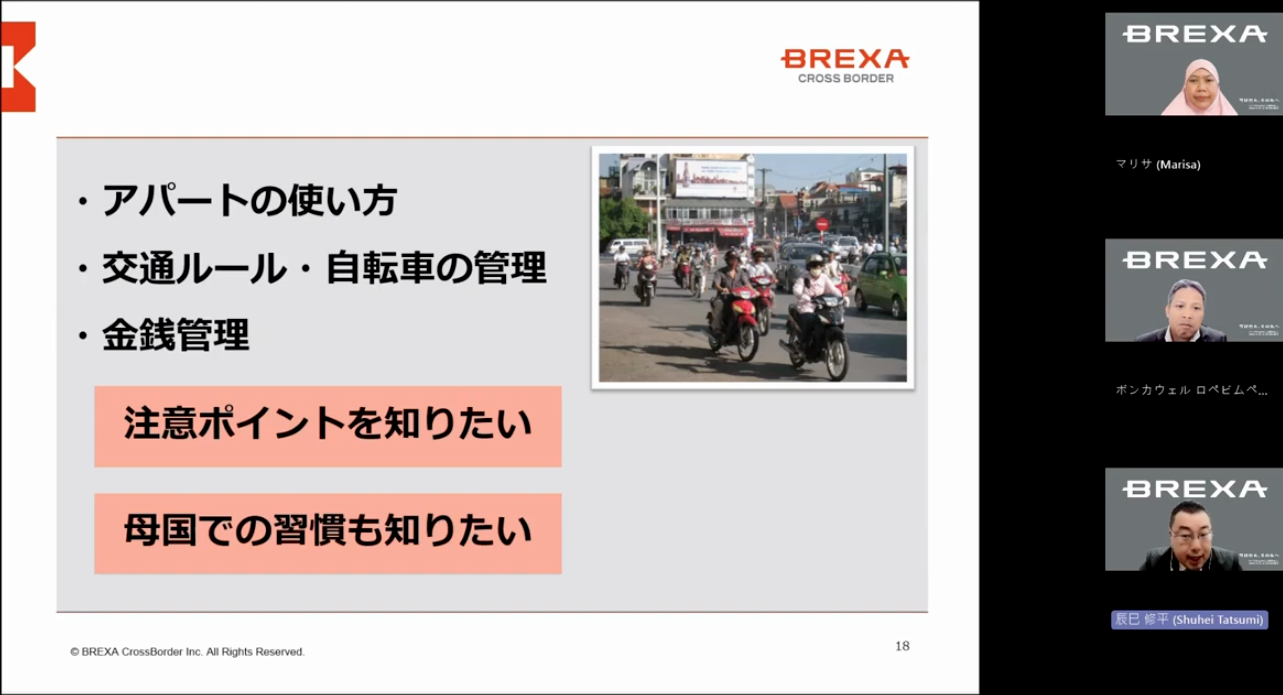
| theme | Differences and challenges from lifestyles in one's home country | Measures taken by support organizations |
|---|---|---|
| Taking out the trash | Customs vary greatly from country to country, such as the Philippines (incineration in rural areas), Indonesia (no sorting), and Vietnam (varies by municipality). | Before and after entering the country, they should practice sorting their trash. They should be thoroughly briefed on the rules and collection days. |
| Moving out of an apartment | There is no rental custom in Indonesia, and people are unaware of the costs of moving out and repairs. | The support organization and the landlord should thoroughly coordinate the rules for when the tenant moves out. Samples of the moving-out fees should be shown and explained, and the condition of the room should be checked regularly. |
| Daily life noise | In bustling cultures such as Indonesia, there is no awareness of noise. | Noise problems often subside once you've warned them. Taking the time to show your good side, such as by visiting your neighbors and saying hello when you move in, can help prevent problems with your neighbors. |
| Borrowing and lending money | In Vietnam, there is a strong sense of mutual help, but not paying back is not acceptable. In Indonesia, some people consider it a "donation." | Encourage people to save for emergencies. Advise against personal lending and borrowing to prevent fraud. |
| Long vacation | During the holidays, they spend time with the same people in the dormitory, so they often get into arguments over small things. | Not only before holidays, but also on a daily basis, we share examples of trouble to raise awareness of danger. We communicate that "we are watching over you" to foster a sense of security. We also communicate in advance how to deal with lost items, etc. |
| Seasonal troubles | Since this is your first winter, there are many unexpected problems that can arise, such as clogged drains due to hardened oil, the risk of fire due to dryness, setting the air conditioner at the right temperature, injuries sustained during winter sports, and caution when drinking alcohol. | Before winter arrives, we will provide guidance on specific problems and how to deal with them. We will also inform students that if they encounter any problems, it will affect their residence status, and we will warn them to never let them happen. |
| disappearance | Technical Intern Training There are cases where students disappear because they cannot pay large debts. Multiple causes overlap, such as treatment and workplace relationships. | Let people know there are evacuation shelters so they don't have to worry alone. Be especially careful on driving test days. |
Future support
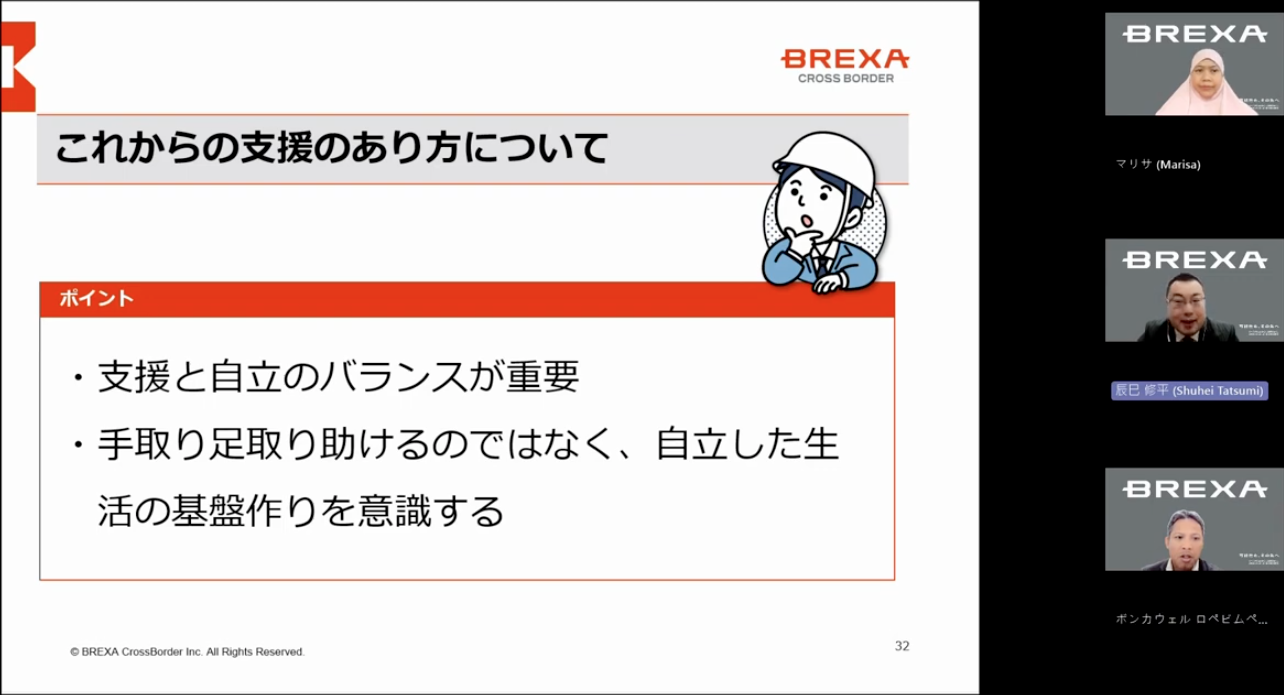
There is a dilemma that encouraging foreigners to become independent is criticized as "insufficient support," while providing support leads to "dependence." It was suggested that when it comes to support, it is important to provide balanced support that encourages independence, with the individual, company, and support organization all working in the same direction, and "supporting from behind to help them achieve their goals on their own."
Challenges of bringing family members
Specified Skills Family companionship is a high hurdle, and there are more situations where support is needed, such as major illnesses or childcare. Japanese language skills are especially important, and family support is also required.
The final lecture concluded with Tatsumi's words, "I hope that we will deal with foreign workers with a good balance of tolerance and strictness."
Summary: Deepening "coexistence" with foreign workers [Lifestyle/Transportation Guidance Course]
Clear instructions and safety
When giving instructions, it is important to clearly communicate the reasons for actions and potential risks to foreign employees, making them persuasive. In particular, it is important to avoid ambiguous expressions such as "you must not" that change meaning depending on the context, and to replace them with specific and clear instructions such as "please do this" or "don't do this." Furthermore, when it comes to information that is not customary in their home country, such as bicycle rules, it is effective not to give too much information at once, but to gradually increase the information starting with situations in which they use the bicycle, such as when commuting, and to encourage independent decision-making through practical guidance.
Multinational team knowledge and support needs
In the guest corner, the secrets to the smooth work of multinational teams were shared as in-depth communication within the team, building unshakable relationships of trust that accept even tough things, and open-mindedness that "it is normal that things don't go well." In addition, Technical Intern Training students seek help with basic life from support organizations, while Specified Skills employees have more in-depth life counseling according to their stage of life, such as marriage and child-rearing, as their Japanese abilities and experience increase.
Lifestyle issues and corporate countermeasures
When it comes to everyday life issues that companies often consult about, issues that arise from significant differences in lifestyle compared to their home countries, such as garbage disposal, moving out of apartments, noise, and lending and borrowing money, were raised. Specific measures suggested to address these issues include providing thorough training on rules before and after arrival, visually explaining moving-out costs, and preventing problems by visiting neighbors to say hello. Furthermore, with regard to seasonal issues such as clogged drains and fire risks in the winter, and serious problems such as disappearances due to debt, the importance of providing advance guidance and sharing a sense of crisis, as well as communicating the information that "there are shelters available and you don't have to worry alone," was emphasized.
Future direction of support
In response to the dilemma that encouraging foreign employees to become independent is considered "lack of support" and providing support leads to "dependence", it was recommended to provide balanced support in which the individual, the company, and the support organization can face the same direction and ultimately "follow from behind" so that they can do it on their own. In addition, as the number of Specified Skills employees with their families increases, there will be more situations where support is needed, such as illness and childcare, so it is important to take into account the Japanese ability of family members.
At JAC, we offer a "Foreign Cooperation Course" for Japanese employees.
This course will help you acquire the knowledge and responsiveness necessary for coexisting with foreign talent, such as cross-cultural understanding and Plain Japanese that are easily understood by foreigners.
We also have a Q&A session, so please join us!
For more details about the course, please visit the 'Foreigner Coexistence Course' page below.
Missed episodes and materials from past courses are also available.
"Foreign Residents Coexistence Course" for Japanese Employees
The operation of this course has been entrusted to BREXA CrossBorder Co., Ltd.
This article is a report on the "Lifestyle/Transportation Guidance Course" held as part of the "Foreigner Coexistence Course 2025" for Japanese employees on Thursday, December 11, 2025.
Seminar Video
Seminar Materials
Seminar Materials_Lifestyle/Traffic Guidance Course 251211.pdf
Q&A_Life/Traffic Guidance Course 251211.pdf
Report on the "Foreigner Coexistence Seminar" for Japanese Employees
- Report on the "Cross-Cultural Understanding Seminar (1)" for Japanese Employees [1]
- Report on the "Cross-Cultural Understanding Seminar (2) Islam" for Japanese Employees [2]
- For Japan employees [3] "Plain Japanese Course (Basics)" Report
- For Japan employees [4] "Plain Japanese Course (Application (1))" Report
- For Japan employees [5] "Plain Japanese Lecture (Application (2))" Report
- Report on the "Lifestyle/Transportation Guidance Course" for Japanese Employees (6)
The author of this article
Japan Association for Construction Human Resources
Chief of Research and Development Department / Administration Department / Public Relations Department
Motoko Kano
(Kano Motoko)


Born in Aichi Prefecture.
He is in charge of public relations, research and investigation, and is the person behind social media.
We update our social media accounts daily with the desire to make people fall in love with Japan, to spread the appeal of construction from Japan to the world, and to ensure that Japan's construction industry continues to be the industry of choice around the world.
He is also engaged in research into the feasibility of implementing skills evaluation exam in Asian countries, and is conducting interviews with local organizations in each country.
Related articles
Report on the "Foreign Workplace Coexistence Seminar 2026" for Japanese Employees: Basic Knowledge of Employing Foreign Workers
Report on the "2026 Seminar on Coexistence with Foreign Employees": Intercultural Understanding Seminar ② - Vietnam & India Edition
Report on the "Foreigner Coexistence Seminar 2026" for Japanese Employees: Intercultural Understanding Seminar ① Indonesia and Islam.
Specified Skilled Worker Recruitment 10 Questions from Construction Companies - FY2025 System Briefing Session Report (Omiya, Saitama)