- やさしい日本語
- ひらがなをつける
- Language
We provide multilingual content through machine translation. Translation accuracy is not 100%. About the multilingualization of the JAC website





- Home
- JAC Magazine
- JAC Initiatives and Activities Report
- Report on the "Foreign Coexistence Course 2025" for Japan Employees Plain Japanese Lecture (Application (2))
- Home
- JAC Magazine
- JAC Initiatives and Activities Report
- Report on the "Foreign Coexistence Course 2025" for Japan Employees Plain Japanese Lecture (Application (2))

Report on the "Foreign Coexistence Course 2025" for Japan Employees Plain Japanese Lecture (Application (2))
I wrote the article!

Japan Association for Construction Human Resources
Chief of Research and Development Department / Administration Department / Public Relations Department
Motoko Kano
(Kano Motoko)
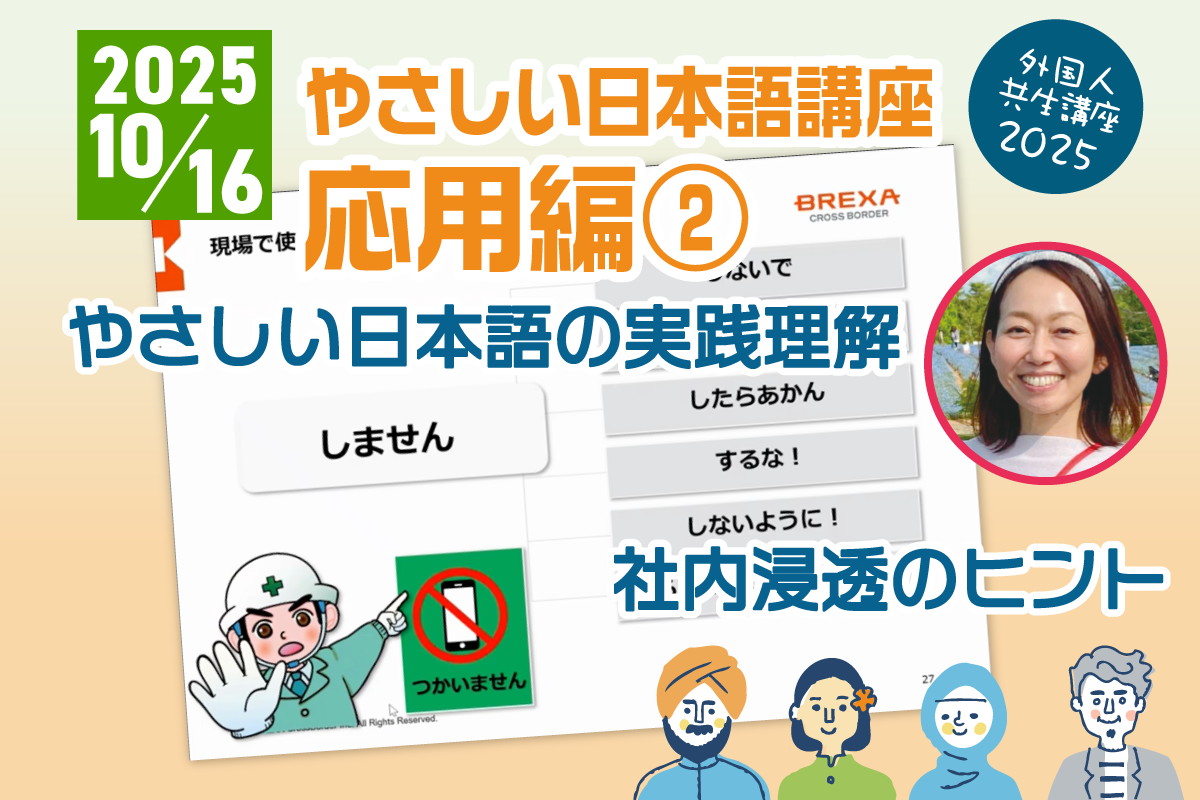
JAC has been holding a total of six "Foreign Symbiosis Lectures" for Japan employees since May 2025. As an application of the popular series "Plain Japanese Courses" that attracted more than 2,000 participants last year, "Application (2)" was held online on Thursday, October 16, following the "Application (1)" in September.
In this lecture, Mr. Kawamoto of BREXA CrossBorder Co., Ltd. was invited as the lecturer, and from reviewing "how to create a Plain Japanese and give instructions", we focused on "communication" and "initiatives that can be done at the company" that are directly related to the retention of foreign employees in the workplace. Finally, a popular guest corner was set up every time.
Review: "Plain Japanese" that combines "ease" and "kindness"
First, I looked back on "What is Plain Japanese?" "Kind" has two meanings: "easy (easy to understand)" and "gentle (compassionate)". This is attracting attention not only from foreigners but also from medical and nursing care settings, and is a universal design concept that is friendly to everyone.
In the course, we reviewed the basic "scissors rule" (speak clearly, to the end, and in short sentences), and also reaffirmed the importance of "giving instructions that are easy to understand," which was covered in Advanced Part 1.
For more information, please see "Basics" and "Advanced 1".
For Japan employees [3] "Plain Japanese Course (Basics)" Report
For Japan employees [4] "Plain Japanese Course (Application (1))" Report
Building trust! Specific ideas for "kind" communication
Some people say, "I feel like it gives a cold impression when I make it Plain Japanese." As much as you lose the soft expressions unique to Japanese, you need to make up for "attentiveness and kindness". Useful ideas for companies were introduced.
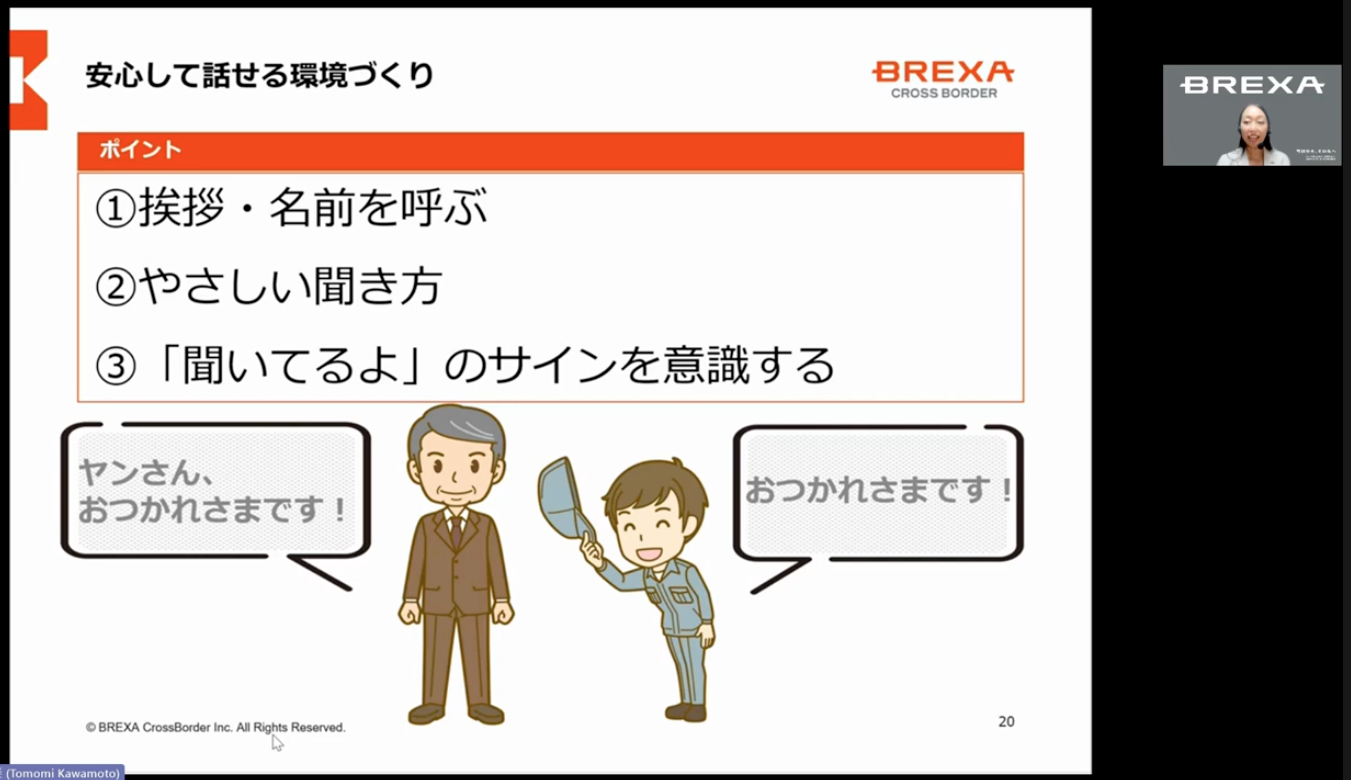
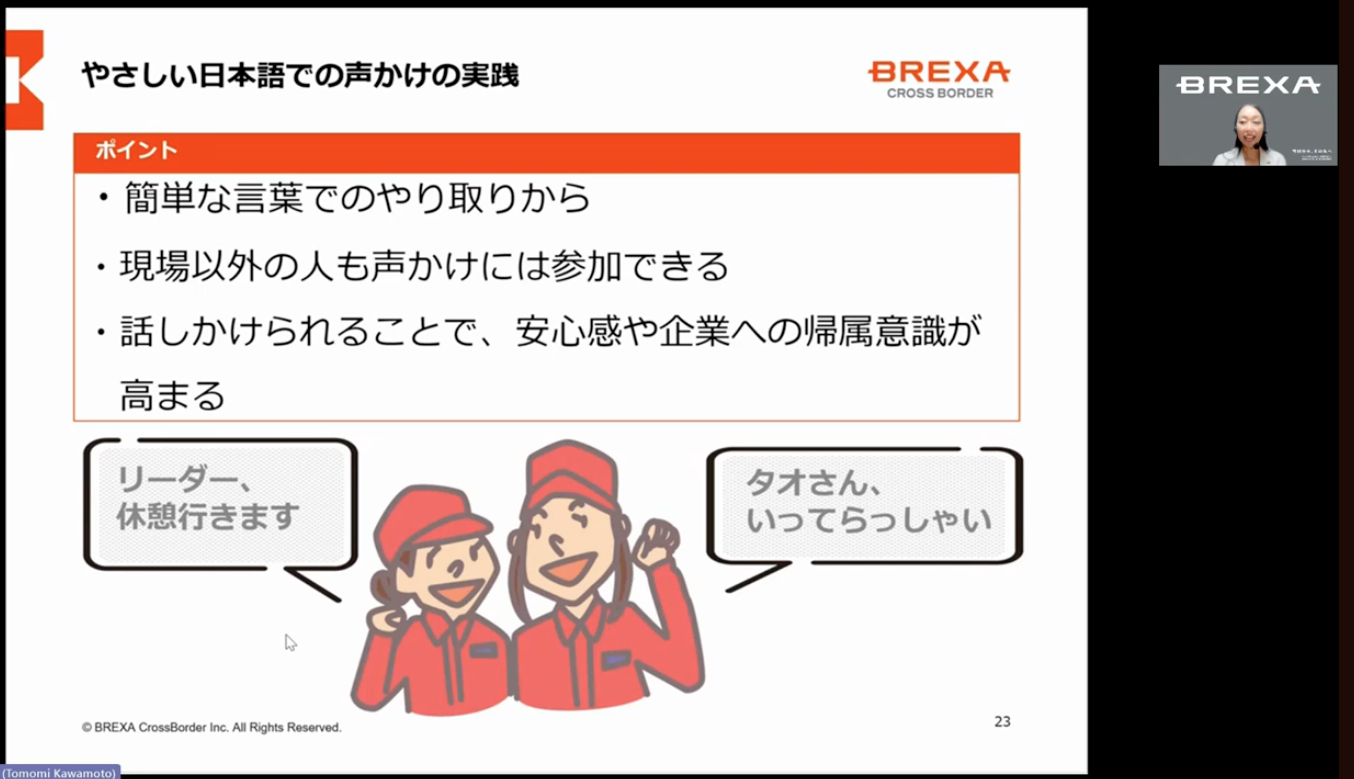
Greetings and consideration that foster a sense of security
As foreign employees have often said, "They don't return my greetings," returning greetings and calling people by name is essential to maintaining motivation at work. Consideration of how you listen, including facial expressions, eye contact, and nodding, creates a sense of security, especially in busy workplaces.
Creating an atmosphere where people feel comfortable asking questions
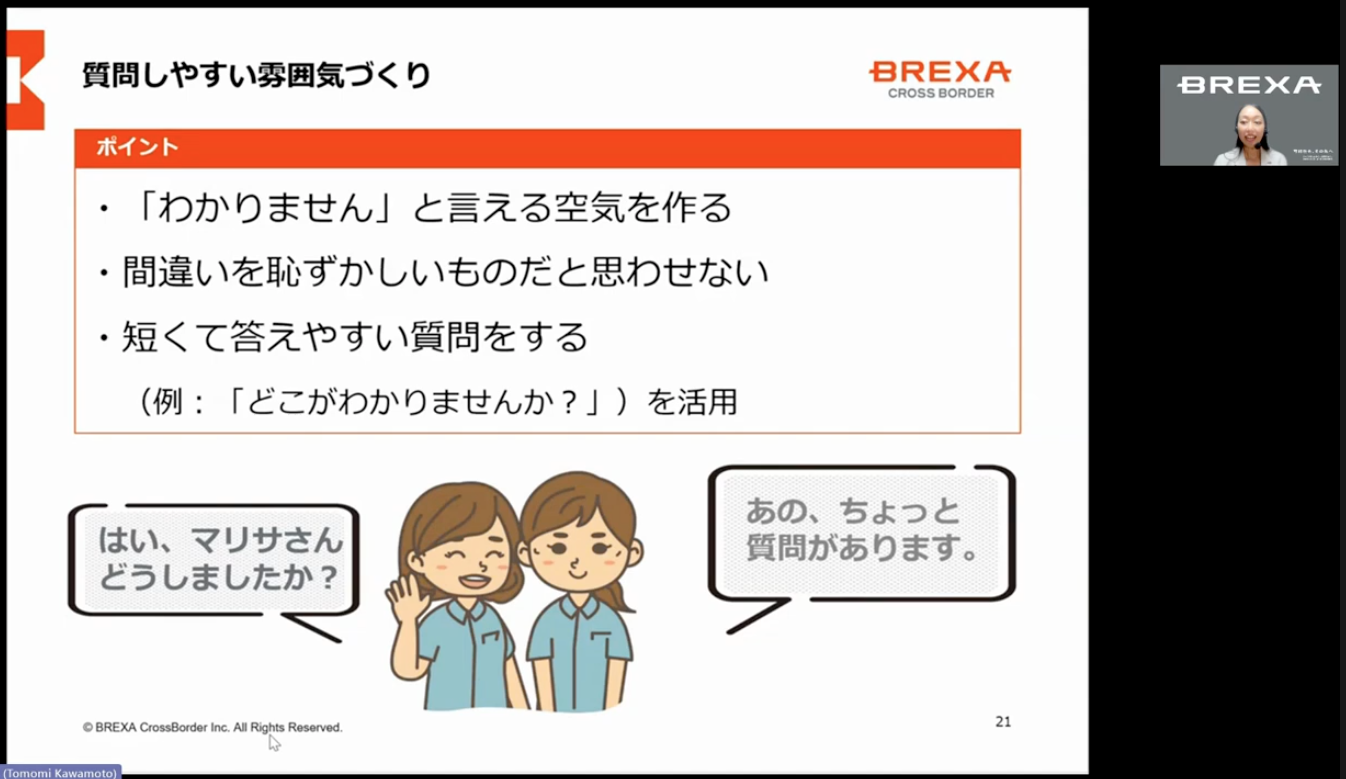
Creating an atmosphere that encourages communication is important for early problem resolution and workplace retention.
- An environment where you can honestly say "I don't know" if you don't understand something.
- A way to make mistakes less embarrassing.
- Actively praise them by saying things like "That's amazing" to help them gain experience of success.
Understand the difficulty of speaking and "wait"
Foreigners take time to assemble Japanese. Even in stuttering Japanese, it is important not to treat them as children, but to have a "generous feeling" that waits a little longer. Practice simple Plain Japanese calls to cultivate trust and security.
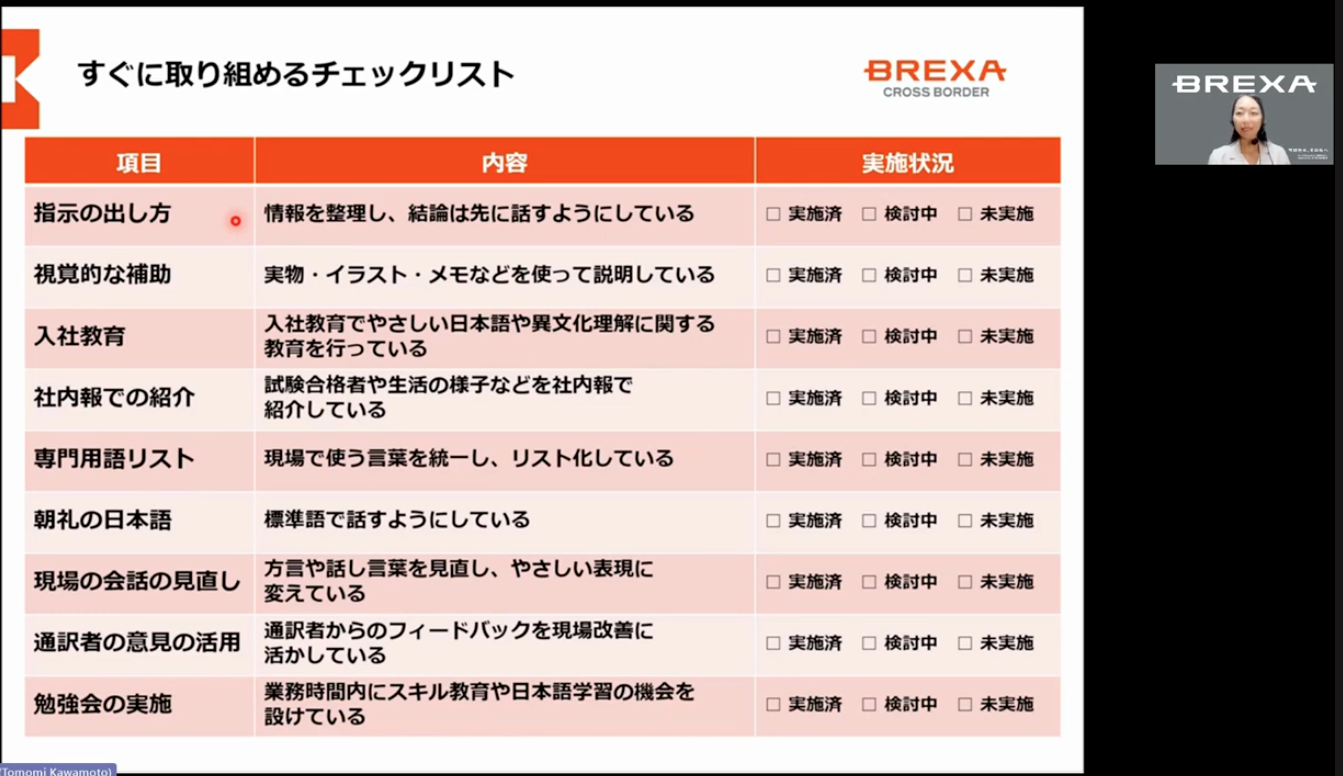
We have prepared a checklist that includes the contents of the "Intercultural Understanding Course."
Please use this to review your company's efforts.

"Education and on-site innovations that companies can implement" to promote employee retention
Specific initiatives to facilitate smooth communication on-site and encourage employees to establish themselves were also introduced.
"Standardizing vocabulary" used in the field
In a field where a variety of vocabulary is flown around even with a single instruction, including dialects, it is effective to devise ways to unify the words used. It was also suggested to visualize the conversations used in the field and write down how to turn them into "Plain Japanese".
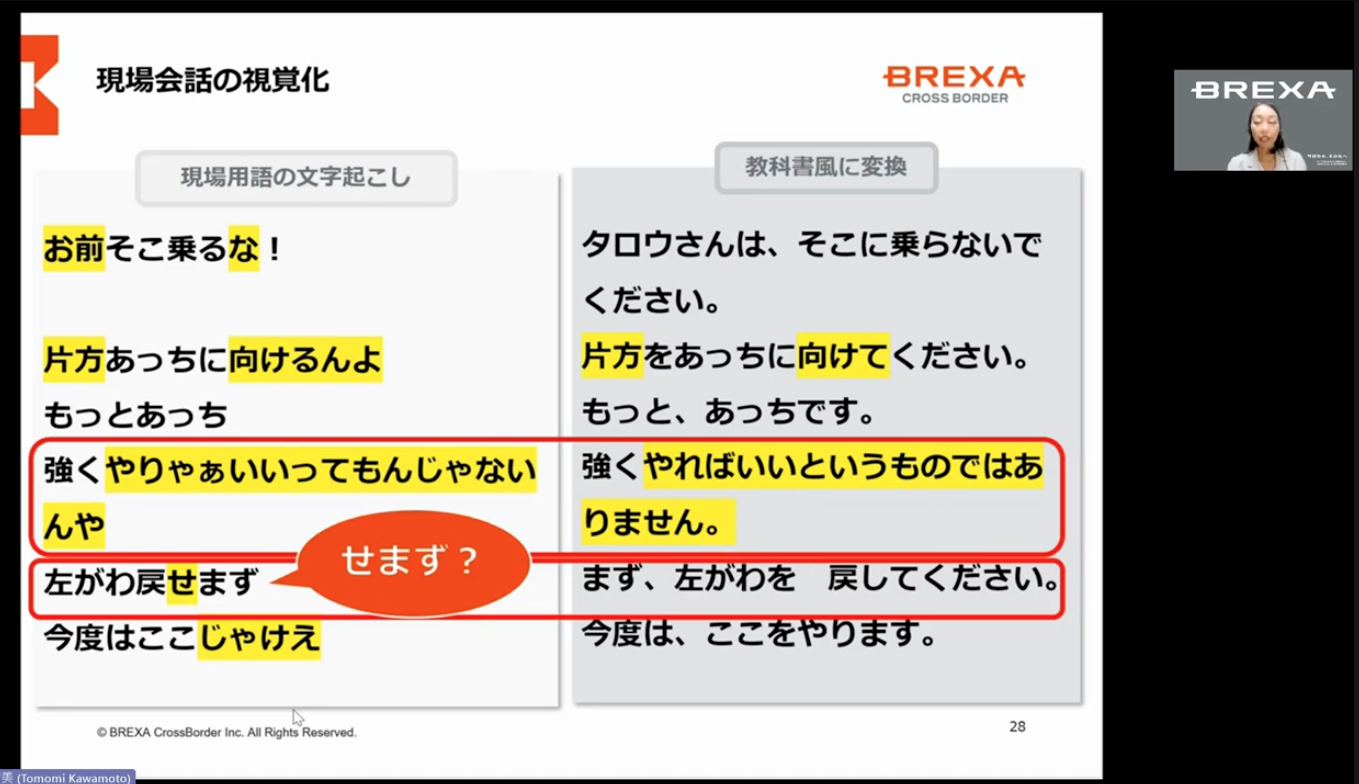
There were also other examples of actual work being done on the ground.
There is a checklist available, so please try to come up with your own ideas within your company.
Japanese Language Education Q&A
Here are some of the frequently asked questions we receive.
I want to know effective methods for teaching Japanese.
→Since it is difficult to gather people after work or on weekends, it is effective to hold Japanese language classes during working hours.
What should I teach?
→In order to achieve results in a limited amount of time, the key to success is to narrow down the content you teach by considering the following three points.
- The person's wishes
- On-site needs
- Company Evaluation
Summary: Two pillars that lead to successful symbiosis
In the practical part 2, we learned about concrete approaches to ensure that coexistence with foreign employees does not end with simply carrying out work, but leads to mutual understanding and settling into the workplace.
1. Communication that complements "ease" with "kindness"
In addition to making instructions easy to understand using the "scissors rule," it is essential to build trusting relationships through thoughtful consideration such as greeting, calling people by their names, creating an atmosphere where they feel comfortable asking questions, and being patient, so as not to give the impression of being cold.
2. Creating company and workplace systems to support employee retention
In addition to individual efforts, companies should also put in place systems such as standardizing vocabulary used on-site and holding Japanese language classes during working hours to enhance the effectiveness of training, which will help foreign employees feel at ease and grow.
Guest Corner: Tips for success from the perspective of Vietnamese employees
In the guest corner, Mr. Long from Vietnam took to the stage. He came to Japan as an international student and worked as a field leader at an agricultural corporation, where he shared his honest thoughts about foreign workers.
Motivation and leadership
Ron said that when he was promoted to field leader after one year of tomato cultivation, he was happy to be recognized for his ability.
Sharing the experience of using Plain Japanese for elderly staff to improve work efficiency.
About Vietnamese temperament
Vietnamese people prioritize doing things their own way, and many of them close their hearts when they are criticized.
They also tend to prioritize what is easy now, without thinking about the future.
Working in Japan requires continuous education, and it is important to deepen mutual understanding.
The key is to make it a habit through continuity, rather than through one-off education.
Relationships between companies and foreign workers
Ron feels that having the meaning of the rules explained to him helps him to do his job with confidence, and that having clear evaluations gives him a goal to work towards and motivates him.
Rather than being scolded, being asked "What's wrong?" builds trust.
Motivation for learning and career
Vietnamese people tend to be motivated when they have a clear vision for the future, and they often say that "speaking Japanese will broaden my future options." It was emphasized that providing opportunities to draw up career plans leads to increased motivation to learn.
Is it difficult for Vietnamese people to pronounce Japanese?
It was also mentioned that there are differences between the north and south, with the north tending to have stronger endings, while the south tends to not pronounce the last letter, and the pronunciation of "ya," "yu," and "yo" tends to be difficult.
It was suggested that Japanese people who are "listening" should also be aware of this in order to understand each other better.
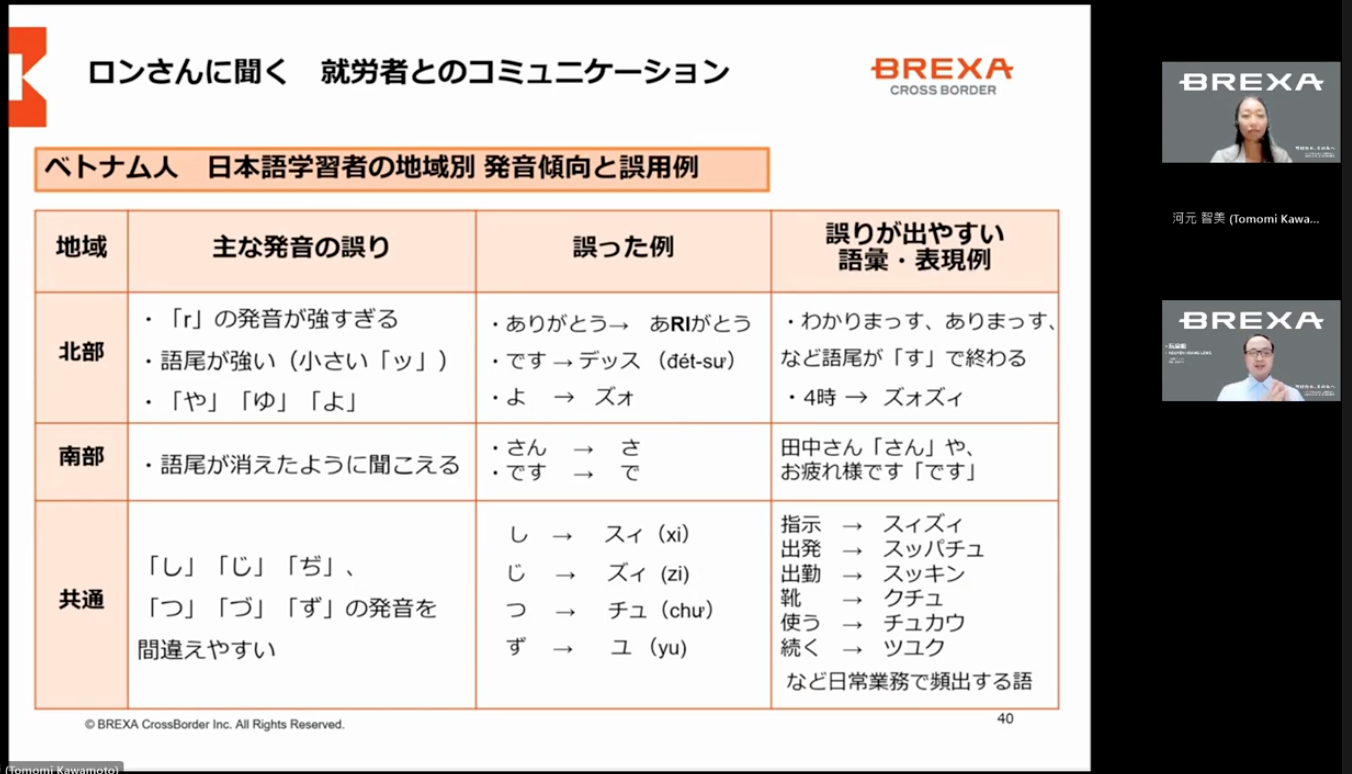
The guest corner provided a lot of knowledge that could be put to use in the field, and was very interesting for the participants.
At JAC, we offer a "Foreign Cooperation Course" for Japanese employees.
This course will help you acquire the knowledge and responsiveness necessary for coexisting with foreign talent, such as cross-cultural understanding and Plain Japanese that are easily understood by foreigners.
We also have a Q&A session, so please join us!
For more details about the course, please visit the 'Foreigner Coexistence Course' page below.
Missed episodes and materials from past courses are also available.
"Foreign Residents Coexistence Course" for Japanese Employees
The operation of this course has been entrusted to BREXA CrossBorder Co., Ltd.
This article is a report on the "Plain Japanese Course Application (2)" of the "Foreign Symbiosis Course 2025" for Japan employees held on Thursday, October 16, 2025.
Seminar Video
Seminar Materials
Seminar Materials_Plain Japanese Lecture (3) Application (2)251016.pdf
Q&A_Plain Japanese Lecture (3) Application (2) 251016.pdf
Report on the "Foreigner Coexistence Seminar" for Japanese Employees
- Report on the "Cross-Cultural Understanding Seminar (1)" for Japanese Employees [1]
- Report on the "Cross-Cultural Understanding Seminar (2) Islam" for Japanese Employees [2]
- For Japan employees [3] "Plain Japanese Course (Basics)" Report
- For Japan employees [4] "Plain Japanese Course (Application (1))" Report
- For Japan employees [5] "Plain Japanese Lecture (Application (2))" Report
- Report on the "Lifestyle/Transportation Guidance Course" for Japanese Employees (6)
The author of this article
Japan Association for Construction Human Resources
Chief of Research and Development Department / Administration Department / Public Relations Department
Motoko Kano
(Kano Motoko)


Born in Aichi Prefecture.
He is in charge of public relations, research and investigation, and is the person behind social media.
We update our social media accounts daily with the desire to make people fall in love with Japan, to spread the appeal of construction from Japan to the world, and to ensure that Japan's construction industry continues to be the industry of choice around the world.
He is also engaged in research into the feasibility of implementing skills evaluation exam in Asian countries, and is conducting interviews with local organizations in each country.
Related articles
Report on the "Foreign Workplace Coexistence Seminar 2026" for Japanese Employees: Basic Knowledge of Employing Foreign Workers
Report on the "2026 Seminar on Coexistence with Foreign Employees": Intercultural Understanding Seminar ② - Vietnam & India Edition
Report on the "Foreigner Coexistence Seminar 2026" for Japanese Employees: Intercultural Understanding Seminar ① Indonesia and Islam.
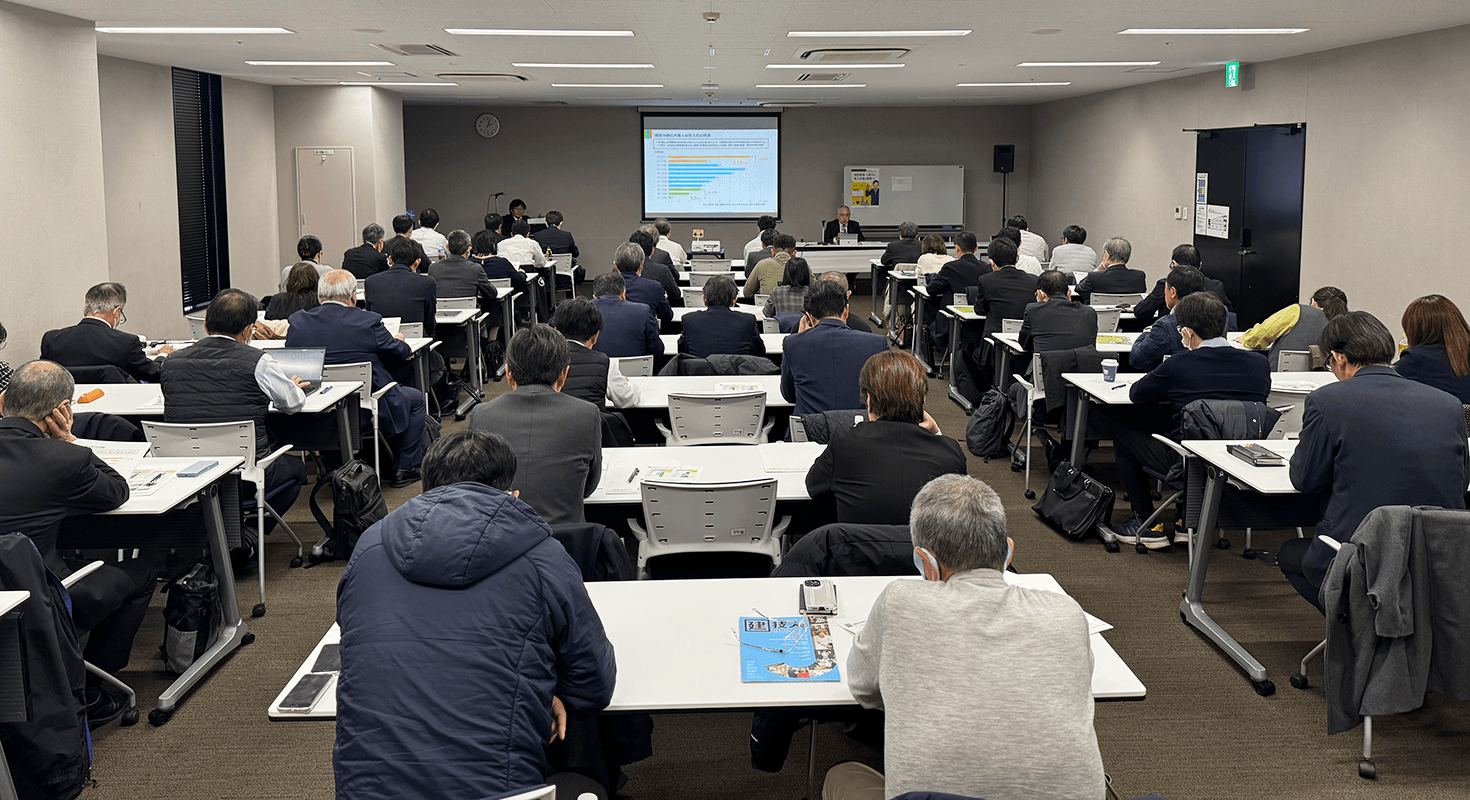
Specified Skilled Worker Recruitment 10 Questions from Construction Companies - FY2025 System Briefing Session Report (Omiya, Saitama)