- やさしい日本語
- ひらがなをつける
- Language
We provide multilingual content through machine translation. Translation accuracy is not 100%. About the multilingualization of the JAC website





- Home
- JAC Magazine
- JAC Initiatives and Activities Report
- Report on the "Foreign Workplace Coexistence Seminar 2026" for Japanese Employees: Basic Knowledge of Employing Foreign Workers
- Home
- JAC Magazine
- JAC Initiatives and Activities Report
- Report on the "Foreign Workplace Coexistence Seminar 2026" for Japanese Employees: Basic Knowledge of Employing Foreign Workers

Report on the "Foreign Workplace Coexistence Seminar 2026" for Japanese Employees: Basic Knowledge of Employing Foreign Workers
I wrote the article!


Japan Association for Construction Human Resources
Chief of Research and Development Department / Administration Department / Public Relations Department
Motoko Kano
(Kano Motoko)
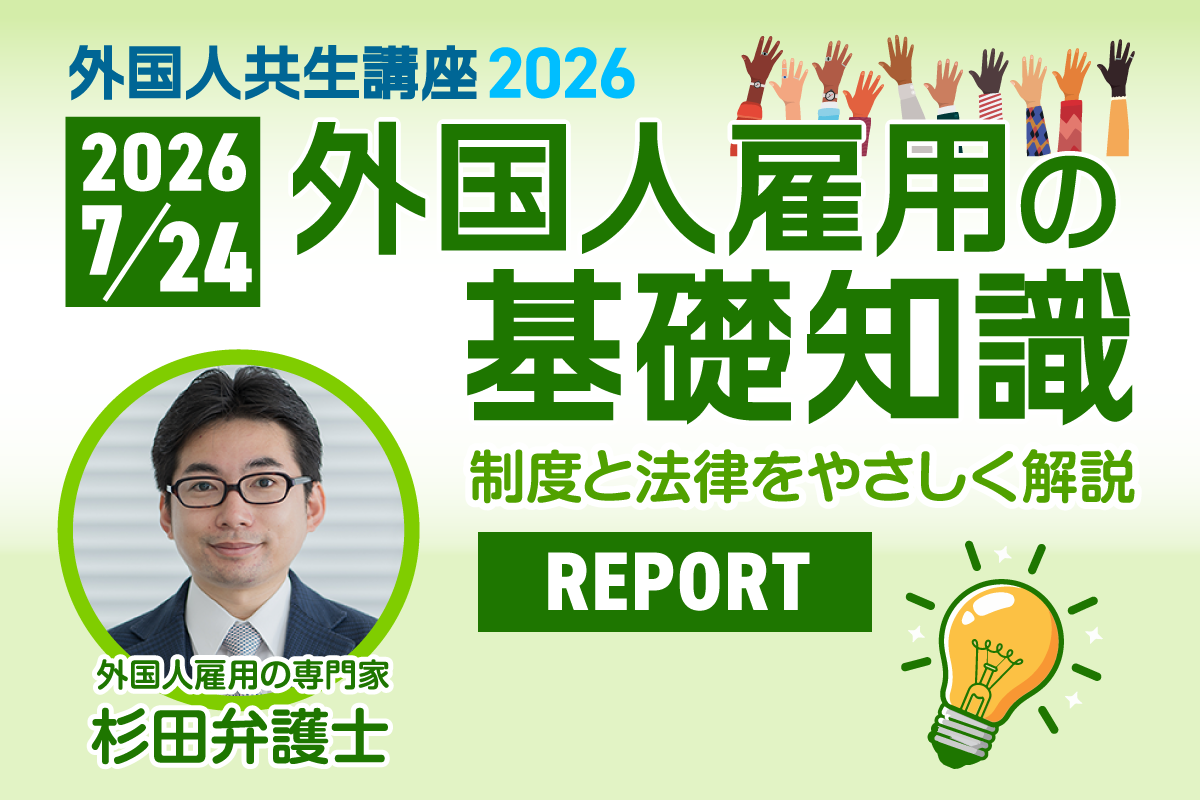
JAC is holding a series of six "Foreign Worker Coexistence Seminars 2026" for Japanese employees starting in May 2026.
This course aims to provide practical knowledge to companies that are working to accept foreign talent.
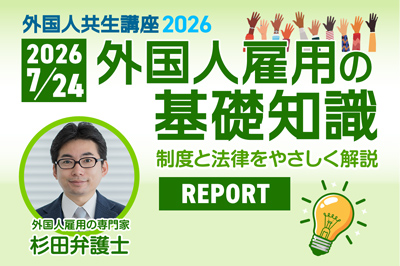
On Friday, July 24, 2026, we held a seminar on the theme of "Basic Knowledge of Employing Foreign Nationals," and 219 out of 344 pre-registered participants (196 online and 23 at the Tokyo venue) attended in real time.
The lecturer was Shohei Sugita, Representative Partner of Global HR Strategy Law Firm.
Ms. Sugita handles approximately 100 consultations a day regarding the employment of foreign nationals and is an expert in the field of foreign employment, serving on committees for various ministries, including the Ministry of Health, Labour and Welfare and the Ministry of Land, Infrastructure, Transport and Tourism.
This time, we received a comprehensive explanation of key points that companies should keep in mind when accepting foreign talent, from the structure of the residence status system to recruitment, work rules, and retention support.
Legal violations resulting from "treating Japanese people the same"
The course began by pointing out that many troubles in foreign employment arise from "unintentionally ignoring Immigration Control and Refugee Recognition Act as a result of treating Japanese employees the same way."
Company personnel systems and work regulations are often implicitly designed with the assumption that they are intended for Japanese employees.
Therefore, if the same procedures are applied to foreign employees without an understanding of the residence status system, necessary procedures may be overlooked.
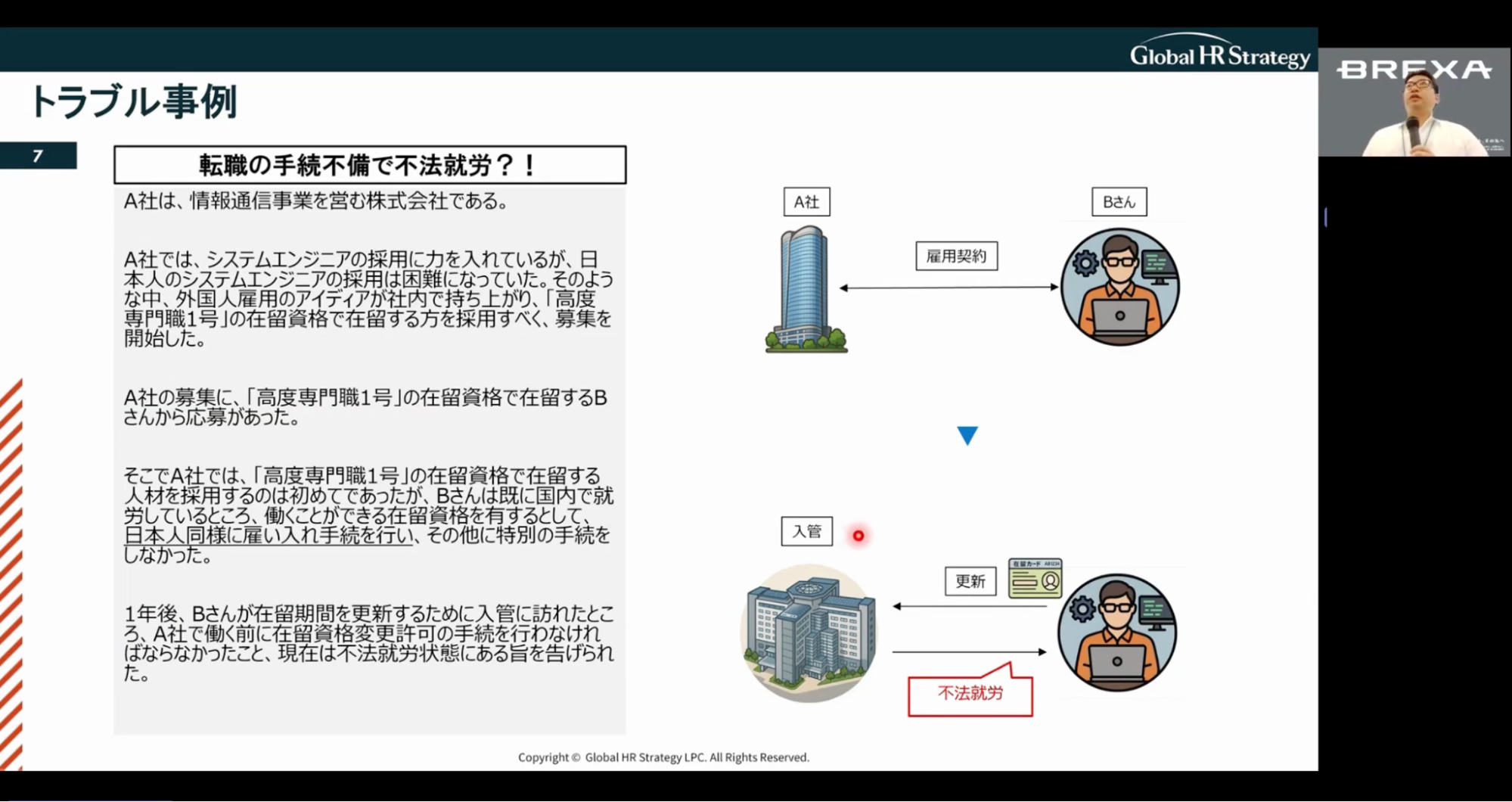
As an example, a case was presented in which an individual residing in Japan under the "Highly Skilled Professional (Type 1)" visa was hired using the same procedures as for Japanese nationals. However, because the necessary procedures for changing residence status were not followed when the individual changed jobs, they ended up working illegally.
In addition, the following four points were also cited as examples that could similarly lead to violations of the law:
- They are being transferred to a job outside the scope permitted by their residence status.
- Failure to carry out the necessary procedures when transferring or seconding foreign personnel under "Specified Skilled Worker (i)" or "Highly Skilled Professional No. 1" to group companies
- I forget the procedures for obtaining a residence status when a company undergoes organizational restructuring.
- We hired an international student with a "student" visa, but they started work without changing their visa status.
These examples of organizational restructuring, transfers, and secondments are merely extensions of normal HR work and not special exceptions, which is something we need to be aware of.
Differences and points to note regarding employment methods in Japan and overseas
Next, they explained the differences between employment in Japan and overseas.
In Japan, "membership-based employment," where employment is based on the individual rather than specifying job duties or work location, is the mainstream. However, overseas, "job-based employment," where the job role is determined in advance and suitable personnel are hired, is more common.
Since the scope of work that can be performed is determined by one's residence status, when hiring foreigners in Japan, employment is often done under this job-based system.
Therefore, they emphasized the importance of organizing the necessary personnel and procedures in advance.
For example, the process involves specifying the type of work to be assigned—whether it be a generalist, specialist, or operational position—confirming the required residence status for that work, and finally hiring someone who meets the requirements to obtain that residence status.
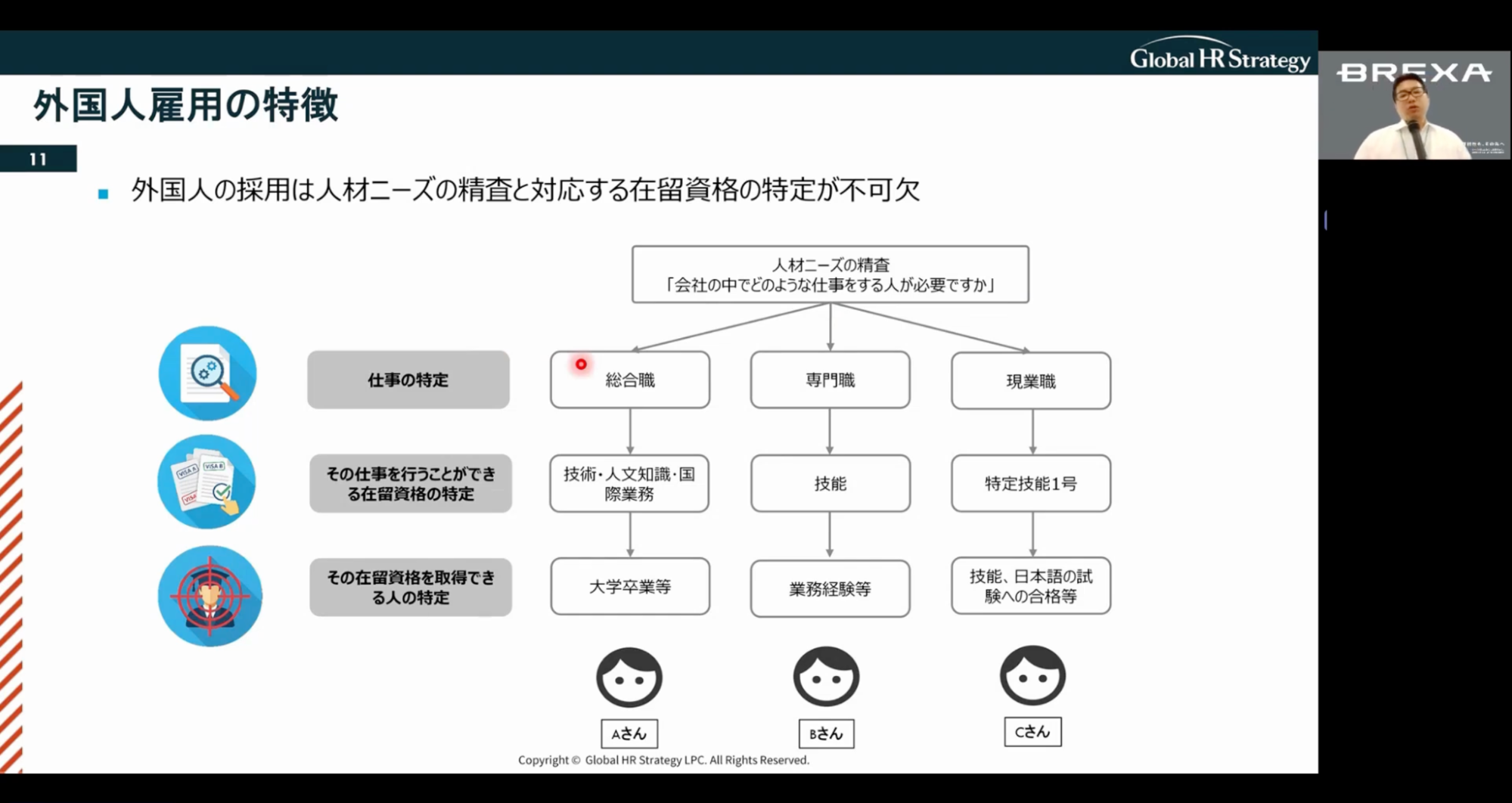
Furthermore, there is a "one residence status, one status" principle which states that each foreigner can only hold one residence status, and it was mentioned that having them work beyond the permitted scope could constitute illegal employment.
Ensuring that the job description matches the applicant's residence status is fundamental to employing foreign workers.
Points to note regarding differences in career development.
In many Japanese companies, the "Japanese-style career" is common, where employees are nurtured by gaining experience in various departments within the same company.
The idea is to cultivate professionals within the company, and it's a system where compensation gradually improves the longer you work for the same company.
On the other hand, overseas, it is common to change companies while staying in the same job field to advance one's career, and the idea is to aim to become a professional within that same job field.
Because of these differences, some foreign employees may interpret this as meaning that "there is no path to promotion as long as I stay at this company."
In reality, Japanese companies also have internal promotion paths, so carefully explaining this point can lead to a smoother transition.
Review of procedures and employment regulations for employing foreign nationals
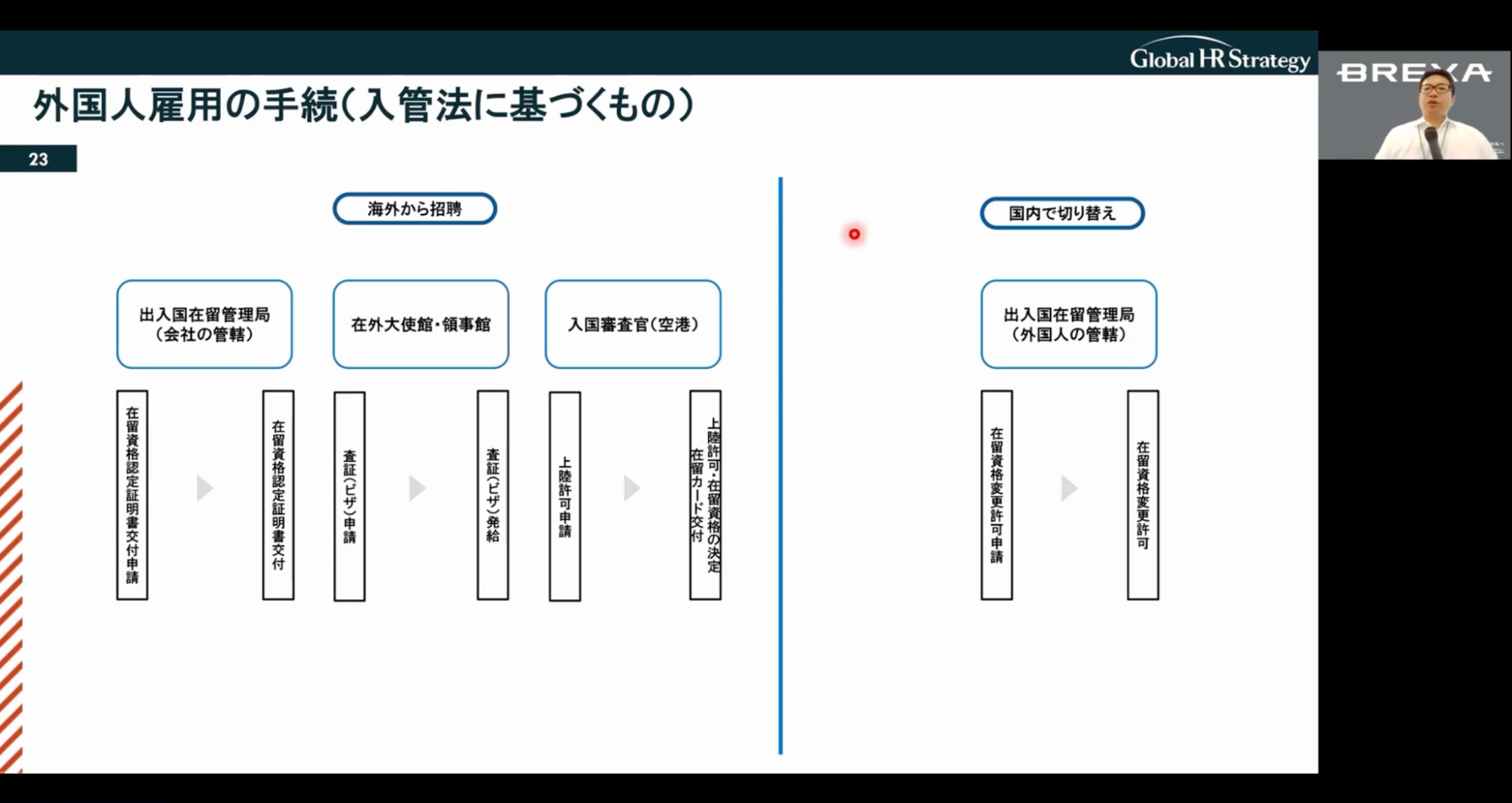
The procedures for employing foreign nationals were explained in detail, including the process for inviting them from overseas and changing their residence status within Japan, as well as the procedures for entering the country and the application process for residence status.
In either case, since collecting the attached documents often takes time, there was also practical advice that it is important to start early.
Furthermore, they provided specific points for revising the employment regulations, taking into account the needs of foreign employees.
The Ministry of Health, Labour and Welfare publishes model employment regulations, but many companies use these as a basis for creating regulations that assume Japanese employees will be working there.
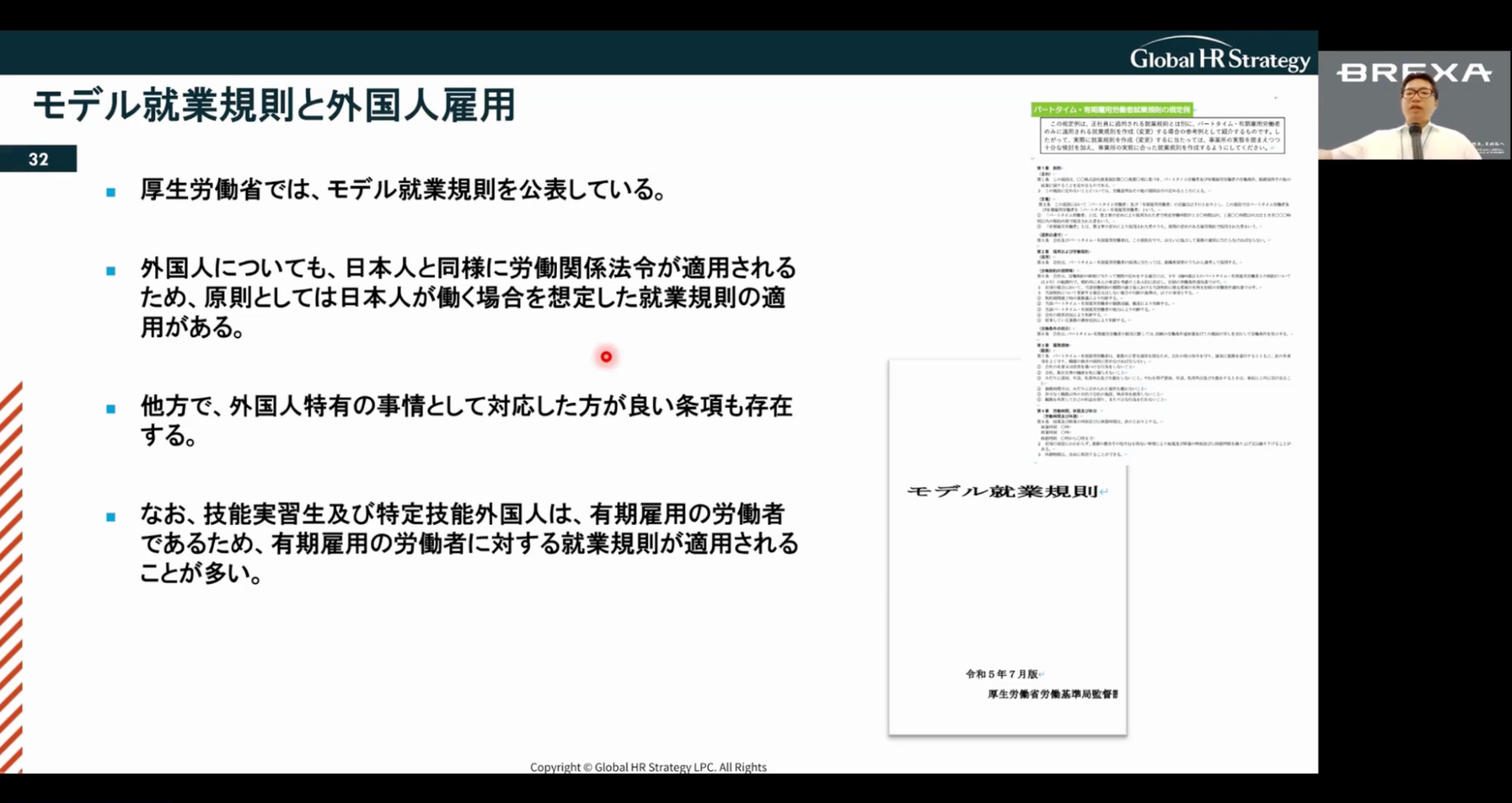
Therefore, we were informed that it is necessary to add items specific to the employment of foreign nationals, such as verification of residence cards at the time of hiring, special leave for temporary return to their home country, labor-management agreements regarding wage deductions, grounds for automatic termination of employment in the event of loss of residence status, and restrictions on residence status when permitting side jobs.
When you start thinking about employing foreign workers, you realize just how many points need to be reviewed in the employment regulations that you normally use without much thought.
Key points for establishing a support system to ensure retention
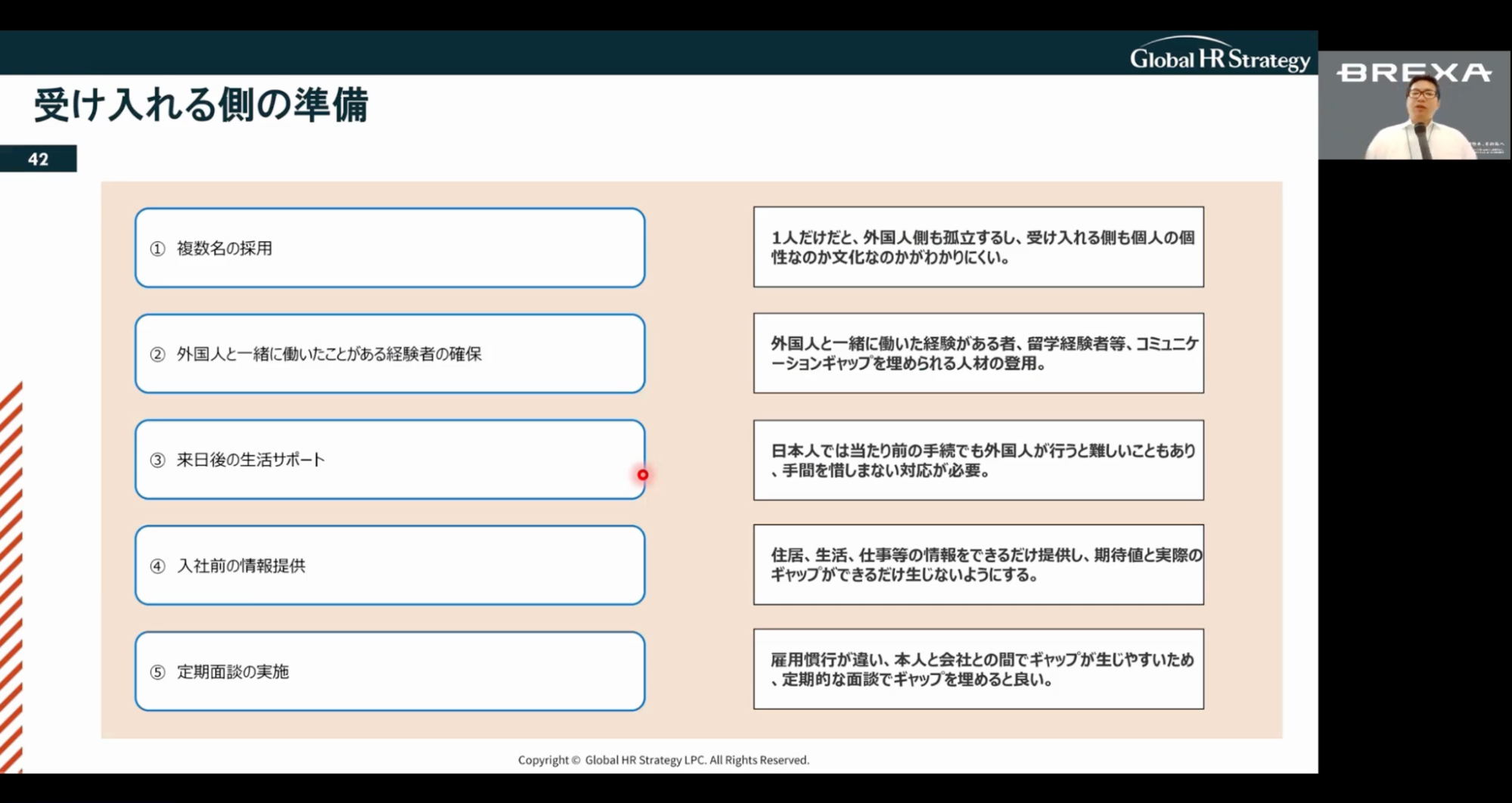
At the end of the seminar, the following five points were introduced as preparations for receiving foreign employees to ensure their retention:
- Hiring multiple people
- Assigning staff with experience working with foreigners
- Support for daily life after arriving in Japan
- Sufficient information provided before joining the company
- Conducting regular interviews
Furthermore, research findings indicating that "foreign workers tend to experience feelings of loneliness" were presented, emphasizing the importance of creating a supportive environment for those receiving them.
Each individual consideration may seem small, but I felt that it was the accumulation of these small details that led to the system becoming established.
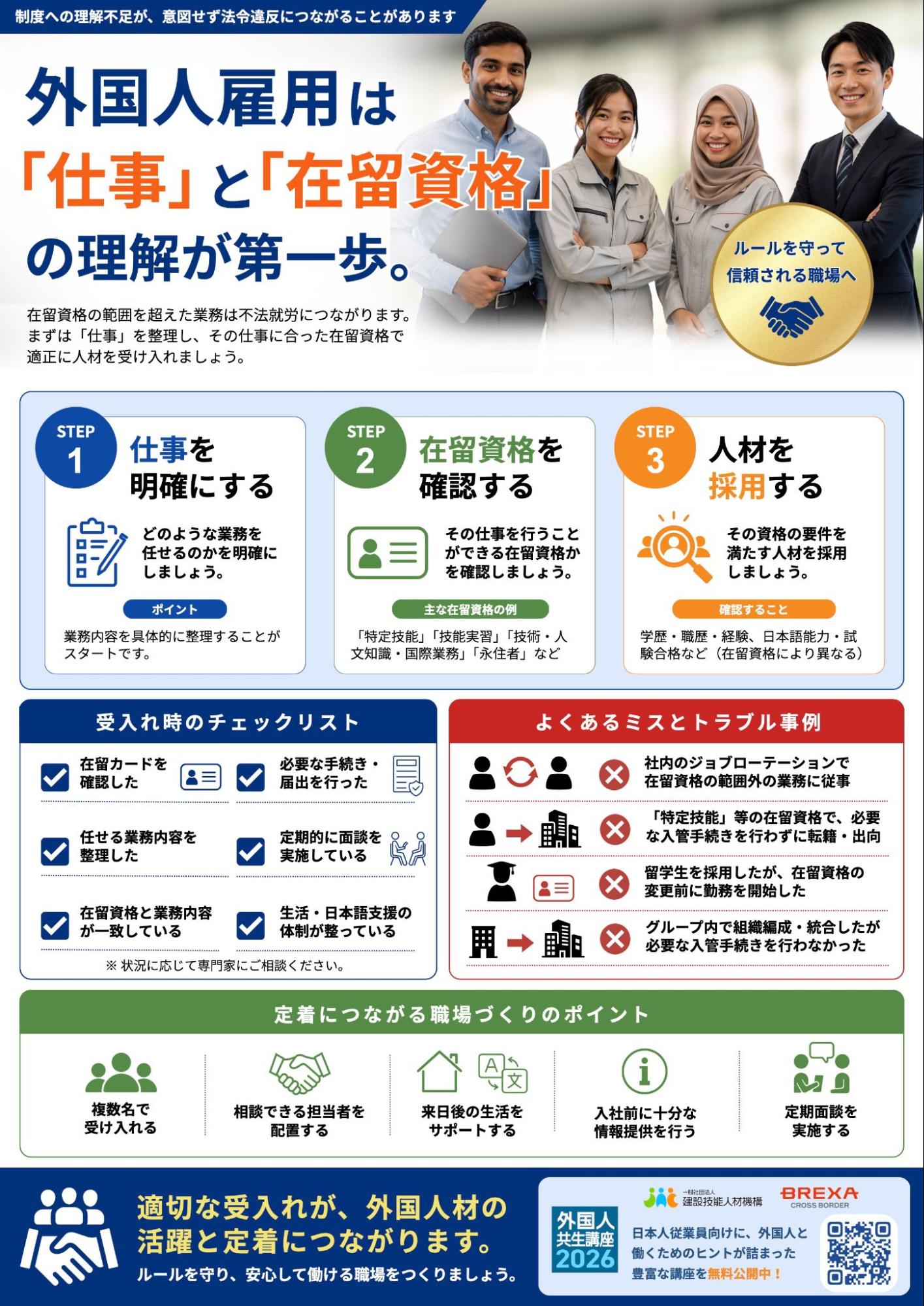
They also prepared an awareness poster summarizing the content of this event on a single sheet.
The book outlines a three-step process: clearly defining the "job," confirming the "residence status," and hiring the "personnel." It also includes a checklist for onboarding, common mistakes and problems, and key points for creating a workplace that encourages employee retention.
Please take a look at this course content in comparison to your company's onboarding system.
Q&A from participants
In the Q&A session in the latter half of the course, we received questions about wages, how to verify residence cards, and reasons for leaving employment.
Here are a few of the questions we received, presented briefly.
- Q.If there are reasonable reasons such as differences in work history or job content, is it acceptable not to pay them the same wages as Japanese employees?
- A.The wages do not necessarily have to be the same. However, setting low wages solely on the grounds that the person is a foreigner is not permitted, so if there is a wage difference, it is important to be able to provide a reasonable explanation, such as differences in years of experience, skill level, job content, and scope of responsibility.
- Q.Can I check the details of the job description other than the residence status using the residence card?
- A.A residence card only shows the type of residence status and the period of stay. To determine if the actual work is in line with the residence status, it is necessary to also check documents such as a graduation certificate, work history, and employment contract.
- Q.What are some of the most common problems that lead to people leaving their jobs?
- A.Issues include language and communication problems, discrepancies in understanding working conditions and job duties, workplace relationships, and anxieties about career development. Thorough explanations and a supportive consultation system are crucial.
- Q.What internal company rules should be established regarding the acceptance of foreign employees?
- A.Examples include how to verify work status and residence cards at hiring, managing and renewing the period of stay, confirming job scope, and handling notifications upon joining or leaving. Additionally, clearly stating the establishment of consultation desks, harassment prevention, and multilingual Safety and Health Education helps establish a system for accepting employees.
In addition, many practical questions were asked, which once again demonstrated the high level of interest in the topic.
Details of the questions and answers received on the day can be found in the "Basic Knowledge of Employing Foreign Nationals Q&A Collection".
Basic Knowledge of Employing Foreign Nationals: Q&A
In a post-course survey, 90% of participants responded with "very satisfied" or "satisfied," and comments included, "I understood that there are different rules for employing Japanese nationals, and that it is important to respond according to their residence status."
On the other hand, we have also received requests such as "We would like to hear an advanced version for practical staff" and "We would like to know more about specific examples of problems in the workplace," so we will take these into consideration when developing future courses.
At JAC, we offer a "Foreign Cooperation Course" for Japanese employees.
This course will help you acquire the knowledge and responsiveness necessary for coexisting with foreign talent, such as cross-cultural understanding and Plain Japanese that are easily understood by foreigners.
We also have a Q&A session, so please join us!
For details about the course, please see the "Foreigner Coexistence Course" page below.
Past lectures, including on-demand recordings, materials, and Q&A from those lectures, are also available.
"Training on Coexistence with Foreign Employees" for Japanese Employees
The operation of this course has been entrusted to BREXA CrossBorder Co., Ltd.
This article is a report on the "Foreign Worker Coexistence Seminar 2026," a basic knowledge seminar on employing foreign workers, held on Friday, July 24th for Japanese employees.
Seminar Video
Seminar Materials
Seminar materials: Basic knowledge of employing foreign nationals 260724.pdf
Q&A_Basic Knowledge of Employing Foreigners260724.pdf
Poster: "Understanding 'work' and 'residence status' is the first step in employing foreign workers."
Report on the "Foreigner Coexistence Seminar" for Japanese Employees
The author of this article
Japan Association for Construction Human Resources
Chief of Research and Development Department / Administration Department / Public Relations Department
Motoko Kano
(Kano Motoko)


Born in Aichi Prefecture.
He is in charge of public relations, research and investigation, and is the person behind social media.
We update our social media accounts daily with the desire to make people fall in love with Japan, to spread the appeal of construction from Japan to the world, and to ensure that Japan's construction industry continues to be the industry of choice around the world.
He is also engaged in research into the feasibility of implementing skills evaluation exam in Asian countries, and is conducting interviews with local organizations in each country.
Related articles
Report on the "2026 Seminar on Coexistence with Foreign Employees": Intercultural Understanding Seminar ② - Vietnam & India Edition
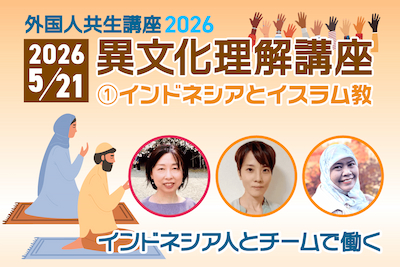
Report on the "Foreigner Coexistence Seminar 2026" for Japanese Employees: Intercultural Understanding Seminar ① Indonesia and Islam.
Specified Skilled Worker Recruitment 10 Questions from Construction Companies - FY2025 System Briefing Session Report (Omiya, Saitama)
Report on the 2025 "Construction Future Award for Creating with Foreign Talent" <Receiving Companies / Excellent Examples of Foreign Talent Utilization Category> Award Ceremony