- やさしい日本語
- ひらがなをつける
- Language
We provide multilingual content through machine translation. Translation accuracy is not 100%. About the multilingualization of the JAC website




- Home
- JAC Magazine
- JAC Initiatives and Activities Report
- Report on the "2026 Seminar on Coexistence with Foreign Employees": Intercultural Understanding Seminar ② - Vietnam & India Edition
- Home
- JAC Magazine
- JAC Initiatives and Activities Report
- Report on the "2026 Seminar on Coexistence with Foreign Employees": Intercultural Understanding Seminar ② - Vietnam & India Edition

Report on the "2026 Seminar on Coexistence with Foreign Employees": Intercultural Understanding Seminar ② - Vietnam & India Edition
I wrote the article!
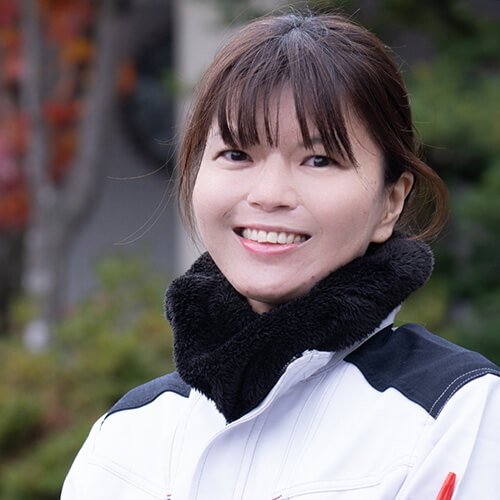

Japan Association for Construction Human Resources
Chief of Research and Development Department / Administration Department / Public Relations Department
Motoko Kano
(Kano Motoko)
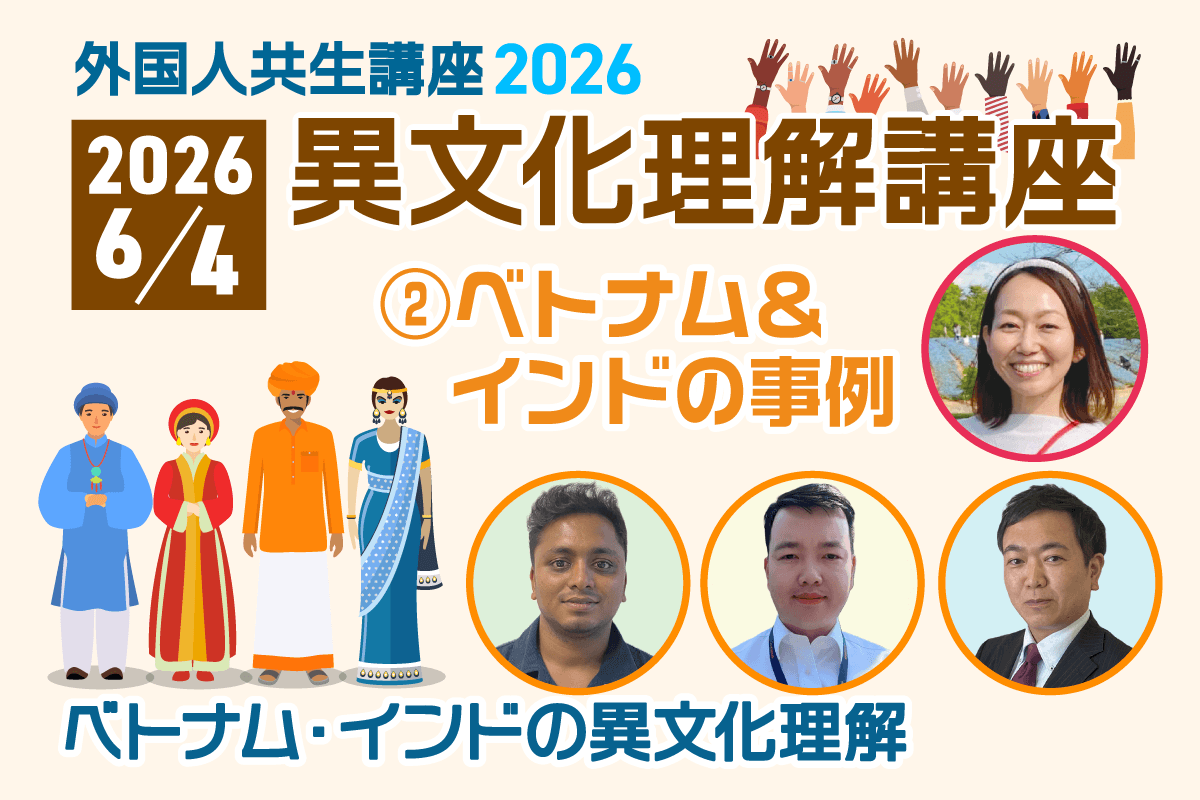
JAC is holding a series of six seminars on coexistence with foreign employees for Japanese employees, starting in May 2026.
We have further refined the "Lectures on Coexistence with Foreigners," which were well-received in 2025, and have structured the program to reflect the voices of those of you who are closer to the field.
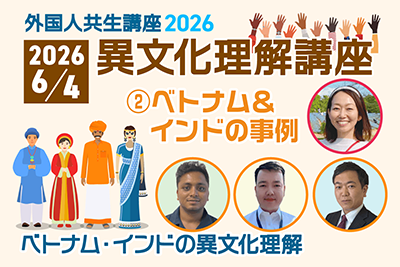
On Thursday, June 4, 2026, we held the "Intercultural Understanding Seminar ② - Learning from the Cases of Vietnam and India - Foreign Talent Management Based on Respect" in a hybrid format, both in-person and online.
The event was moderated by Mr. Kawamoto of BREXA CrossBorder Inc., and featured guest speakers Tran Manh Cuong from Vietnam and Kartikeyan Naresh from India.
Furthermore, Ms. Sakuraba, who is in charge of human resource management for foreign workers, provided an explanation of country-specific trends and approaches from a manager's perspective.
Review: A basic overview of intercultural understanding
First, moderator Mr. Kawamoto began by discussing the "iceberg model," which was also mentioned in the Intercultural Understanding Lecture ① Indonesia and Islam.
He shared a story using the analogy of an iceberg, explaining that "there is always a reason behind an action, and in fact, many discrepancies on the ground occur in unseen areas."
"Visible differences" such as language, clothing, and religion are relatively easy to spot.
On the other hand, the values and beliefs that underpin those actions are the "invisible parts" beneath the surface, and these are often overlooked.
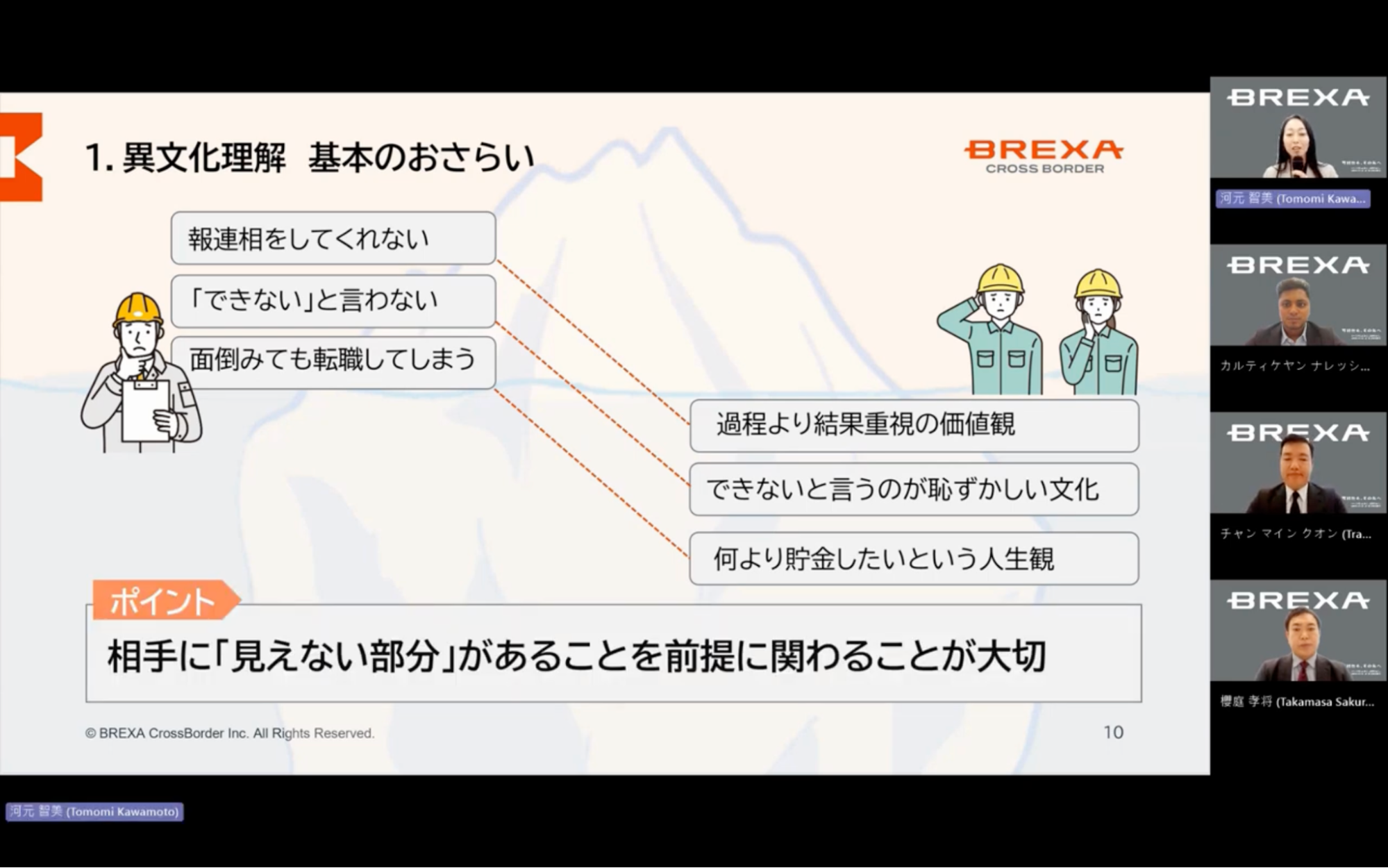
It was emphasized that when interacting with foreign talent from different cultures, it is important to assume that there are "unseen aspects" to their behavior.
Learning from Vietnam's example: How to work with foreign talent
Next, Ms. Tran Manh Cuong, who came to Japan from Vietnam six years ago, shared some examples from her workplace.
We asked MineKuon to share her experiences in the workplace in response to three questions.
Question 1: What kind of interactions in your Japanese workplace made you think, "I want to do my best here!"?
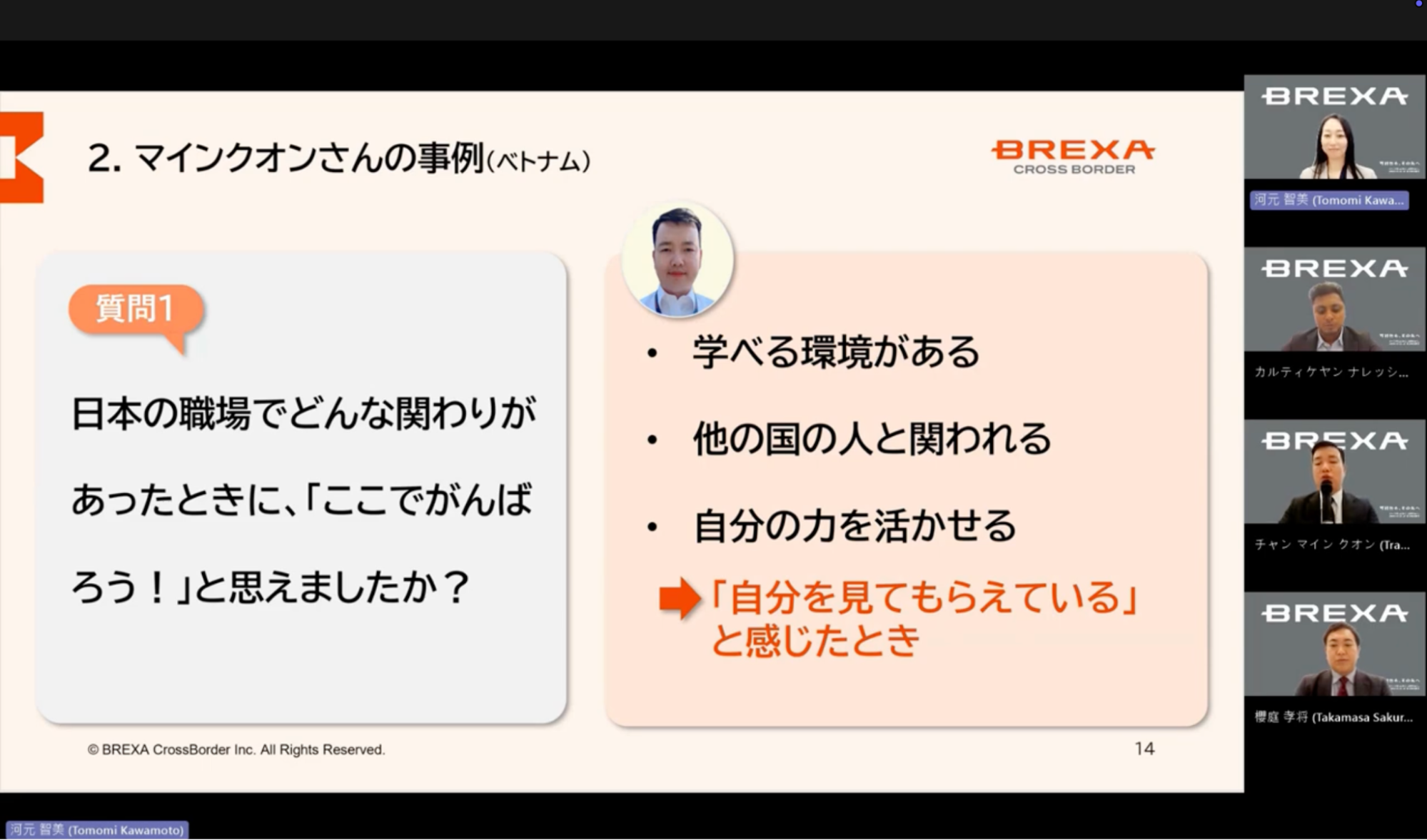
First, when asked what motivated them to work hard, they cited three things: "having an environment where they could learn," "having more opportunities to interact with people from other countries," and "being able to utilize their own abilities."
Technical Intern Training I was entrusted with coordinating at a site where about 100 students were involved and there were many troubles, and as we resolved issues one by one, the situation improved. Now, I also serve as coordinator for 235 people.
Through these experiences, she felt that her managers and the company were really paying attention to her, which boosted her motivation.
They also told us that being able to utilize their own strengths and being entrusted with work motivated them to "try even harder."
Question 2: What kind of Japanese language or instructions did you find difficult or hard to understand in your workplace in Japan?
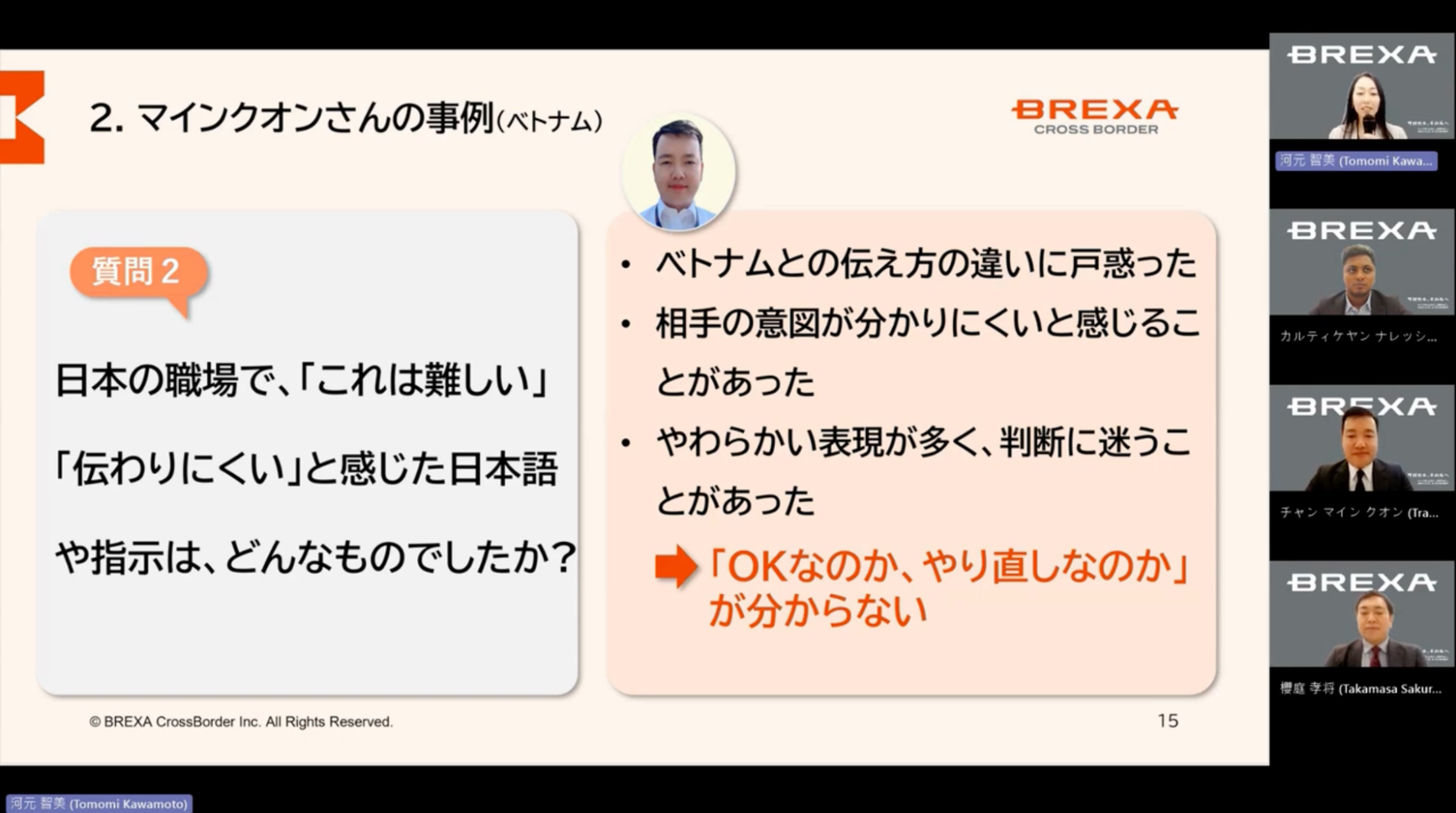
On the other hand, what I found difficult to understand at work was the soft, gentle way Japanese people speak.
In Vietnam, when something is not possible, they will clearly say no, whereas in Japan, there are many ambiguous expressions such as "It might be a little different" or "Please do something about it," which sometimes made it difficult to make a decision.
Question 3: When you're in trouble or don't understand something, how would you like to communicate with your colleagues in a Japanese workplace?
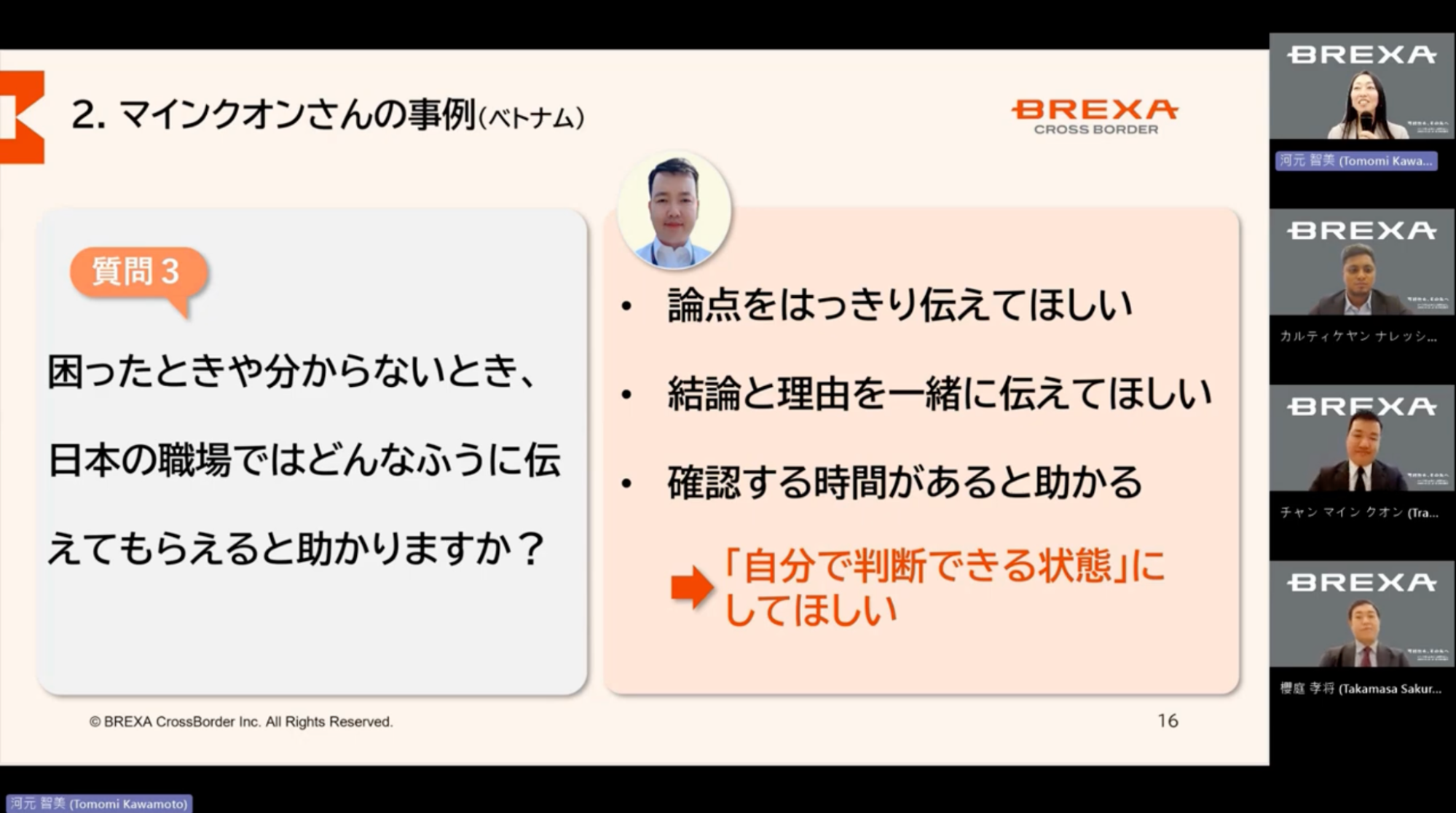
Finally, in response to the question of what kind of communication would be helpful, I mentioned that it would be helpful if the main points were clearly stated, the conclusion and reasons were presented together, and time was provided for confirmation.
They told me that being given the opportunity to make their own decisions leads to a more secure and comfortable working environment.
Learning from India's example: How to work with foreign talent
Next, we have the case of Kartikeyan Naresh, who is from South India.
We also asked Mr. Naresh to answer three questions.
Question 1: In your Japanese workplace, in what situations did you feel that "my concerns were properly listened to" or "the reasons were explained to me and I was able to understand them"?
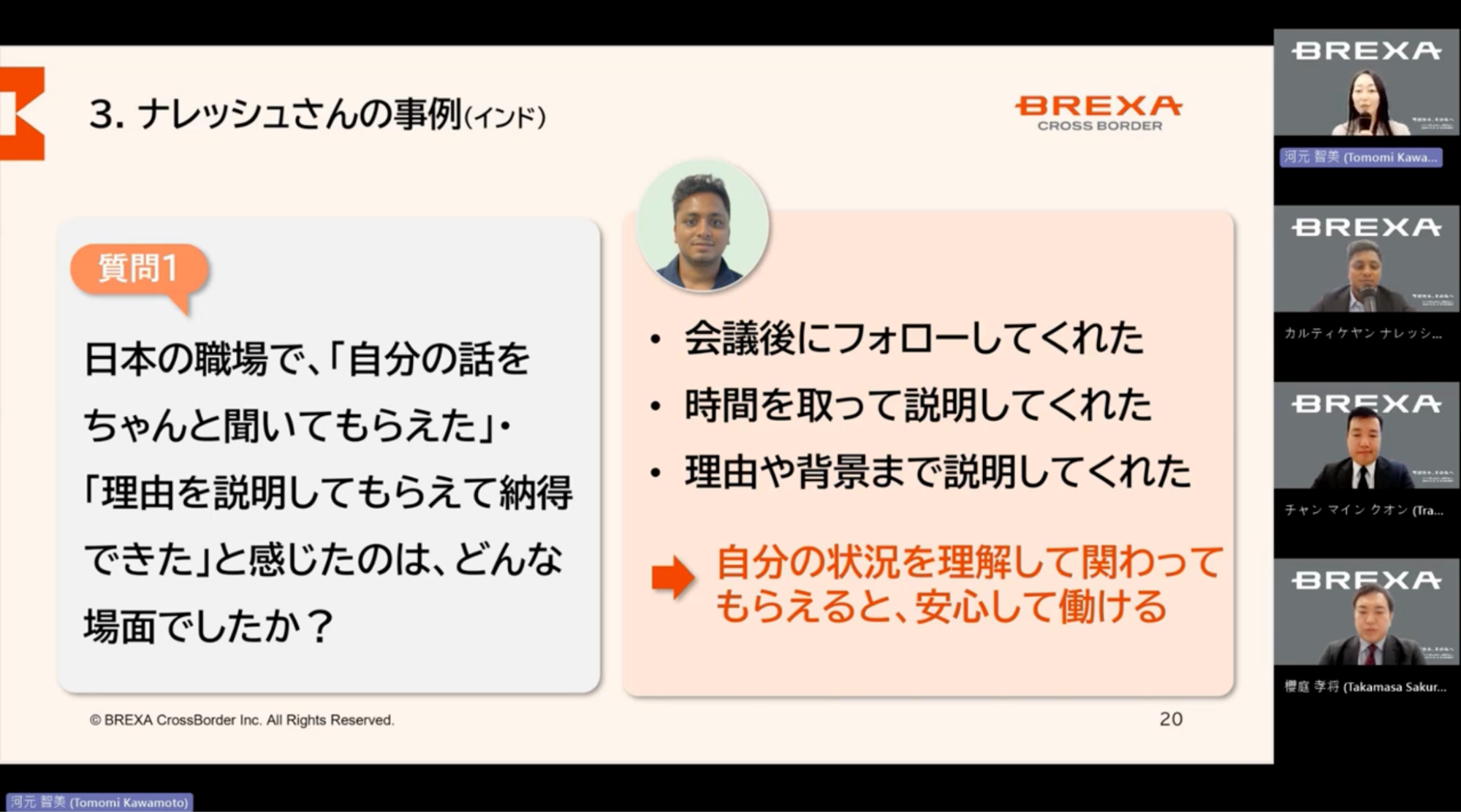
When Naresh started his career at a Japanese company, everyone around him was Japanese, and all meetings were in Japanese, so he struggled because he couldn't speak Japanese yet and could hardly understand what was being said.
At that time, a Japanese person kindly explained after the meeting why this particular approach was taken, and what would have happened if other methods had been used, which was very helpful.
They told me that they feel more secure working when their situation is understood and they receive support accordingly.
Question 2: What were some things you did while working in Japan that surprised you or were different from what you had imagined?
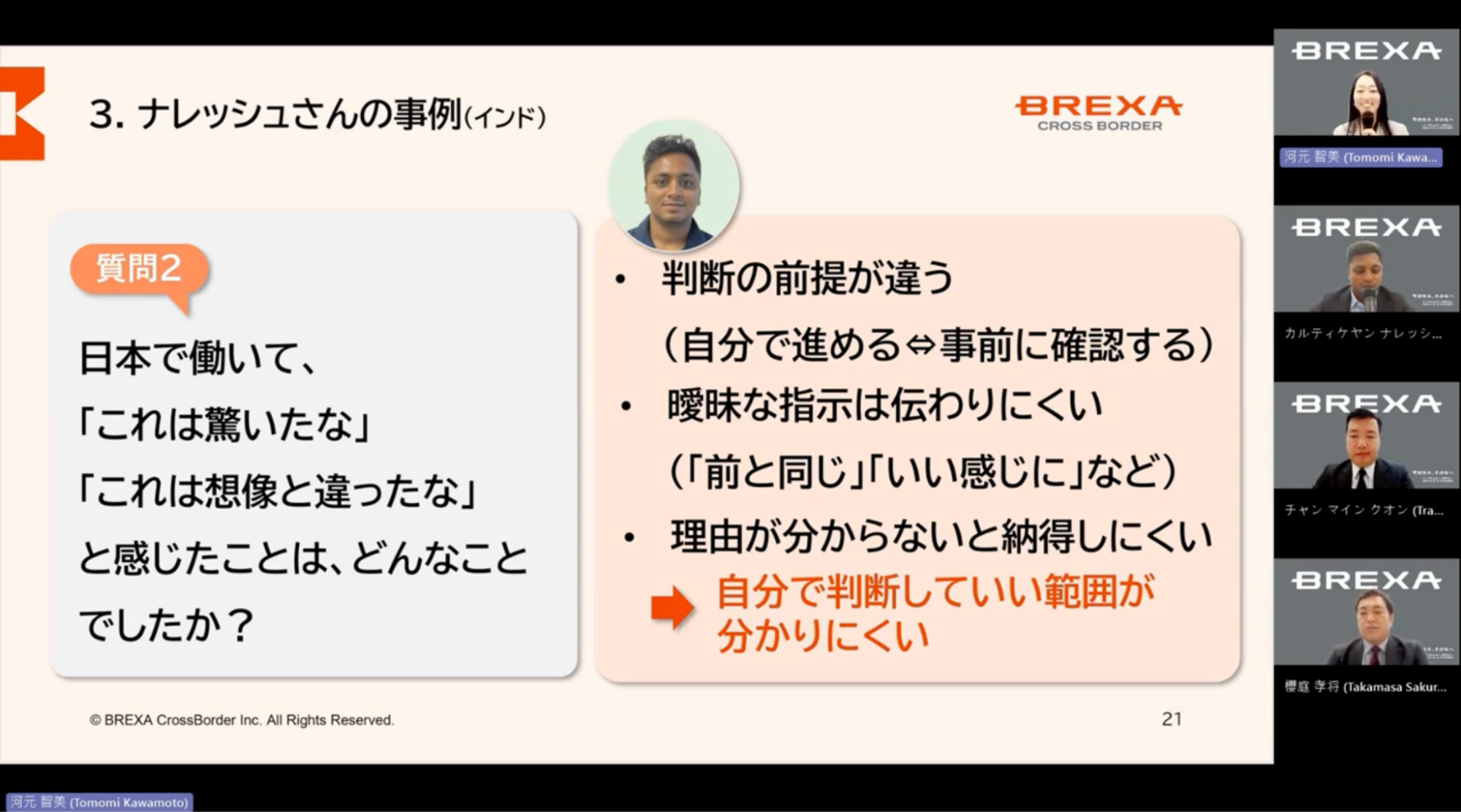
When asked what surprised them about working in Japan, the main points mentioned were the assumptions behind decisions, the instructions, and the explanations given.
In India, it's common to make decisions and proceed on your own, but in Japan, it's considered important to confirm things beforehand, and apparently, sometimes you might be accused of "making decisions on your own."
In addition, she was confused by vague instructions, and when she was reprimanded without knowing the reason, it was difficult for her to accept it, which sometimes led her to repeat the same mistakes.
Question 3: What kind of explanations or interactions in a Japanese workplace would make you feel that it was a "comfortable place to work"?
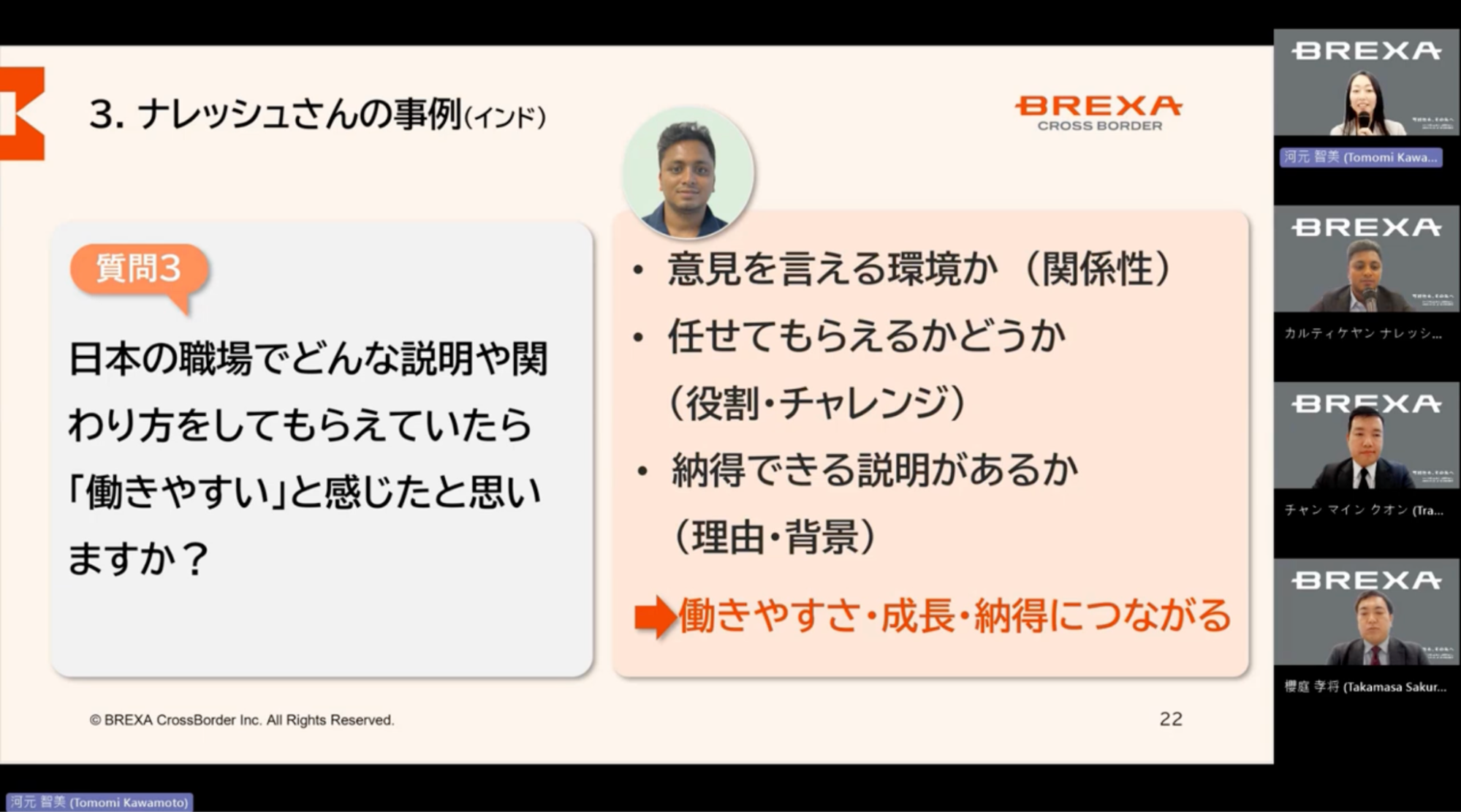
When asked about what kind of interaction makes them feel comfortable working, they first mentioned "an environment where you can easily express your opinions."
Furthermore, being given a role or entrusted with responsible tasks makes one feel trusted, which leads to personal growth.
This relates to questions 1 and 2, but they told us that being able to explain the conclusion and the reasons together, and being told why those rules exist, makes them "able to proceed with confidence" and "leads to a better work environment."
Learning how to work with foreign talent from the perspective of a Japanese manager
Next, Ms. Sakuraba, who is in charge of human resource management for foreign workers at BREXA CrossBorder, took the stage.
Based on their experience in supporting companies in accepting and retaining Vietnamese and Indian employees, they shared insights into the characteristics of Vietnamese and Indian individuals observed on the ground, as well as key points for interacting with them.
Trends observed in Vietnam and India (from the field)
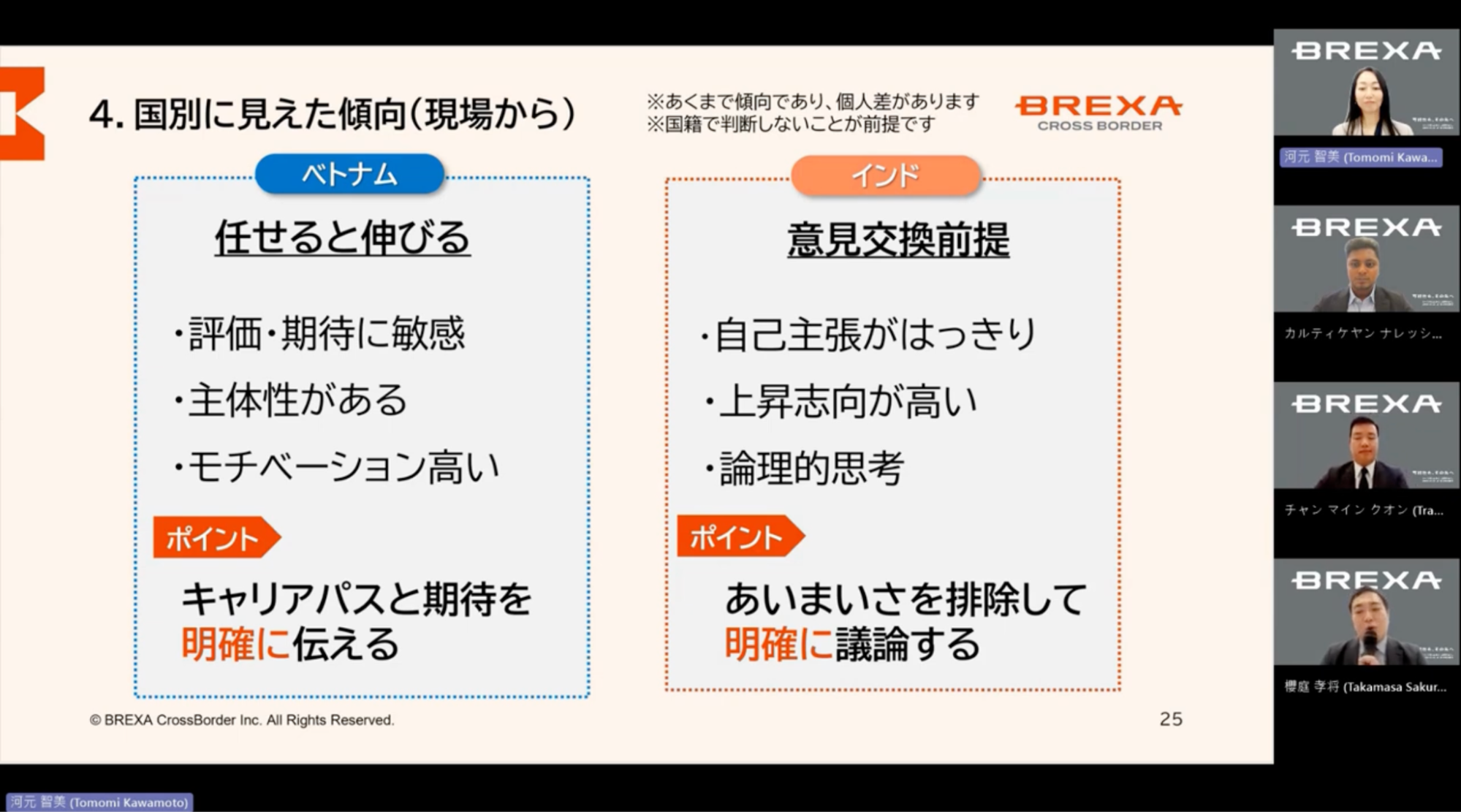
While this is merely a general trend and individual differences are inevitable, Vietnamese people tend to be proactive, thrive when given responsibility, and are more likely to be motivated when their evaluations and expectations are clearly communicated.
The key to engaging with them, according to the company, is to clearly communicate their career path and expectations.
Indians tend to have strong logical thinking skills and express their opinions clearly, which is said to be due to a cultural background that is based on negotiation and assertiveness.
One key point regarding how to engage with the group was to eliminate ambiguity and engage in clear and concise exchanges of opinions.
The difference between a workplace that works and one that doesn't.
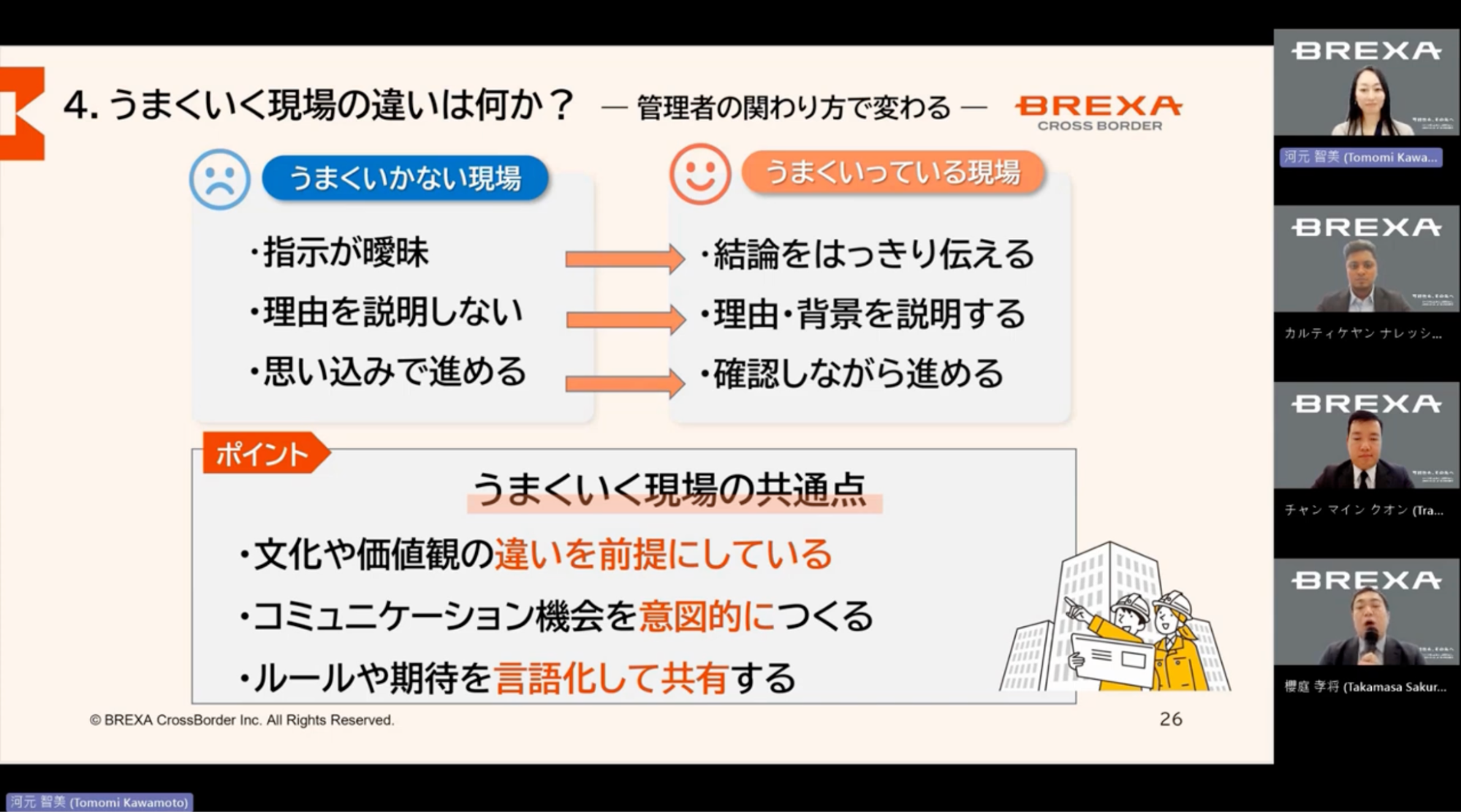
There have been cases where employees proceeded with work without understanding the instructions, resulting in defective products or dangerous behavior; cases where employees were instructed in a harsh tone without explanation, leading to decreased motivation or resignation; and cases where employees proceeded based on assumptions, deviating from the rules.
The common thread in successful workplaces is that they acknowledge differences in culture and values, intentionally create opportunities for communication, and clearly articulate and share rules and expectations.
While trends may vary from country to country, what's important is looking at the individual, not their nationality.
And, make sure to express it clearly in words.
These two points are key to building better relationships with foreign talent.
Q&A from participants
In the latter half of the course, a communication time was set aside where guests and instructors directly answered questions from participants.
Here are some examples.
- Q.Is there a way to motivate someone who lacks enthusiasm for studying Japanese and exhibits problematic behavior to improve?
- A.The key is to lower the goal and let them accumulate small successes, increasing their sense of accomplishment. It's important to make the goal something that can be demonstrated through actions, such as asking "Is this okay?" or repeating instructions, rather than just abstract "try your best."
- Q.Would it be alright to suggest that we try to use Japanese as much as possible in our work conversations?
- A.While the proposal itself is fine, it is important to communicate it as a common language for safety and for the Ministry of Communications, so that it is not perceived as a "ban on native language." At the same time, companies should also create an environment that is user-friendly for Japanese, such as Plain Japanese and short, specific instructions.
- Q.Please tell me about initiatives to prevent employee turnover and improve retention rates.
- A.Clearly defining career paths is crucial. However, simply establishing systems is insufficient; it's essential to communicate these plans effectively to the individual and ensure they understand them. The key is to share future visions and expectations through careful dialogue.
At JAC, we offer a "Foreign Cooperation Course" for Japanese employees.
This course will help you acquire the knowledge and responsiveness necessary for coexisting with foreign talent, such as cross-cultural understanding and Plain Japanese that are easily understood by foreigners.
We also have a Q&A session, so please join us!
For details about the course, please see the "Foreigner Coexistence Course" page below.
Past lectures, including on-demand recordings, materials, and Q&A from those lectures, are also available.
"Training on Coexistence with Foreign Employees" for Japanese Employees
The operation of this course has been entrusted to BREXA CrossBorder Co., Ltd.
This article is a report on the "Intercultural Understanding Seminar ②: Learning from the Cases of Vietnam and India - Management of Foreign Talent Based on Respect" held on Thursday, June 4, 2026, for Japanese employees.
Seminar Video
Seminar Materials
JAC Foreigner Coexistence Course 2026_Intercultural Understanding (2) Course Materials (Digest Version).pdf
[Q&A Collection] JAC Foreigner Coexistence Course 2026_Intercultural Understanding Course (2) Vietnam & India Edition.pdf
Awareness poster: "Secrets to effective communication when working with foreign employees".pdf
Report on the "2026 Seminar on Coexistence with Foreign Employees" for Japanese Employees
The author of this article
Japan Association for Construction Human Resources
Chief of Research and Development Department / Administration Department / Public Relations Department
Motoko Kano
(Kano Motoko)


Born in Aichi Prefecture.
He is in charge of public relations, research and investigation, and is the person behind social media.
We update our social media accounts daily with the desire to make people fall in love with Japan, to spread the appeal of construction from Japan to the world, and to ensure that Japan's construction industry continues to be the industry of choice around the world.
He is also engaged in research into the feasibility of implementing skills evaluation exam in Asian countries, and is conducting interviews with local organizations in each country.
Related articles
Report on the "Foreign Workplace Coexistence Seminar 2026" for Japanese Employees: Basic Knowledge of Employing Foreign Workers
Report on the "Foreigner Coexistence Seminar 2026" for Japanese Employees: Intercultural Understanding Seminar ① Indonesia and Islam.
Specified Skilled Worker Recruitment 10 Questions from Construction Companies - FY2025 System Briefing Session Report (Omiya, Saitama)
Report on the 2025 "Construction Future Award for Creating with Foreign Talent" <Receiving Companies / Excellent Examples of Foreign Talent Utilization Category> Award Ceremony