- やさしい日本語
- ひらがなをつける
- Language
We provide multilingual content through machine translation. Translation accuracy is not 100%. About the multilingualization of the JAC website





- Home
- JAC Magazine
- Working with foreign workers
- [Survey Report] Insights from Surveys! Specified Skilled Worker The Realities of Acceptance Preparation
- Home
- JAC Magazine
- Working with foreign workers
- [Survey Report] Insights from Surveys! Specified Skilled Worker The Realities of Acceptance Preparation

[Survey Report] Insights from Surveys! Specified Skilled Worker The Realities of Acceptance Preparation
I wrote the article!


Japan Association for Construction Human Resources
Public Relations Department/Administration Department
Shohei Katayama
(Shohei Katayama)
Hello, this is Katayama from JAC (Japan Association for Construction Human Resources).
As labor shortages in the construction industry become more serious, many companies are likely considering accepting Specified Skilled Worker as one of the countermeasures.
However, there are also many voices saying things like, "I don't know where to prepare," or "I'm worried about troubles after accepting the offerings."
This time, we conducted a survey of 197 construction companies that have already accepted Specified Skilled Worker.
We have compiled feedback from the field, from internal preparations before acceptance to hiring criteria and initial support after assignment.
We hope this information serves as a practical reference for companies considering accepting the company.

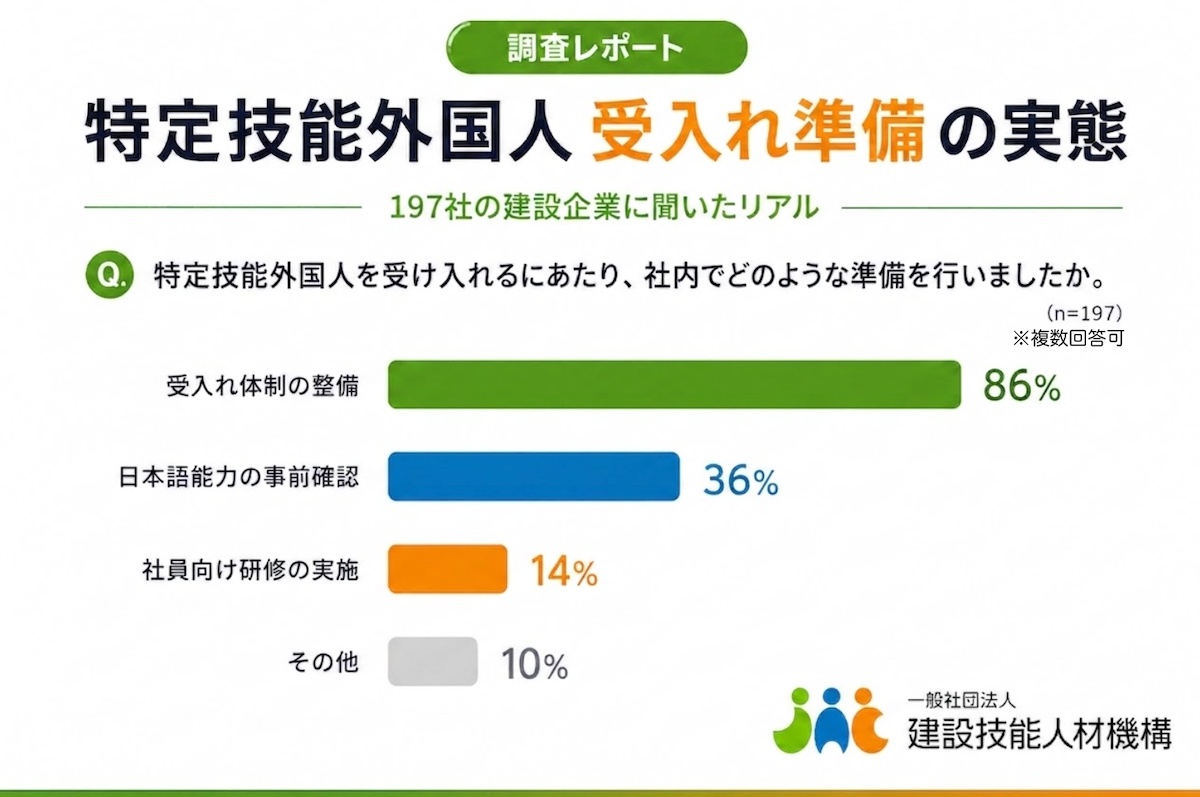
Q. What preparations did you make internally to accept Specified Skilled Worker?
*Multiple answers allowed
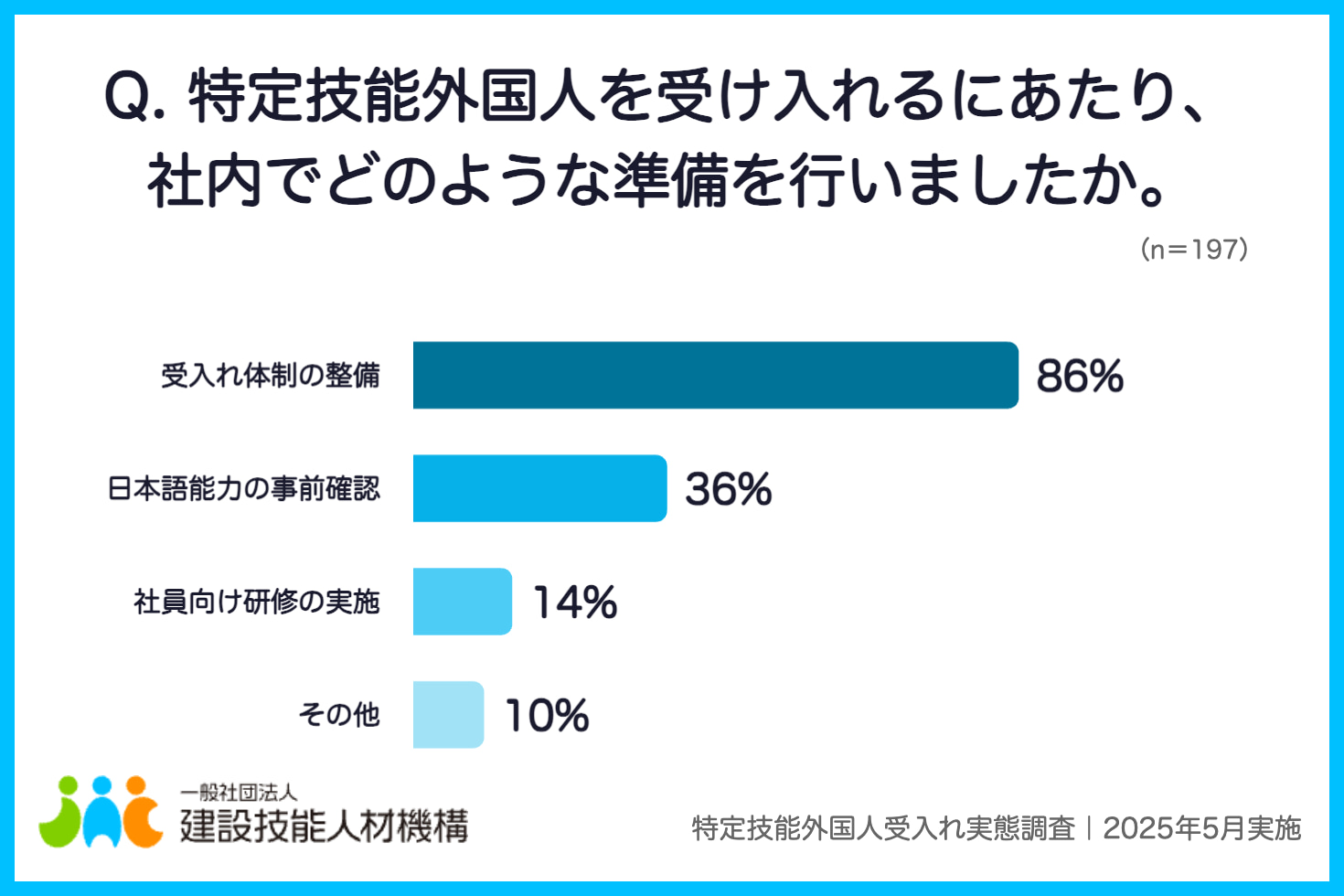
The survey results included responses on three items: "establishment of acceptance system," "prior confirmation of Japanese language ability," and "implementation of employee training."
Specific example of an initiative: Development of a system for receiving visitors.
Many companies cited "establishing acceptance systems" as preparation for accepting Specified Skilled Worker.
Specified Skilled Worker is putting great effort into providing a foundation for their lives and work.
Specific examples of support included assistance with housing, work, and employee benefits, such as the following:
[Support related to housing and daily life]
- Securing housing for Specified Skilled Worker, such as securing condominiums or dormitories or purchasing real estate.
- Purchase of household goods, daily necessities, bedding, commuter bicycles, and other items related to daily life.
- Wi-Fi is now available in all rooms.
[Support system for work-related matters]
- Appointment of support staff
- Establishment of a dedicated support department (Working Group for Supporting Foreign Employees)
- Placement of foreign employees in the country
[Employee benefits and career support]
- Establishment of the 'Foreman Allowance' with Specified Skilled Worker (ii) in mind
- Promoting the full utilization of paid leave
- Support for obtaining a driver's license
- Provision of a complete set of tools necessary on site (carpentry tools, work clothes, etc.)
Specific example of an initiative: Pre-assessment of Japanese language proficiency
Some companies have focused on "pre-checking Japanese proficiency" to prevent troubles caused by language barriers.
In the case of Specified Skills, Japanese proficiency test requires N4 or higher Japanese skills, but actual communication level is difficult to confirm without thorough dialogue.
Specific initiatives included the following: confirmations during recruitment and transition, and preparation for educational support.
[Confirmation during hiring and transition]
- Confirmation of Japanese language proficiency (N4, N5 level) and understanding of on-site safety instructions.
- Confirmation of enthusiasm for work and communication through Japanese language exchange.
[Continued educational support]
- Preparation for a Japanese language study session led by an external instructor
- Preparing to use Japanese language classes and learning apps that can be accessed via smartphone
- Collaboration with sending organizations regarding learning progress before entry into the country.
Specific examples of initiatives: Pre-training and understanding promotion for internal staff
Only 14% of companies reported taking measures to educate their Japanese employees who were accepting the foreign workers, or to promote understanding throughout the company.
Whether foreign workers can smoothly adapt to the workplace largely depends on the understanding and support of the receiving side.
Sharing information about cultural and customary differences in advance can help prevent problems and misunderstandings on-site.
Specifically, the following initiatives were mentioned:
[Awareness reform]
- Instruction on "polite explanation methods" that take into account differences in culture and customs, and language barriers.
- Registered Support Organizations Conducting training by the (Union) on how to respond to employees after acceptance.
[Enhancing communication]
- Share images of your work and work style on your website and social media.
- Preparations for a company social event, including sports exchanges.
[Institutional understanding]
- Understanding the Shift in Roles from "Technical Intern Training" to "Specified Skills"
- Company understanding regarding leave for marriage or returning home for the holidays.
Examples of specific initiatives: Others
In cases where companies transition directly from Technical Intern Training to Specified Skills, many companies have not made any special preparations because their living infrastructure and work environment are already in place.
However, some respondents said they placed importance on clearly communicating the "change in position" during the transition.
While Technical Intern Training is a place for 'learning,' Specified Skills is employment as a 'professional.'
Directly explaining these differences to the individual and encouraging them to approach their work responsibly is an essential effort during the transition from Technical Intern Training to Specified Skills.
Furthermore, some respondents said they have engaged in long-term career support by setting future goals together in anticipation of the transition to Specified Skilled Worker (ii) (long-term employment and family accompaniment).
This shows an attitude toward not merely transitioning to the system but also aiming to boost motivation and lead to retention.
Q. What were the key points you focused on when hiring Specified Skilled Worker?
*Multiple answers allowed
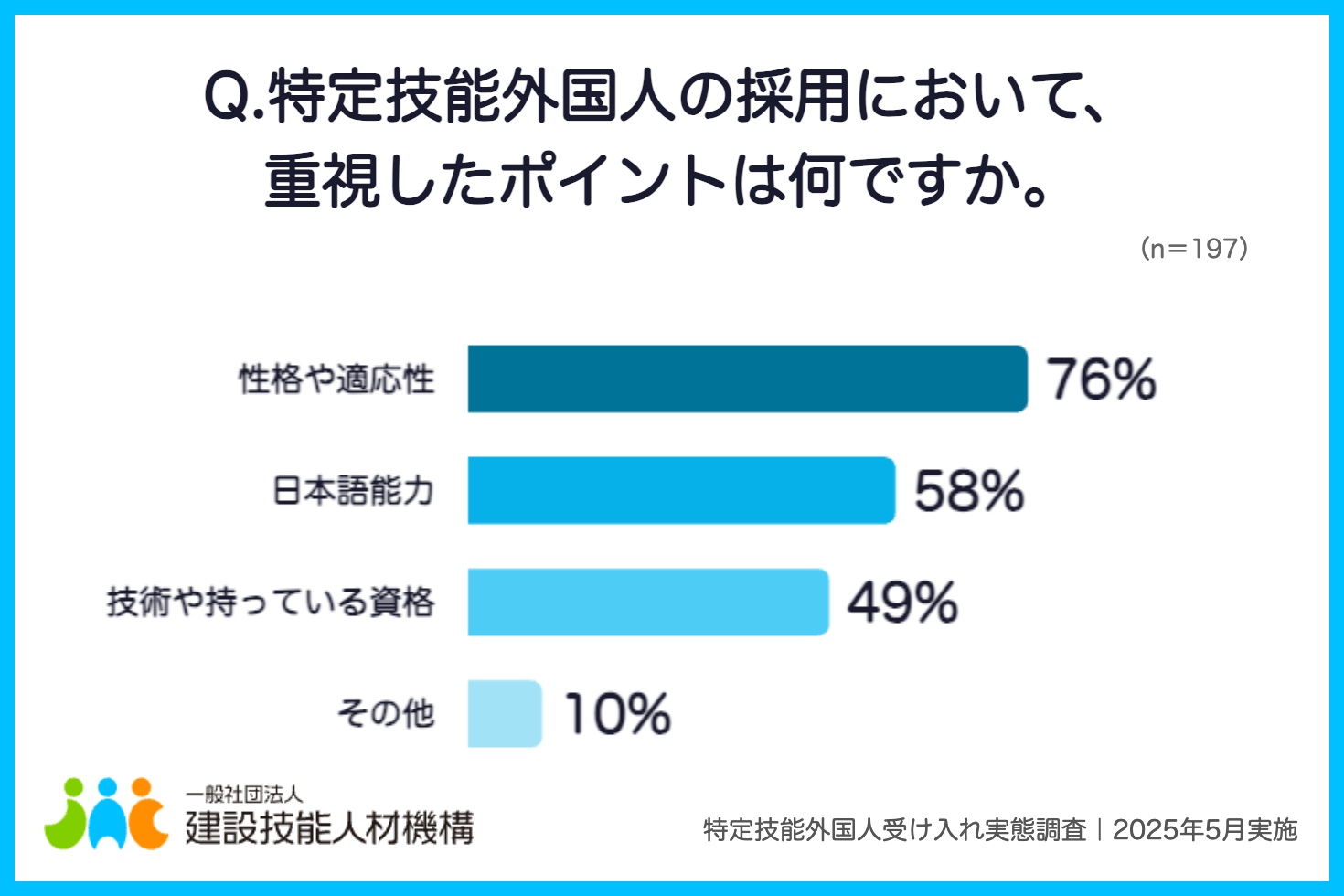
Of the three options—"personality and adaptability," "Japanese language ability," and "technical skills and qualifications"—the results showed that many companies prioritize "personality and adaptability."
Many companies have selected two or more items, suggesting that they are making comprehensive judgments from multiple perspectives.
Three key points we emphasized in the hiring process
We will provide more detailed information on each point raised in the survey, based on feedback from the companies.
Personality and adaptability
In addition to "seriousness" and "teamwork," many voices emphasized "motivation and proactiveness toward work."
Many companies evaluate not only current skills but also their motivation to grow, such as whether they have been actively engaged since the Technical Intern Training period or whether they are studying to achieve Specified Skilled Worker (ii).
Japanese language proficiency
Many responses use "conversation without an interpreter" as their benchmark.
From the perspective of safety management and work efficiency, the ability to accurately understand on-site instructions is required, and some respondents indicated that an N3 level or higher would be ideal.
On the other hand, some companies say they "don't expect much in terms of Japanese language ability," which suggests that there is a difference in standards between companies that ideally require N3 level proficiency and those that prioritize adaptability over fluency.
Skills and qualifications
Many companies tend to evaluate their experience as immediate assets (such as board installation, heavy machinery, scaffolding, etc.) as a key point for transitioning from Technical Intern Training.
The required qualifications and skills vary depending on the industry, and in some cases, they explicitly check for qualifications such as "special training in scaffolding," "slinging skills training," and "heavy equipment certification."
Furthermore, some companies acknowledge that "even if individuals possess technical skills, their skill levels vary," and they hire with the understanding that they will provide training after hiring to meet their own company standards.
Qualifications and experience can be seen as merely confirming the starting line.
Key points to consider when hiring.
We observed examples of companies attempting to assess candidates from multiple perspectives, not just through interviews, but also by using evaluations during the internship period and their own unique tests.
Specifically, the following responses were received:
[Technical Intern Training Evaluating "Performance" Over the Period]
- I gather feedback from the site manager and foreman at the site where I was assigned and use it as a basis for my decision.
- Hiring is based on 'trust' that has completed the Technical Intern Training five years without issues, such as oversleeping or malicious behavior.
- We ask them to talk about the "good things" and "difficulties" they experienced during their internship to gauge the depth of their thinking and their level of experience.
[Skill Check]
- Even if their Japanese isn't perfect, we'll assess their ability to understand context and their aptitude for listening comprehension.
- The practical language skills are checked by having employees read Japanese work reports aloud and then type them in hiragana.
- In industries like construction, where handling numbers is common, simple calculation problems are given orally in the employee's native language to assess their response speed and accuracy.
[Confirming Values]
- Specified Skilled Worker (ii) Check if you are motivated to study with that goal
- Check their "feelings towards family" and "attitudes towards work."
- Even if they have some difficulty with language, we look for whether they have the attitude to try their best to communicate.
While the specific points emphasized in hiring vary slightly from company to company, one common thread that emerged was that they value not only current skills and language abilities, but also a positive attitude itself.
Some companies emphasize whether candidates have a willingness to communicate, even if they have some difficulty with language, and some view proactive communication as an indicator of adaptability.
Additionally, some companies accepted them as Specified Skills based on evaluations during the internship period such as "high communication skills, proactive and diligent work," indicating a correlation between proactivity and work attitude.
We explain in detail the key points to watch for during interviews here, so if you are planning to interview for Specified Skilled Worker, please take a look.
Specified Skilled Worker What questions should you ask in a recruitment interview? Here are sample questions and points to watch out for
Q. To smoothly accept Specified Skilled Worker, have you communicated anything to employees beforehand?
*Multiple answers allowed
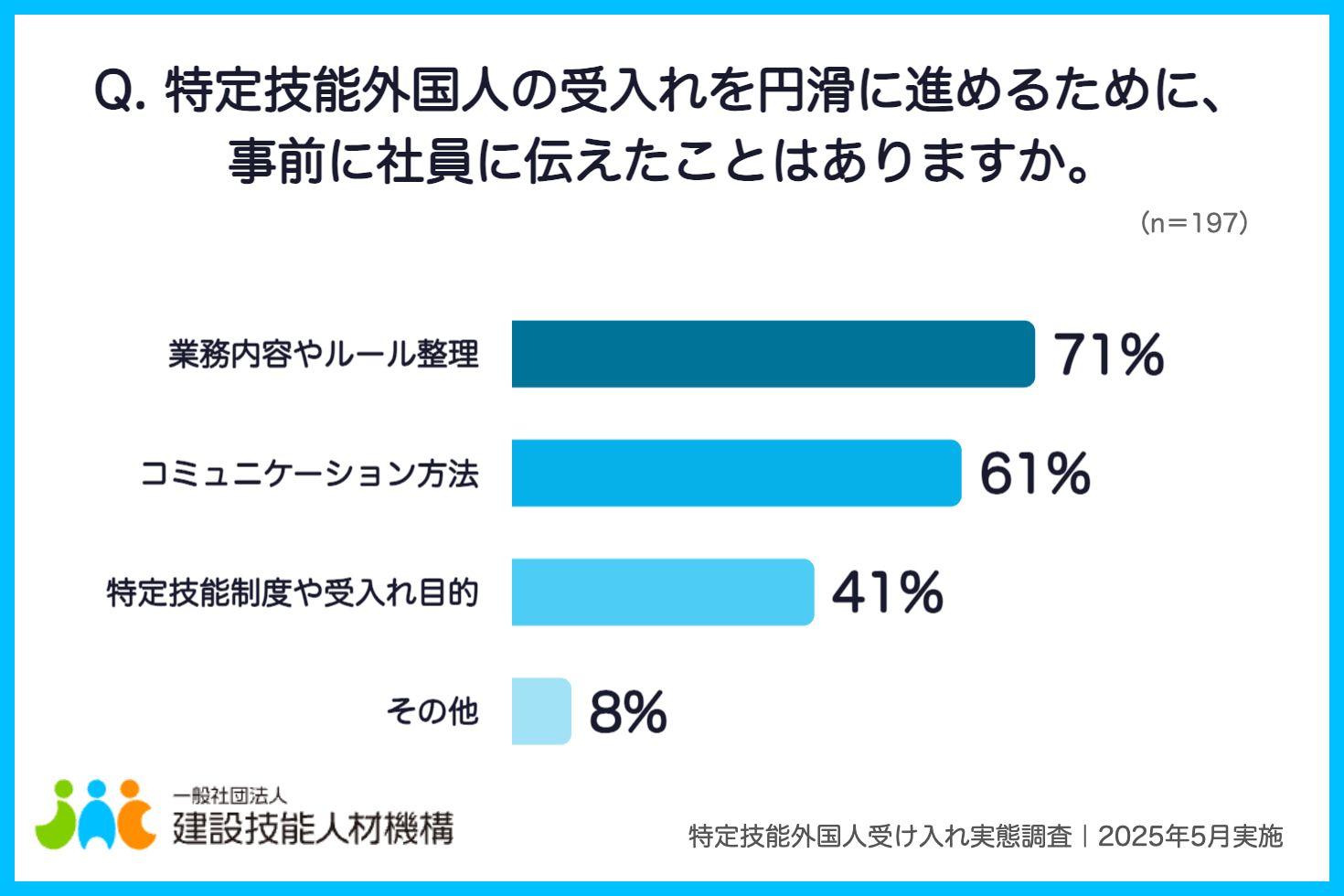
The survey results showed that the most common information communicated to employees in advance was "clarification of work content and rules," at 71%.
Regarding "communication methods," it was found that more than half of the companies had already prepared by informing their employees about them in advance.
Here are some specific initiatives submitted by companies.
Clarifying work procedures and rules (safety management, work methods)
Many companies seem to be aware of the need for thorough safety management, standardization of work instructions, and patient instruction on on-site rules.
In the construction industry in particular, prior communication to prevent accidents is considered extremely important.
Some respondents shared a sense of crisis that "a lack of understanding of Japanese can directly lead to serious accidents," and suggested that they are retraining Japanese employees on the importance of complying with labor safety and health laws and other regulations to protect their own lives.
Communication methods
Many companies were observed to share the following tips for everyday communication in advance:
- Using Plain Japanese
- Slow down your speaking speed.
- Checking multiple times to make sure the message was understood, etc.
Plain Japanese refers to Japanese that uses words with simple meanings and reduces the number of kanji to make them easier for foreigners to understand.
For more details about Plain Japanese, please check this article for more information.
What is Plain Japanese? Introducing example sentences and the background of its creation
Some respondents also mentioned that they communicate cultural differences, such as language use and attitudes towards physical touch, to their employees to the best of their ability.
Some companies regularly conduct training sessions on "how to communicate with foreigners," and in some cases, this goes beyond mere prior notification and becomes a continuous effort.
Communication methods vary from country to country.
The following article explains communication tips based on national characteristics, so please refer to it as well.
What is the national character of Thailand? We introduce their personality and communication tips!
What is the national character of Nepal? We introduce their personality and communication tips!
What is the national character of Filipinos? We introduce their personalities and communication tips!
What is the Vietnamese national character? We introduce their personality and communication tips!
What is the national character of Myanmar? We introduce their personality and communication tips!
What is the Indonesian national character? We introduce their personality and communication tips!
Specified Skilled Worker System and purpose of acceptance (company policy, significance of employment)
As mentioned in promoting understanding within the company Technical Intern Training, many companies are working to thoroughly communicate the differences in employment status (perception of workers as workers) and to thoroughly raise awareness of their policies and the significance of employment.
Specified Skilled Worker In some cases, employees share their Specified Skilled Worker (ii) goals in advance.
There was also an opinion that former interns who have returned once value creating an atmosphere where they can smoothly reintegrate into their workplace circle when returning as Specified Skills.
Q. What kind of initial support did you provide after being assigned to Specified Skilled Worker?
*Multiple answers allowed
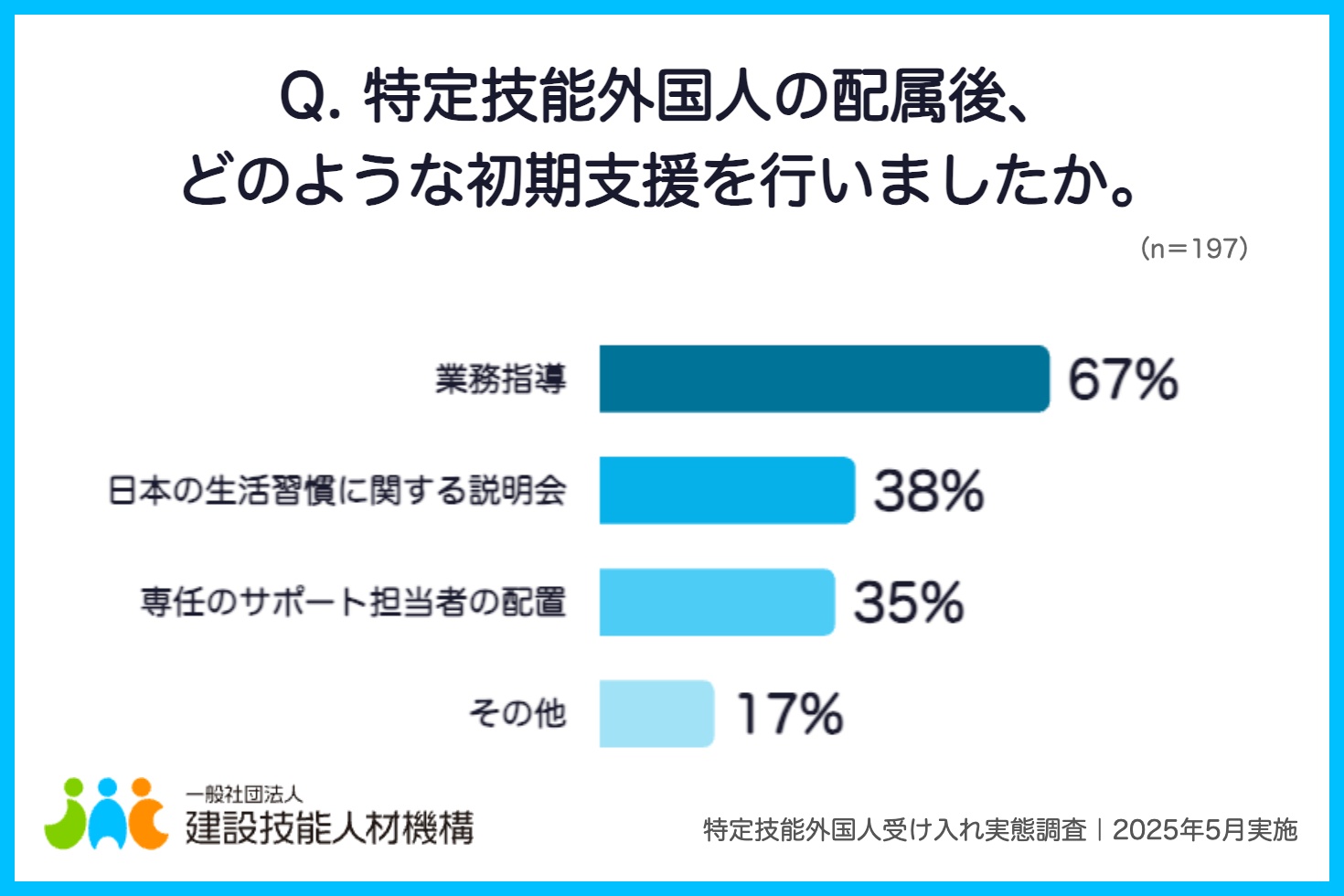
As for initial support, many companies responded that they provided "business guidance."
Furthermore, more than 30% of companies are implementing support measures such as "briefing sessions on Japanese lifestyles" and "assigning dedicated support staff."
They also provided answers regarding the specific support they would be providing.
Business guidance
Not only are there job explanations, but also initiatives focused on stepping up as Specified Skills stand out.
Specifically, the following initiatives were proposed.
- Thorough on-the-job training (OJT) by foremen and site managers, including direct instruction on work procedures.
- Safety training and work explanations using videos and books in the native language.
- Support for obtaining qualifications
- Initiatives to Enable Foremen and Team Leaders to Gain Experience with an Eye on 'Specified Skilled Worker (ii)'
- Technical Intern Training Education that promotes awareness as a guiding role in life
Guidance on Japanese lifestyle habits
Specific rules and guidance are also provided to help people navigate Japanese communities without causing trouble.
- Explanation of local rules such as garbage sorting and collection days, and consideration for neighbors.
- Shopping, banking, and accompanying you to public institutions
Assignment of a dedicated support staff member
Some companies have clearly defined support channels to help alleviate feelings of loneliness and anxiety.
It appears that the support staff not only provide consultations but also actively engage with employees by offering thorough explanations regarding salary structures and their positions (rights and obligations).
- A designated advisor will be assigned to provide continuous support.
- Multifaceted support from multiple executives and other stakeholders
- Outsourcing procedural support and orientation to Registered Support Organizations or specialized contractors
others
There is also a frequent shift from Technical Intern Training to Specified Skills, and in such cases, since they already have a foundation of living in Japan, support is either "simplified" or "continued."
For example, some responses indicated that the skills acquired during the three-year internship period were considered complete, and therefore no additional support was provided, prioritizing a smooth transition. Others stated that life guidance had been completed, and the focus was shifted to more advanced work instruction and improved working conditions.
If you're worried about preparing to accept Specified Skilled Worker, consult JAC!
At Japan Association for Construction Human Resources (JAC), we offer a variety of services to address the challenges faced by companies considering accepting Specified Skilled Worker and to support their proper operation.
In addition to "Online Individual Consultations" and "Foreigner Coexistence Courses," we have established a system to continuously support the success of foreign talent after acceptance.
Online individual consultation session (free)
Specified Skilled Worker Our specialized consultants will provide thorough one-on-one guidance on how to proceed with acceptance procedures, document preparation, and payroll calculation methods.
If you want specific advice tailored to your company's situation, please make use of this opportunity.
Since this is an online consultation using Zoom, you can easily participate from anywhere in the country!
If this sounds like you, please feel free to contact us!
[Examples of consultation topics]
- I attended the information session, but I'd like to ask some more in-depth questions.
- I want to Specified Skills foreigners at our company but want to know where to start.
- We've had a problem with a foreigner we're hosting, and we'd like some advice on how to resolve it.
- A foreigner is retiring or changing jobs, so I would like to know the procedures involved.
For details and registration, please see the "Online Individual Consultation Session" below.
Online Individual Consultation Session
Free lecture on coexistence among foreigners
JAC also holds "Foreign Worker Coexistence Seminars" for Japanese employees to support the creation of an environment where foreign workers can work comfortably and grow together.
As can be seen from the survey conducted this time, many companies are taking initiatives such as sharing communication methods with Japanese employees before accepting Specified Skilled Worker.
For foreign talent to smoothly adapt to the workplace and thrive for a long time, it is important not only to establish systems but also to gain understanding from the accepting companies.
Packed with tips for smooth work with foreign talent, such as courses on cross-cultural understanding and Plain Japanese.
Please make use of this as part of our acceptance preparations!
For details about the course content and how to register, please check the following page.
[Online, Free] "Learning about Coexistence with Foreign Employees" for Japanese Employees
Specified Skills Acceptance Support Service
To help you handle various situations after accepting Specified Skilled Worker, we offer a wide range of support options such as:
- Skill development support: Online special training in safety and health, Japanese language courses, etc.
- Support for promoting coexistence with local communities: Temporary Return Support, Construction Career Up System fee support, etc.
- Daily life support: Medical interpretation support, support for everyday problems
We provide support that includes assistance after the company has been accepted, so even first-time companies can rest assured.
For detailed information about our services, please check the page below.
Specified Skills Acceptance Support Services
Summary: Preparing to accept Specified Skilled Worker is important! If unsure, consult a specialized agency
To successfully accept Specified Skilled Worker, it is essential to carefully build up each step, from establishing the acceptance system, evaluating recruitment processes, to post-assignment support.
This survey revealed that many companies are creating a welcoming environment throughout the company, prioritizing not only skills and language abilities, but also the individual's attitude and adaptability.
In particular, the fact that on-site communication and improved understanding among Japanese employees significantly impact retention and success is a crucial point.
When accepting a Specified Skilled Worker for the first time, you may feel anxious or have many doubts.
However, by identifying the necessary points in advance and preparing in a way that suits your company, Specified Skilled Worker will surely become a major asset!
If you're unsure where to start or what to do in your company's specific situation, please feel free to contact JAC!
The author of this article
Japan Association for Construction Human Resources
Public Relations Department/Administration Department
Shohei Katayama
(Shohei Katayama)
Born in Fukushima Prefecture.
I am currently working as a public relations officer.
In public relations, I cover the advanced initiatives of companies that accept Specified Skilled Worker in the construction field, and write articles and disseminate information.
In addition, we continue to disseminate information every day with the desire to let foreign workers working in Japan know more about the charm of Japanese culture and the way they think about work.
Related articles
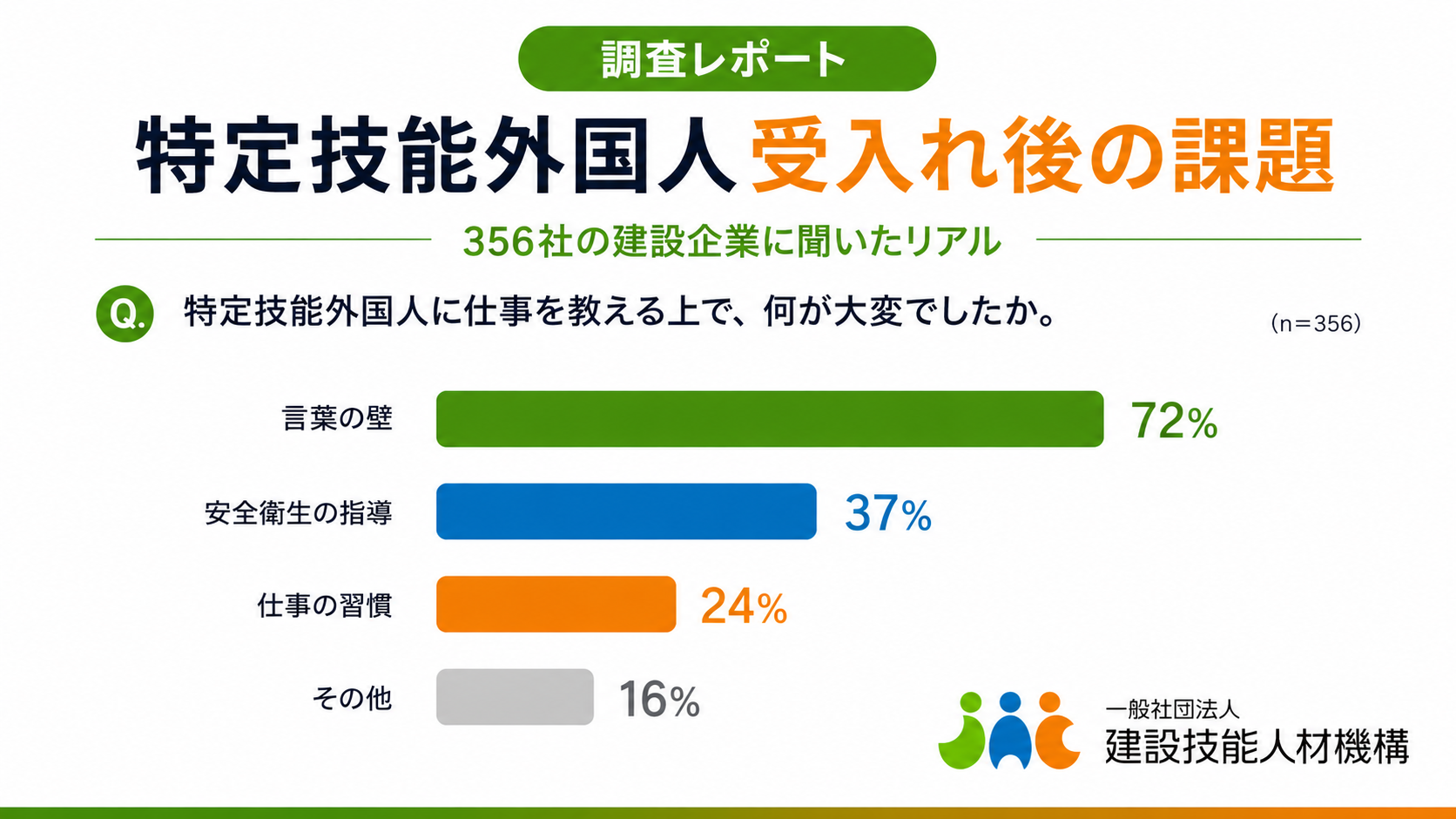
[Survey Report] Viewing from the Survey Perspective! Specified Skilled Worker Challenges After Acceptance

Considering "Japanese language education" for foreign workers: What are the necessities and teaching methods?

What makes a workplace welcoming to foreigners? Key points for creating a workplace that companies should implement.
Check out the causes and safety measures for the three major disasters in the construction industry!