- やさしい日本語
- ひらがなをつける
- Language
We provide multilingual content through machine translation. Translation accuracy is not 100%. About the multilingualization of the JAC website





- Home
- JAC Magazine
- Working with foreign workers
- What makes a workplace welcoming to foreigners? Key points for creating a workplace that companies should implement.
- Home
- JAC Magazine
- Working with foreign workers
- What makes a workplace welcoming to foreigners? Key points for creating a workplace that companies should implement.

What makes a workplace welcoming to foreigners? Key points for creating a workplace that companies should implement.
I wrote the article!
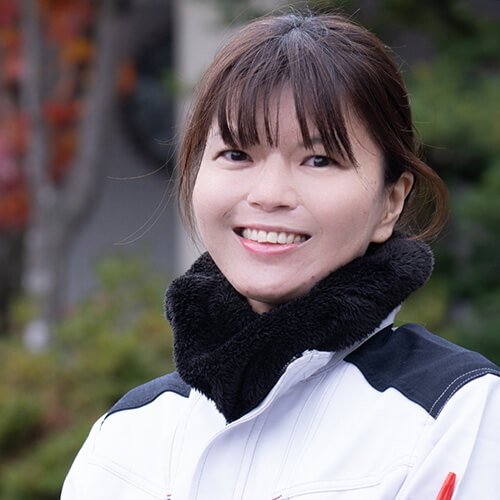

Japan Association for Construction Human Resources
Chief of Research and Development Department / Administration Department / Public Relations Department
Motoko Kano
(Kano Motoko)

Hello, this is Kano from JAC (Japan Association for Construction Human Resources).
In recent years, more companies have been accepting foreign employees as employees.
However, many have also expressed concerns such as "I hired someone but quit right away," or "Communication doesn't go well and mistakes keep coming."
For foreign employees to overcome language and cultural barriers and continue to thrive for a long time, it is important for companies to establish a good environment.
This time, we will explain the characteristics of a comfortable working environment for foreigners and key points for creating a workplace environment.

What makes a workplace welcoming to foreigners? What are the differences between a welcoming and a less welcoming workplace?
To successfully hire foreign employees, it's essential to create a comfortable and supportive work environment.
A comfortable work environment and a difficult work environment each have their own distinct characteristics.
Understanding these differences will help you consider if there are any areas for improvement in your current work environment.
Characteristics of an environment that foreign employees find easy to work in
It's important that there are fewer language-related anxieties, allowing for confident communication, and that there's an atmosphere that makes it easy to ask questions.
Furthermore, the acceptance of religion and the culture of one's home country makes employees feel more comfortable working here.
Workplaces that offer the following conditions are likely to be more welcoming to foreigners.
Business processes are visible.
Having illustrated manuals, video tutorials, and instruction manuals with photos makes it easier to feel confident even if your Japanese isn't perfect.
Furthermore, in industries such as construction and manufacturing, the availability of warning signs and safety notices for machine operation in multiple languages also contributes to a sense of security.
There is a friendly atmosphere that makes it easy to talk to someone.
It's also important to have an environment where you can honestly say "I don't understand" when there's something you don't understand.
It would be beneficial to have a support system in place, such as having a mentor you can consult about even minor issues, or having a contact point where you can get advice in your native language.
Many people find it difficult to strike up a conversation casually if they are not confident in their Japanese.
They have an understanding of religion and culture.
When there is consideration for religion and culture, such as restrictions on prayer times and meals, or respect for national holidays, it makes you feel "valued."
For example, for Muslim employees, this might include ensuring they have time off for prayer and providing halal meals.
The following article summarizes what you should know when working with Muslim employees.
Things to know when working with Muslim employees in a Japanese company
Characteristics of environments where foreign employees are likely to feel uncomfortable working
In a difficult work environment, anxiety and stress can lead to a lack of attention, resulting in serious accidents and mistakes.
Furthermore, if an employee feels they can no longer work for the company, it can lead to risks such as early resignation or, in the worst-case scenario, disappearance.
If your workplace has any of the following atmospheres or customs, you should reconsider them.
The instructions are vague.
Vague instructions like "just do it as you see fit" or "read the room" are difficult for foreigners to understand.
Ambiguous instructions are likely to lead to mistakes, which can cause a loss of confidence.
It's hard to approach them.
If the atmosphere seems busy, or if you don't know who to ask questions to, you'll end up not knowing what you don't know.
Furthermore, if I'm not able to join in on conversations or participate in group activities during breaks, I feel a strong sense of loneliness.
Many foreign employees have few people they can rely on outside of work, so workplace isolation can easily cause significant emotional distress.
Lack of understanding of religion and culture
Without consideration for religious worship, dietary restrictions, and important events in one's home country, it can be difficult to work and can easily lead to stress.
Furthermore, culture and manners vary greatly from country to country.
For example, there are differences such as the following:
- Being reprimanded in front of others feels humiliating.
- For example, being taboo about having one's head touched.
In an environment where these differences are not understood by the entire company, it is likely that employees will feel uncomfortable working there.
How to create an environment where foreigners can work comfortably

Let's start with something we can tackle right away.
Translate and visualize business manuals into multiple languages.
Don't just rely on text-based manuals; make use of photos and videos as well.
Procedures for operating machinery and other tasks become easier to understand when they are broken down into short steps with illustrations or photographs.
Ideally, safety-related signs and notices should be displayed in both Japanese and the native language.
Also, when giving instructions or communicating, be mindful of the "Plain Japanese."
Plain Japanese refers to Japanese designed to be easy to understand for foreigners such as:
- Use simple grammar
- Rephrase using simpler words.
- Communicate in short sentences
For more about Plain Japanese, please also refer to this article.
What is Plain Japanese? Introducing example sentences and the background of its creation
Clearly define the rules for giving instructions.
Let's formalize the following as a workplace communication rule: "When giving instructions, clearly communicate 'what, by when, and at what level.'"
Regardless of whether you're dealing with foreigners or not, clearly defining the standards for instructions throughout the entire company helps prevent mistakes and misunderstandings.
Clearly define the person responsible for education.
We designate a person to ask if we have any problems.
In addition to the person in charge of teaching practical skills, it would be better to have someone who acts as a counselor, providing support for personal matters and personal concerns.
Let's not just talk about work, but also try to initiate casual conversations in Japanese.
Even if you don't understand the meaning, if you feel that "this person cares about me" or "it's fun to be around them," that can lead to increased motivation at work.
Regular consultations and mental health support are provided.
Let's conduct one-on-one individual meetings, even if only for a short time, about once a month.
By asking questions outside of work, such as "Are you having any difficulties in your daily life?" or "Are you feeling alright?", you can more easily sense any feelings of loneliness or anxiety that foreign employees may be experiencing.
In industries such as construction, where work is primarily done off-site, some companies not only require employees to go directly to and from the work site, but also create opportunities for all foreign employees to gather at the company once a month.
We make an effort to prevent foreign employees from feeling isolated by having them chat about work with the president and senior colleagues while enjoying light snacks, or discussing how they spend their weekends.
Establish a support system for daily life.
Let's also provide support to alleviate anxieties about daily life, such as government procedures, medical appointments, and housing issues.
Personal stability directly impacts work performance.
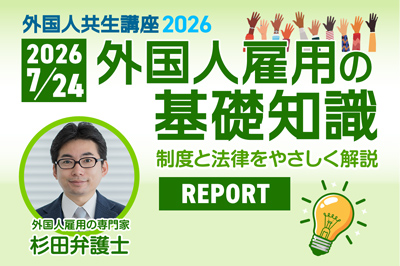
JAC's lifestyle support services for foreigners
JAC offers 'Medical Interpretation Support' for Specified Skilled Worker (i) in the construction sector, such as 'Medical Interpretation Support' for hospital searches and consultations, and 'Life Trouble Support' for everyday life issues, so please make use of these as well.
Medical Interpretation Support
Support for daily life troubles
Provide opportunities for Japanese staff to understand different cultures.
One of the reasons why foreigners find it difficult to work is a lack of understanding of the culture, religion, and manners of other countries.
Sometimes, unconscious words and actions can cause offense to others.
Therefore, it is important for Japanese staff to have basic knowledge about the countries of origin of their foreign employees.
JAC's course for Japanese employees
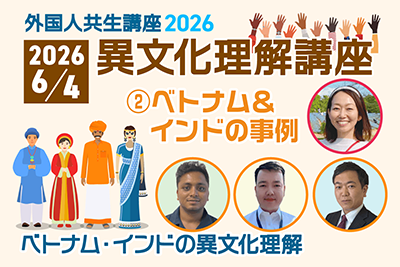
At JAC, we hold a "Foreign Symbiosis Course" for Japanese employees of companies employing Specified Skilled Worker.
We deepen our understanding of the cultures of various countries and religions, and consider tips for creating a comfortable working environment for both Japanese and foreign employees.
Foreigner Coexistence Seminar
Additionally, this article explains the national characteristics of Indonesia, the Philippines, Vietnam, Myanmar, Nepal, and Thailand, so please be sure to check it out as well.
What is the Indonesian national character? We introduce their personality and communication tips!
What is the national character of Filipinos? We introduce their personalities and communication tips!
What is the Vietnamese national character? We introduce their personality and communication tips!
What is the national character of Myanmar? We introduce their personality and communication tips!
What is the national character of Nepal? We introduce their personality and communication tips!
What is the national character of Thailand? We introduce their personality and communication tips!
Benefits for companies from creating an environment where foreigners can work easily
Improving the workplace environment is not merely a matter of "consideration for foreigners," but also an investment that brings significant benefits from a business perspective.
This section will introduce the benefits that companies can gain from improving their work environment.
Retention rates improve and recruitment costs can be reduced.
By having employees stay with the company for a long time, the cost per hire can be reduced.
Hiring foreign nationals often incurs higher costs compared to hiring Japanese nationals, including recruitment and placement fees, as well as procedures for obtaining residence permits. Furthermore, losses due to early departures are particularly significant.
Reduced educational burden leads to increased productivity.
Having manuals and systems in place can reduce the burden of training.
If foreign employees can take initiative, the overall productivity of the workplace will improve significantly.
Japanese employee satisfaction will also improve.
Clear and easy-to-understand instructions and standardized manuals create a more comfortable working environment not only for foreigners but also for Japanese employees and new graduates.
Clearly defining tasks leads to smoother communication and improved transparency throughout the organization.
There are some tricks to communicating smoothly with foreigners.
Please refer to the following column.
What measures can be taken to ensure smooth communication with foreign workers?
Summary: Creating an environment where foreigners can work comfortably has significant advantages.
A workplace environment that is welcoming to foreigners is one where work instructions are clearly defined, there is an atmosphere that makes it easy to ask questions, and there is an understanding of their religion and culture.
Ambiguous instructions and guidance that lacks understanding of religion and culture can create feelings of isolation, potentially leading to mistakes and early resignation.
To ensure that foreign employees can work comfortably and securely for the long term, let's create a supportive work environment by developing multilingual manuals and providing mental health support through regular interviews.
A workplace environment that is easy for foreigners to work in is also a workplace that is easy for Japanese people to work in.
This also brings benefits to companies, such as improved productivity across the workplace and reduced recruitment costs.
Let's create an environment where we can respect foreign employees as colleagues with different backgrounds and work together while deepening our mutual understanding.
If you are a company that is considering accepting Specified Skilled Worker in the construction industry, please feel free to contact JAC!
The author of this article
Japan Association for Construction Human Resources
Chief of Research and Development Department / Administration Department / Public Relations Department
Motoko Kano
(Kano Motoko)


Born in Aichi Prefecture.
He is in charge of public relations, research and investigation, and is the person behind social media.
We update our social media accounts daily with the desire to make people fall in love with Japan, to spread the appeal of construction from Japan to the world, and to ensure that Japan's construction industry continues to be the industry of choice around the world.
He is also engaged in research into the feasibility of implementing skills evaluation exam in Asian countries, and is conducting interviews with local organizations in each country.
Related articles
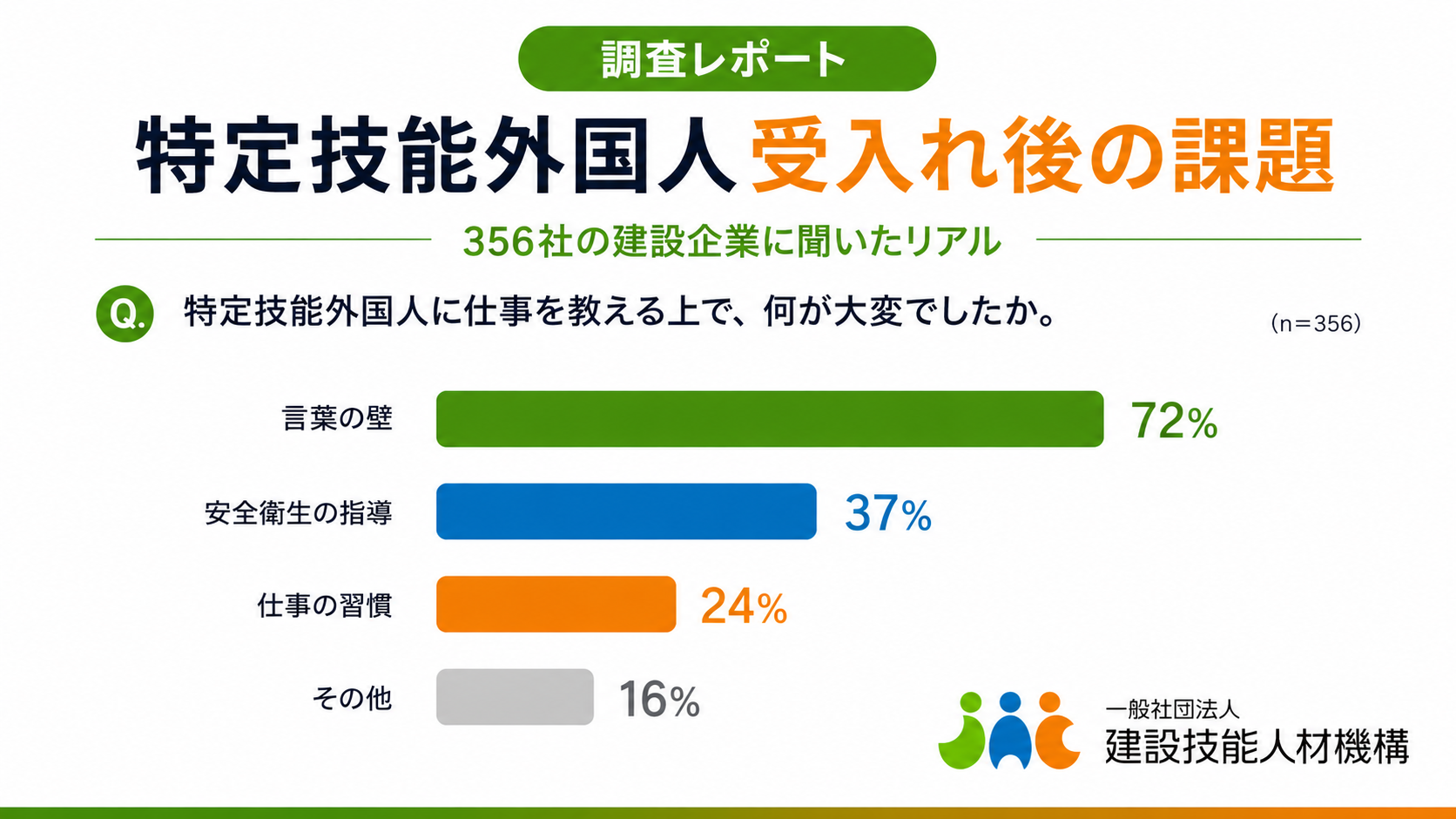
[Survey Report] Viewing from the Survey Perspective! Specified Skilled Worker Challenges After Acceptance
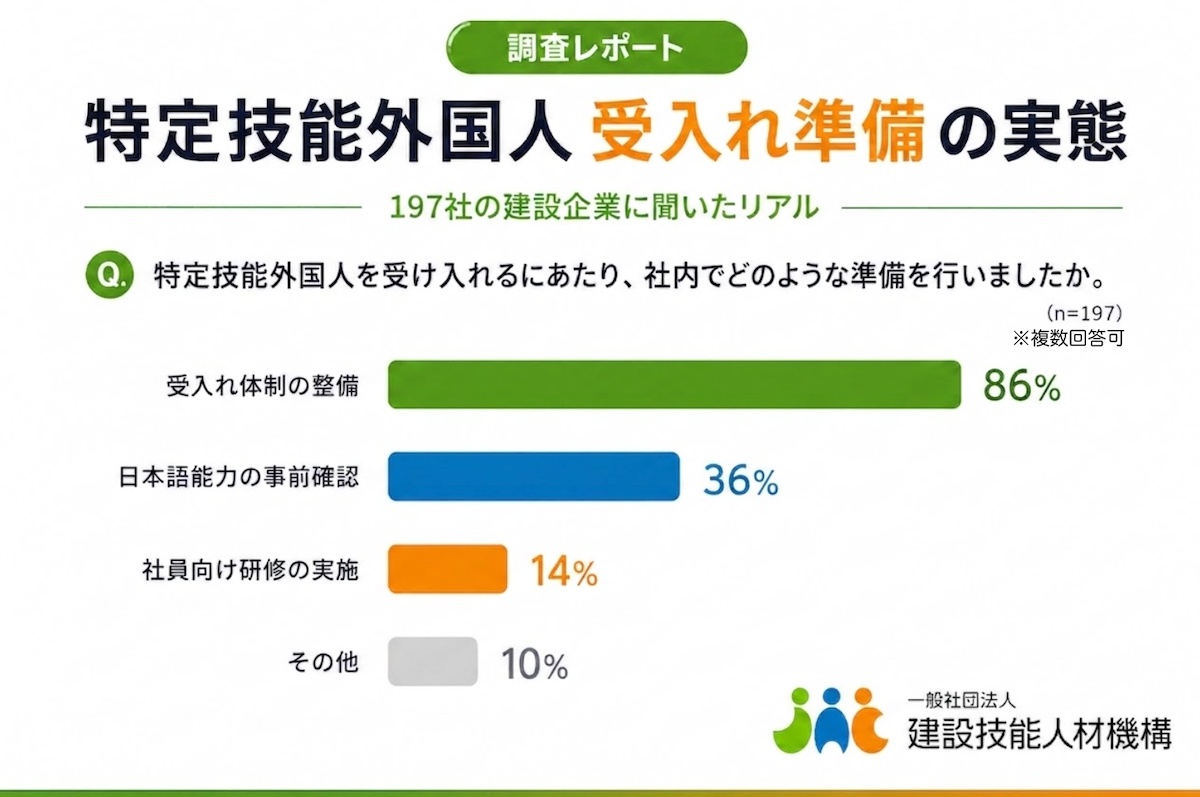
[Survey Report] Insights from Surveys! Specified Skilled Worker The Realities of Acceptance Preparation

Considering "Japanese language education" for foreign workers: What are the necessities and teaching methods?
Check out the causes and safety measures for the three major disasters in the construction industry!