- やさしい日本語
- ひらがなをつける
- Language
We provide multilingual content through machine translation. Translation accuracy is not 100%. About the multilingualization of the JAC website




- Home
- JAC Magazine
- Working with foreign workers
- [Survey Report] Viewing from the Survey Perspective! Specified Skilled Worker Challenges After Acceptance
- Home
- JAC Magazine
- Working with foreign workers
- [Survey Report] Viewing from the Survey Perspective! Specified Skilled Worker Challenges After Acceptance

[Survey Report] Viewing from the Survey Perspective! Specified Skilled Worker Challenges After Acceptance
I wrote the article!

Japan Association for Construction Human Resources
Public Relations Department/Administration Department
Shohei Katayama
(Shohei Katayama)
Hello, this is Katayama from JAC (Japan Association for Construction Human Resources).
Specified Skilled Worker host companies face more than just immigration procedures.
After actually starting to work together, various challenges become apparent.
This time, we conducted a survey of 356 companies in the construction sector that accept Specified Skilled Worker to discuss the challenges they faced after acceptance.
The survey gathered firsthand voices from the field, from teaching methods to communication methods.
Based on these results, we introduce the challenges faced on the ground and the specific initiatives companies are implementing.

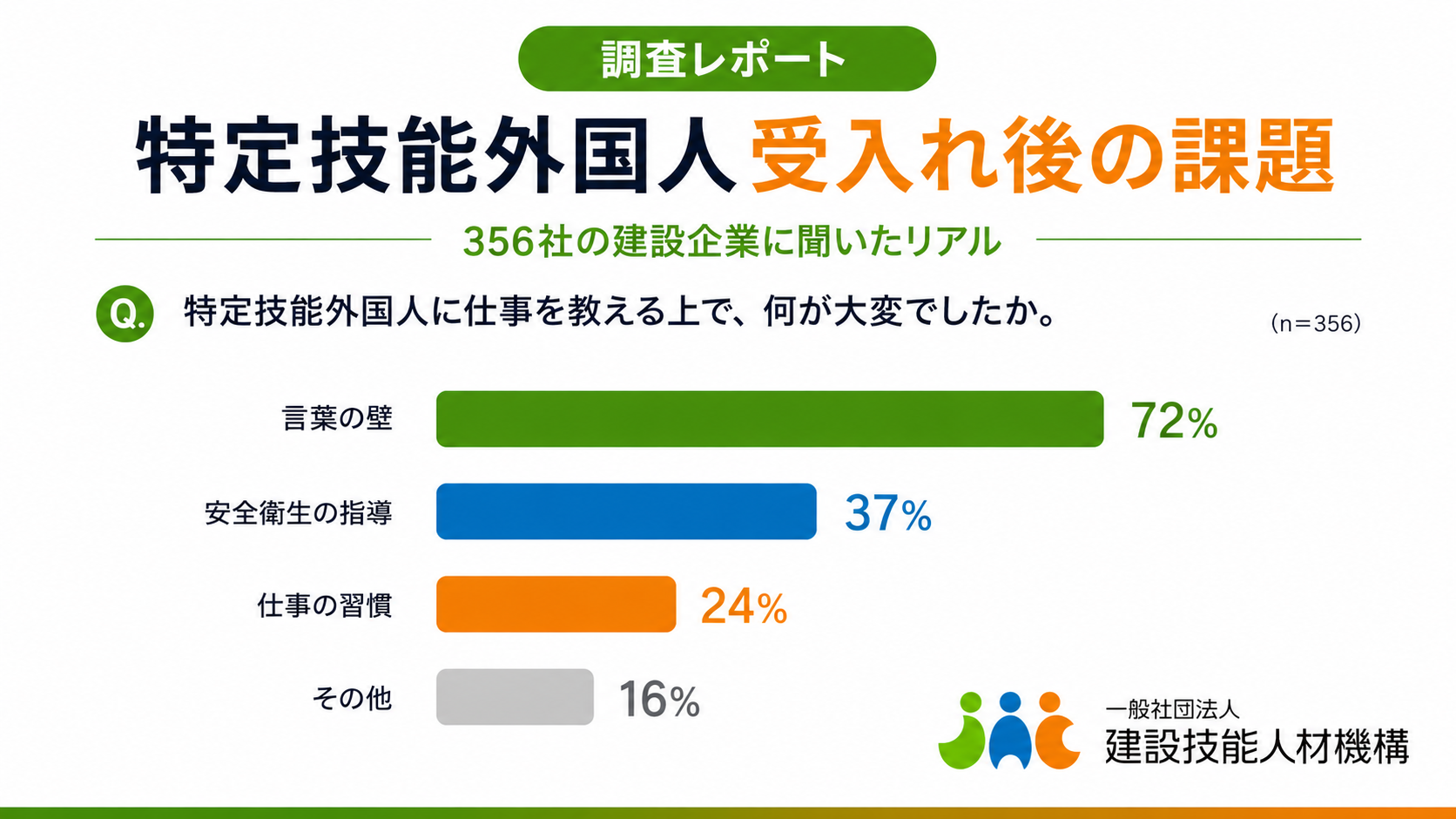
Q. What was the challenge in teaching Specified Skilled Worker?
*Multiple answers allowed
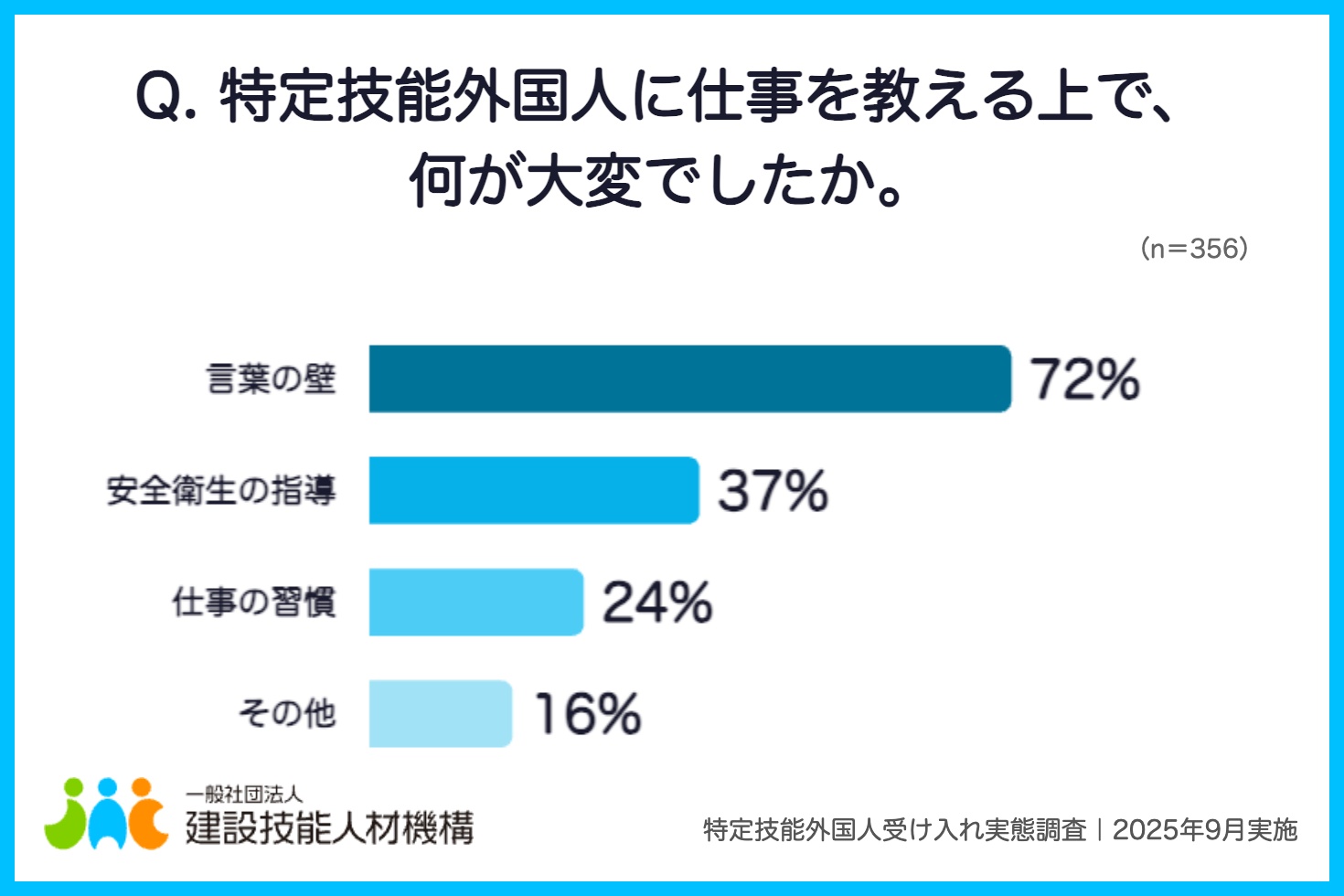
The most common response was "language barrier," with 72% of companies citing it as a challenge.
This was followed by "safety and health guidance" at 37% and "work habits" at 24%.
Regarding the "language barrier," many companies shared experiences such as, "We gave instructions in Japanese, and they nodded in response, so we thought they understood, but in reality, they didn't understand at all."
Additionally, values regarding safety and health often differ between Specified Skilled Worker 's country of origin and Japan, and there is a strong tendency to neglect safety and health, thinking "this is enough."
In terms of work habits, some respondents mentioned noticing differences in how people behave after completing their assigned tasks compared to Japanese workplace practices.
Actions like "reading the room and acting accordingly," such as helping out a colleague who is falling behind, often won't be understood unless explicitly communicated.
Specific initiatives at the site
We asked them to describe the measures they are taking on-site as countermeasures.
Rephrase it in simpler terms.
Construction sites often include a lot of technical jargon and difficult words for beginners in morning meetings and work instructions, making them quite challenging for foreigners.
For example, the following 'Plain Japanese' was practiced as a way to rephrase it with '' in mind.
- 禁止→ダメ
- 歩行→歩く
- 本日の作業内容→今日の仕事の内容
- 揚重→クレーンで吊ること
There were also comments that demonstrative pronouns such as "that," "it," "this," and "over there" are difficult to understand.
Clearly communicating what you intend to show is also one way to improve your presentation.
Demonstrate and teach
Many companies have experienced the limitations of trying to communicate solely through words.
It's not uncommon for someone to respond with "I understand" immediately after receiving instructions, but then, upon checking back later, find they've been working in a completely different way.
Based on these experiences, many people expressed the opinion that "showing it is the best way to do it, rather than explaining it in words."
The steady approach of demonstrating the process with gestures and body language, and repeatedly confirming the steps, seems to be leading to a solid understanding.
Q. What challenges have you faced in accepting Specified Skilled Worker so far?
*Multiple answers allowed
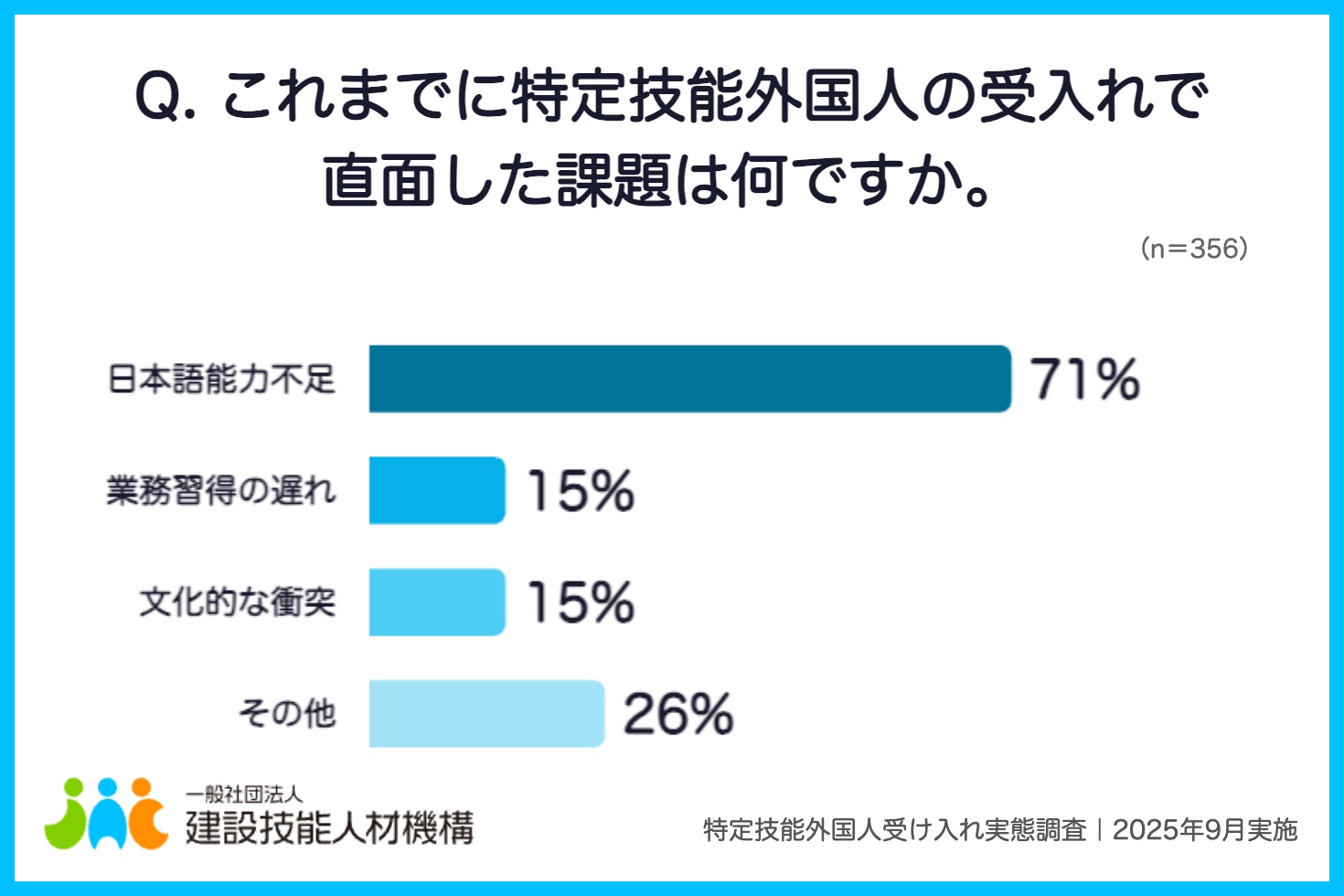
"Insufficient Japanese language ability" was the overwhelming majority at 71%, followed by "Other" at 26%, and "Delays in learning the job" and "Cultural conflicts" at 15% each.
In the "Other" free-response section, many respondents cited the difficulty and complexity of changing residence status and the numerous application documents required.
Many companies experience some kind of trouble or confusion after accepting employees due to insufficient Japanese language skills or cultural clashes, and the real challenge begins after immigration procedures are completed.
Below, we will introduce specific challenges, initiatives, and innovations reported from the field.
Specific initiatives on-site
We will introduce the actual challenges that the host companies faced on-site, as well as the initiatives and innovations they have implemented to address them.
We support Japanese language acquisition throughout the company.
We observed initiatives such as Japanese language educators providing slow, deliberate instruction, and setting aside time for students to be exposed to Japanese by limiting conversations between foreigners in their native languages.
Furthermore, some companies have implemented innovative approaches, such as creating their own company-specific tests or using apps to facilitate collaborative learning.
In Specified Skills, an N4 or higher Japanese proficiency test is required, but even if you have obtained N4, it may not be effective for practical work or communication on the ground, so it is important to establish a follow-up system after acceptance.
For a detailed explanation of the Japanese level required for Specified Skilled Worker, please take a look here.
What is the Japanese level of Specified Skilled Worker? Points to note and measures after acceptance
Carefully explain the culture and customs.
There have been reports of complaints from neighbors regarding issues such as garbage disposal and nighttime noise, and many companies seem to be realizing the importance of carefully explaining living rules to tenants when they move in.
Furthermore, some voices expressed difficulty understanding that taking photos inside the venue is prohibited.
In some cases, SNS is more widespread in Specified Skilled Worker 's home country than in Japan, and even without malicious intent, it can lead to risks in information management.
These kinds of problems often cannot be resolved with just a single explanation at the time of move-in or start of employment; it is important to repeatedly and persistently communicate the information.
Actively utilize the support of interpreters and support organizations.
When language barriers or daily life troubles arose, several people reported being helped by interpreters or Registered Support Organizations staff.
For host companies to actively utilize external support rather than handling everything alone, it seems likely to be a major help in solving these issues.
Q. What difficulties have you faced communicating with Specified Skilled Worker?
*Multiple answers allowed
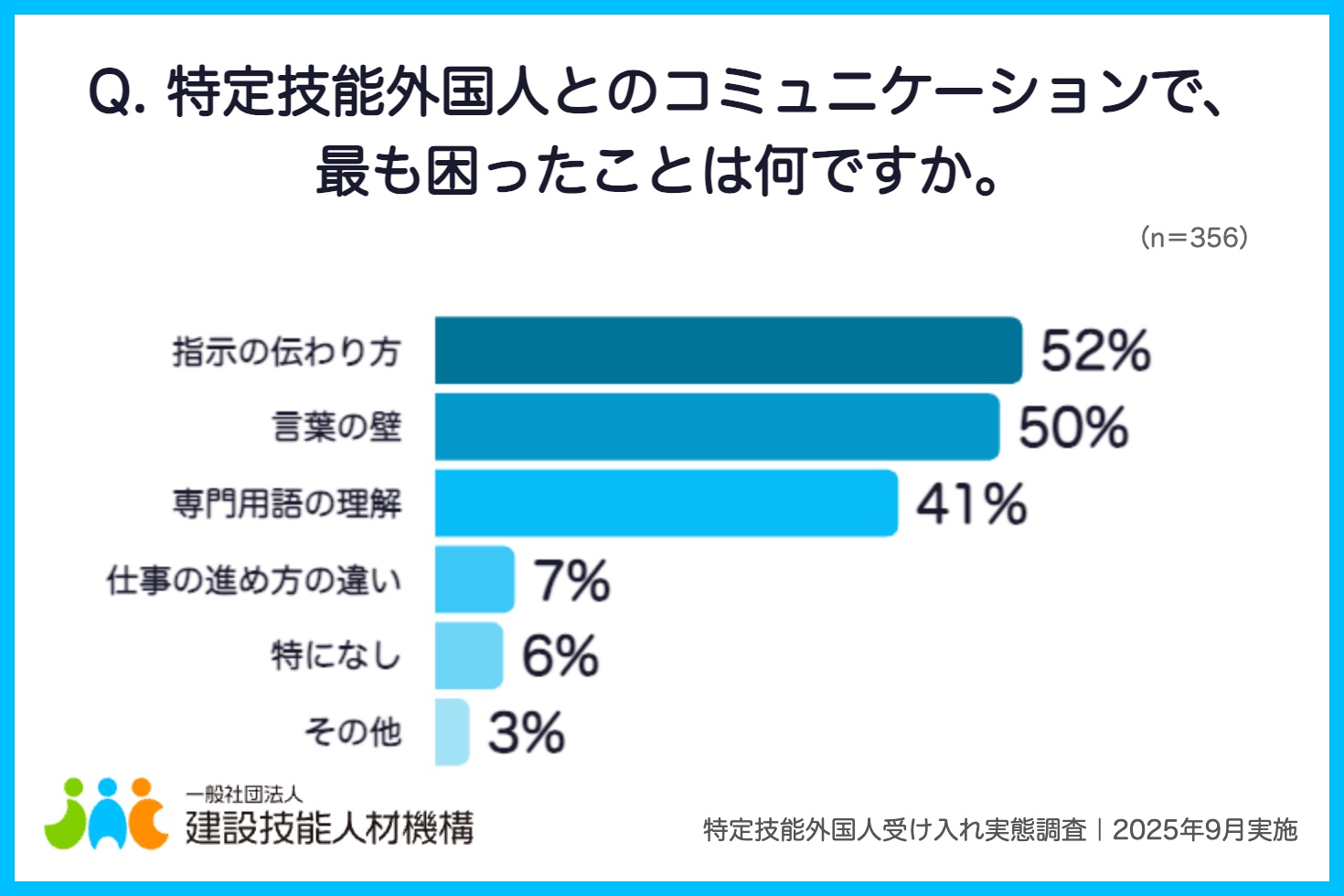
The results showed that 52% cited "how instructions are communicated," 50% cited "language barriers," 41% cited "understanding technical terms," and 7% cited "differences in work procedures."
Regarding how instructions are communicated and language barriers, the most common complaint was, "Even when I say 'I understand,' I don't actually understand."
We learned that companies are undertaking various initiatives and efforts to address these challenges.
For tips on how to communicate smoothly with foreign workers, please also see this.
What measures can be taken to ensure smooth communication with foreign workers?
Specific initiatives at the site
The area that often presents challenges in communication is language comprehension.
We asked them to describe the measures they are taking to address the issue.
Develop the habit of questioning "I understand."
Numerous cases have been reported where individuals respond with "I understand" or "It's okay" even when they don't fully understand, resulting in them taking actions different from those instructed.
In response to this, some companies shared their perspective, saying, "They might be responding because they think they'll get scolded."
It's important not to judge solely based on their responses, but to confirm their understanding by having them actually try it.
Some respondents said they "realized they didn't understand the nuances," suggesting that developing observational skills through daily interactions is also important.
Another suggested approach was to replace phrases like "do not do" or "should do" in instructions with clearer terms such as "OK/NG."
Utilize non-verbal communication methods.
Other approaches included using gestures and body language in instruction, as well as illustrating work procedures with diagrams and charts.
In some cases, understanding can be aided by combining actions and visual information, rather than relying solely on language.
Use LINE and translation tools
Some companies have established a practice of using LINE as a means of communication, with Specified Skilled Worker responding using translation tools.
For example, checking whether someone understands is done by phone, and the communication method and confirmation method are separated, and it seems they use different methods depending on the situation.
Translation tools are used by many companies as a means of communication with Specified Skilled Worker.
Details will be introduced in the next chapter.
Q. What means of communication do you use with foreign workers?
*Multiple answers allowed
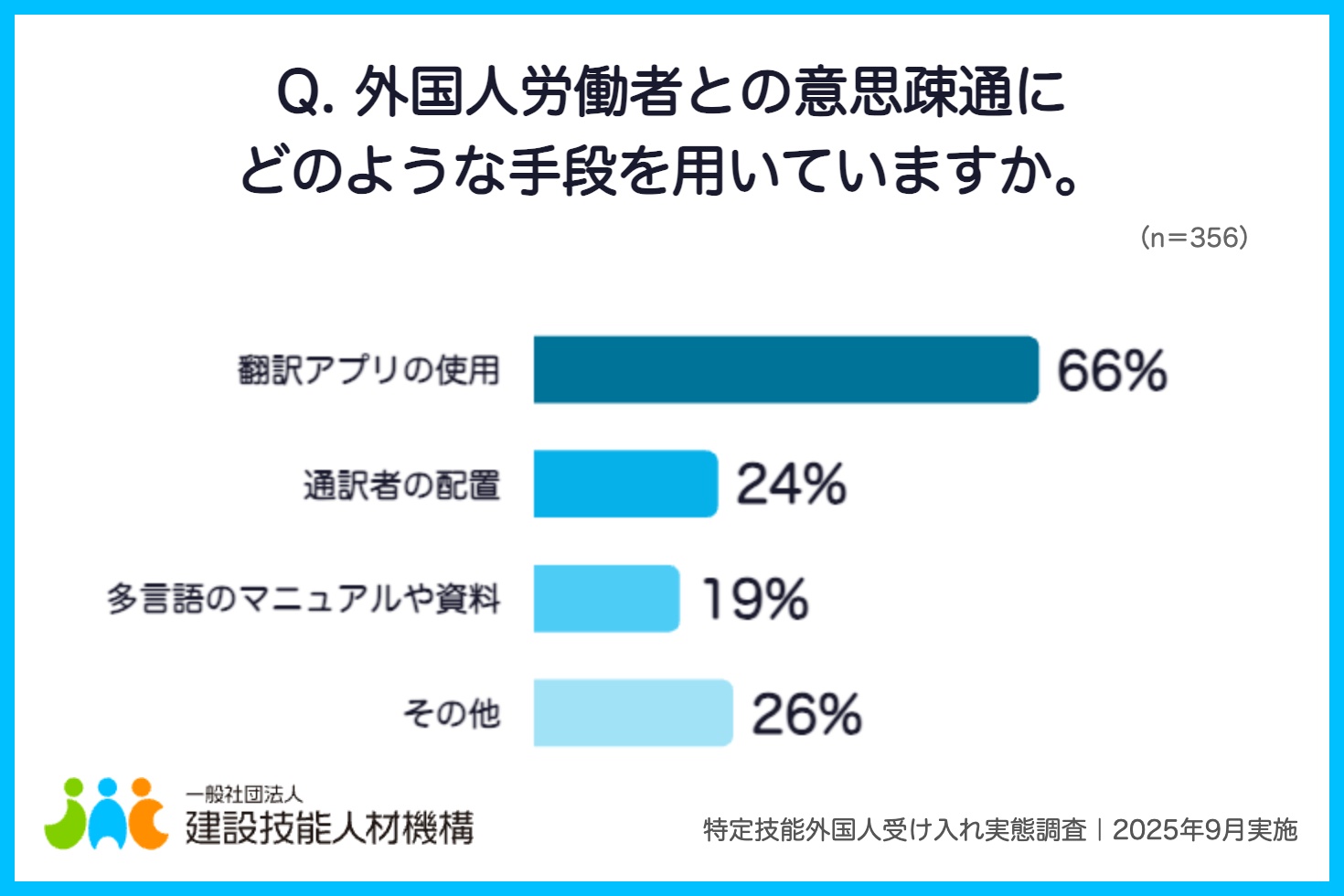
The most common method, cited by 66% of companies, was "using translation apps."
Following that, "Other" accounted for 26%, "Placement of interpreters" for 24%, and "Multilingual manuals and materials" for 19%.
For each method, we received many comments from companies regarding specific ways of using them and the challenges they face.
Specific initiatives at the site
Based on responses from companies, we will introduce the initiatives that are actually being implemented on the ground.
Use translation apps
Many users mentioned using apps as supplementary tools, such as "checking important information with a translation app" or "translating and distributing documents in advance using ChatGPT, etc."
On the other hand, some companies felt that translation apps had limitations, such as "frequent mistranslations" and "difficulty in conveying nuances effectively."
Due to a lack of trust in translation accuracy, some people are skillfully using both methods depending on the situation, such as prioritizing demonstrations over verbal explanations, especially when it comes to work-related matters.
Develop multilingual manuals.
An increasing number of companies are creating multilingual materials that summarize tool names and usage, work procedures, and safety precautions, often accompanied by photographs and diagrams.
Regarding safety and health in particular, some suggested that using a version in the user's native language would be effective.
Collaborate with interpreters and Registered Support Organizations
Many companies had established a system where an interpreter would be present during important discussions (regarding employment conditions, personal issues, medical consultations, etc.).
It seems that many people use Japanese for everyday communication, but use an interpreter for detailed and important matters.
Some companies have even hired dedicated interpreting staff as full-time employees.
We value everyday communication.
Many companies feel that building relationships on a daily basis is the foundation of communication, in addition to using translation apps and hiring interpreters, and the following kinds of efforts were observed:
- External social events such as dinner parties, barbecues, and sports.
- Interaction through watching videos as a hobby
- Use of LINE and social media
- Accumulation of everyday conversations
Many companies felt that creating an atmosphere where employees feel comfortable speaking up about problems is key to long-term employee retention.
The real work begins after acceptance! Make use of JAC's support services!
Specified Skilled Worker can be a major asset, but as shown in the survey above, there are situations where support is needed for language, culture, and business acquisition.
Japan Association for Construction Human Resources (JAC) offers a variety of services to support the acceptance of Specified Skilled Worker!
* JAC's "Acceptance Support Service" is operated based on the Specified Skilled Worker (i) 's acceptance fee.
JAC's "Specified Skills Acceptance Support Service"
At JAC, we support foreign talent from the following three perspectives, mainly to ensure Specified Skilled Worker can thrive for a long time.
① Skill development support
We offer courses and training support to help Specified Skilled Worker improve their skills.
A survey revealed that 37% of companies felt they had challenges with "safety and health guidance," but JAC offers free online special education and skills training courses that can be taken in your native language.
Furthermore, we offer comprehensive support for skill development directly related to practical work, including Japanese language courses to address the "insufficient Japanese language proficiency" issue cited by 71% of companies, and educational training support to help employees acquire job-related skills.
② Support for promoting coexistence with local communities
We have also established support for CCUS (Construction Career Up System) fees, support systems to promote accumulation of employment history, and Temporary Return Support.
The survey also revealed that "daily communication and relationship building lead to long-term retention," and JAC will support the creation of a foundation that allows foreign workers to work for a long time with peace of mind, from the perspective of creating such an environment.
③ Support for daily life
We have a system in place to support you when you encounter difficulties outside of work, such as medical interpretation support or assistance with everyday life problems.
Hospital visits and everyday life problems are among the situations that are difficult for companies to handle on their own.
By utilizing this kind of specialized support, the burden on both the company and the foreign worker can be reduced.
JAC's Specified Skills acceptance support service assists in resolving common issues and problems encountered when accepting Specified Skilled Worker.
We offer a wide range of services, so please see the details on the page below.
Specified Skills Acceptance Support Services
Support for the cost of post-acceptance training.
Companies certified under Specified Skilled Worker Acceptance Plan in the construction field are required to attend the "Post-Employment Training" conducted by FITS (Foundation for International Transfer of Skills and Knowledge in Construction), an appropriate employment management agency, within approximately six months after the foreigner begins employment.
This is a course designed to help Specified Skilled Worker who visit Japan thoroughly understand the rules and manners of Specified Skilled Worker System and the construction industry.
JAC will cover the full cost of this post-arrival training.
Details about the post-acceptance training are available here.
Post-acceptance training to deepen understanding of the system
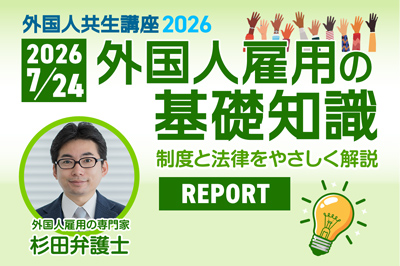
Seminar on Coexistence with Foreign Nationals
As the survey results show, smooth communication with foreign talent requires not only support for the foreign talent themselves, but also understanding and involvement from the receiving company.
JAC offers free 'Foreign Nationals Coexistence Courses' for Japanese employees.
In this course, you can learn topics such as cross-cultural understanding and Plain Japanese, which are useful for smooth communication with foreign talent.
Please use this opportunity to deepen your understanding of common challenges that arise after onboarding, such as "instructions not being communicated effectively" and "being confused by differences in values."
[Online, Free] "Learning about Coexistence with Foreign Employees" for Japanese Employees
Summary: Support is crucial after accepting Specified Skilled Worker!
The survey revealed that many companies are making efforts to sincerely engage with foreign talent.
Values and Japanese language proficiency vary from person to person, and that's true even for our Japanese staff.
Even if things didn't go smoothly at first, many companies were able to build trust through daily interactions and have the employees contribute as long-term assets.
The important thing is not to try to handle everything in one company.
Let's make good use of JAC's support services and create a sustainable acceptance system!
If you are a company that is considering accepting Specified Skilled Worker in the construction industry, please feel free to contact JAC!
The author of this article
Japan Association for Construction Human Resources
Public Relations Department/Administration Department
Shohei Katayama
(Shohei Katayama)
Born in Fukushima Prefecture.
I am currently working as a public relations officer.
In public relations, I cover the advanced initiatives of companies that accept Specified Skilled Worker in the construction field, and write articles and disseminate information.
In addition, we continue to disseminate information every day with the desire to let foreign workers working in Japan know more about the charm of Japanese culture and the way they think about work.
Related articles
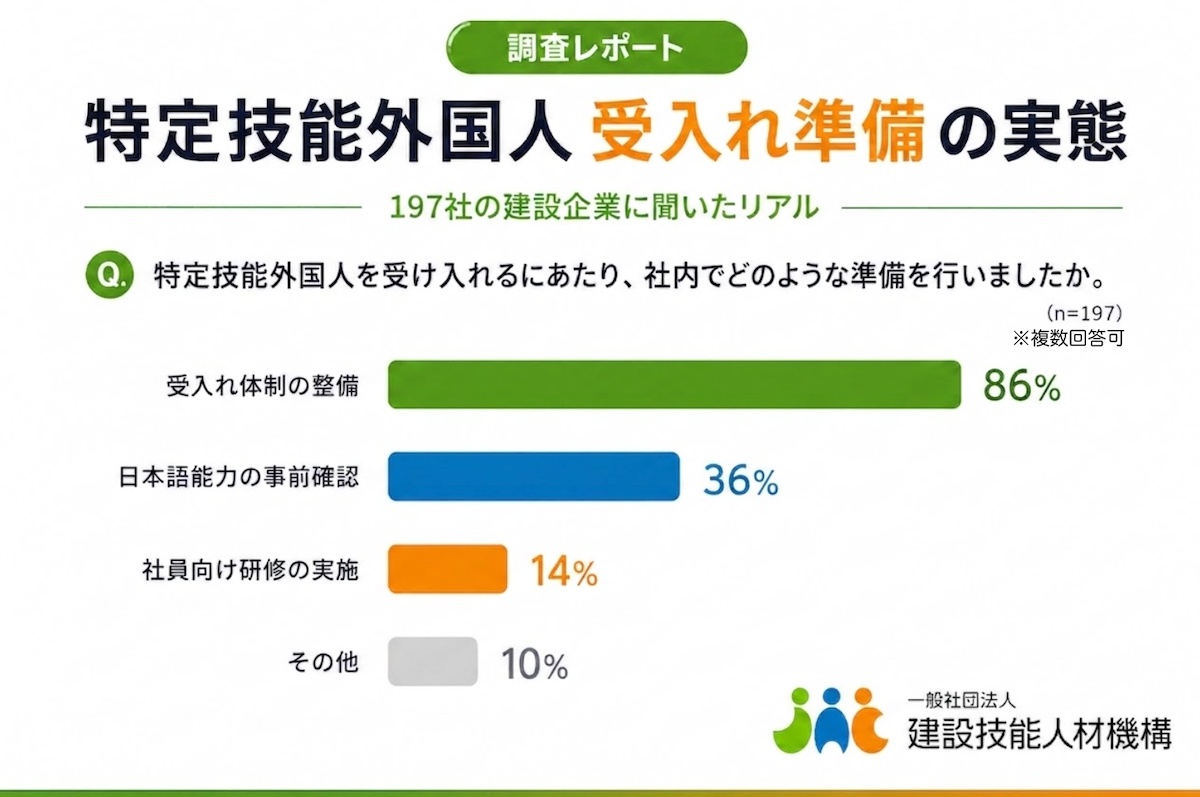
[Survey Report] Insights from Surveys! Specified Skilled Worker The Realities of Acceptance Preparation

Considering "Japanese language education" for foreign workers: What are the necessities and teaching methods?

What makes a workplace welcoming to foreigners? Key points for creating a workplace that companies should implement.
Check out the causes and safety measures for the three major disasters in the construction industry!