- やさしい日本語
- ひらがなをつける
- Language
We provide multilingual content through machine translation. Translation accuracy is not 100%. About the multilingualization of the JAC website




- Home
- JAC Magazine
- Working with foreign workers
- Considering "Japanese language education" for foreign workers: What are the necessities and teaching methods?
- Home
- JAC Magazine
- Working with foreign workers
- Considering "Japanese language education" for foreign workers: What are the necessities and teaching methods?

Considering "Japanese language education" for foreign workers: What are the necessities and teaching methods?
I wrote the article!


Japan Association for Construction Human Resources
Chief of Research and Development Department / Administration Department / Public Relations Department
Motoko Kano
(Kano Motoko)

Hello, this is Kano from JAC (Japan Association for Construction Human Resources).
As the number of companies hiring foreign workers increases year by year, many professionals are struggling with the question, "How should Japanese education be conducted?"
Language barriers are directly linked to work efficiency and workplace safety.
In this article, we will explain in detail why Japanese education is necessary for foreign workers, specific teaching methods, and key points to ensure the long-term use of education.

Is Japanese language education necessary for foreign workers?
The level of Japanese language proficiency required of foreign workers coming to Japan varies depending on their residence status.
For example, in the case of Specified Skilled Worker (i) foreign workers, the requirement is to meet one of the following requirements regarding Japanese capability.
- Japanese Language Proficiency Test (JLPT): N4 level or higher
- Japan Foundation Test for Basic Japanese (JFT-Basic): A2 level or above
Japanese Proficiency Test N4 is considered to be able to understand basic Japanese.
For more details on N4-level Japanese, please refer to this article.
What is the Japanese level of Specified Skilled Worker? Points to note and post-acceptance measures
Depending on the residence status, proof of Japanese proficiency may not be required, but if your Japanese ability is insufficient, it can cause trouble.
Problems and risks that are likely to occur due to insufficient Japanese language skills
If foreign workers are placed on-site without adequate Japanese language education, there is a risk of various problems arising.
Common problems and risks include the following:
Deterioration of interpersonal relationships
In environments where communication is difficult, small misunderstandings can easily accumulate, making it challenging to build trust with Japanese employees.
When instructions are not accurately conveyed or communication breaks down repeatedly, it can lead to resentment among colleagues and negatively impact the overall atmosphere of the workplace.
Decreased work efficiency
If instructions or confirmations for work need to be given every time, and communication relies on an interpreter or gestures, it takes time and effort, reducing productivity.
This also increases the likelihood of having to redo work due to miscommunication.
Decreased motivation among foreign employees
When foreign employees feel they cannot effectively communicate their thoughts and ideas, or that they cannot fit in with their colleagues, their motivation may decrease, which can lead to early resignation.
Losing employees who have been hired and trained represents a significant loss for a company.
Risk of serious injury or accident
In particular, in fields with many hazardous tasks, such as construction and manufacturing, the inability to understand instructions and warnings in Japanese can be a cause of serious accidents.
If signs such as "No Entry" and "Danger" are not understood, or if verbal safety instructions are not communicated, it could lead to irreversible consequences.
How can we provide Japanese language education to foreign workers?

Continuous Japanese language training after employment is essential for smooth communication and safe work practices in the workplace.
There are various options for how companies can implement Japanese language education.
Choose the best method based on your company's situation and the needs of your foreign employees.
We conduct Japanese language training within the company.
This involves inviting a Japanese language instructor to the company or preparing training materials and conducting regular training sessions.
Conducting the training in-house offers several advantages: it allows for the incorporation of content directly related to business operations, and it also enables us to monitor the proficiency levels of foreign employees as we progress.
On the other hand, it is important to note that this can place a heavy burden on staff responsible for Japanese language education, such as securing instructors and creating curricula.
They will attend a Japanese language school or Japanese language class.
We can also consider having them attend local Japanese language schools or classes.
Because you receive expert instruction, you can learn Japanese gradually and at your own pace.
However, it is necessary to consider that adjustments to working hours will be required, and that costs such as transportation expenses and tuition fees will be incurred.
It is important to create an environment that makes it easy for employees to take the course, such as by having companies cover part of the costs.
We will provide learning materials and have them study on their own.
Another approach is to provide textbooks, learning apps, and video materials to encourage self-study.
In recent years, the number of free learning apps and online materials has increased, so simply sharing these tools can create opportunities for learning.
While this has the advantage of allowing foreign employees to learn at their own pace, it can be difficult to maintain motivation, and there are many cases where employees find themselves unable to continue without realizing it.
Regular progress checks and communication are crucial support from the company.
Use external Japanese language courses
In recent years, there have been many external Japanese courses available online or in person with professional instructors.
Costs and content vary, but you can learn Japanese step by step from the basics with a curriculum designed by experts.
Additionally, some courses allow you to manage your progress, and many offer an environment that makes it easy to continue.
JAC offers free "JAC Japanese Courses" for Specified Skilled Worker in the construction industry.
We will explain more in detail next, so please make use of it.
Japanese education for Specified Skilled Worker in the construction industry is available in the "JAC Japanese Course"!
JAC (Japan Association for Construction Human Resources) offers a free Japanese course called the "JAC Japanese Course" for Specified Skilled Worker working in the construction industry.
JAC Japanese Course
JAC's specialized education team monitors and supports your learning progress, making it easy to overcome the major challenge of Japanese learning such as losing motivation and quitting halfway.
Target Audience
The following foreign nationals are eligible to take the JAC Japanese language course:
- Foreign nationals with the residence status "Specified Skilled Worker (i)" currently working at a company engaged in construction work *1
- Specified Skilled Worker (i) Currently employed at the same company as the foreign national and willing to transition to Specified Skilled Worker (i) Technical Intern Training *2
*1 You must pay the acceptance fee for foreigners attending the course.
*2 You must pay the acceptance fee for all Specified Skilled Worker you belong to.
If the capacity is reached, regardless of the order of application, [1.] Specified Skilled Worker of the above will take priority.
Course Lineup
JAC Japanese Language Courses offer a variety of courses to suit the needs and levels of students.
Here are some representative examples.
Learn Japanese on your smartphone
You can learn Japanese at your own pace by using a learning app on your smartphone.
It's ideal for busy people who want to tackle it during their commute or breaks.
Japanese for use at construction sites
This online course teaches the Japanese language skills necessary for safe and secure work on construction sites.
You will acquire Japanese language skills directly applicable to your work, such as how to read signs and understand rules and instructions on site.
Japanese language course for success
We offer exam preparation courses for the Japanese Language Proficiency Test (JLPT) from N5 to N2 levels.
You can learn by talking directly with a Japanese teacher online.
The course is held twice a week on weekday evenings for a total of 20 sessions (1 hour each), and you can take the course on your smartphone after work.
Japanese language lessons taught from my home country
This is an online course where instructors teach Japanese in the native languages of foreign workers.
A key feature is that explanations are provided in your native language, making it easier to understand the content.
After registering, you can participate at any time you like.
In addition to the courses we've introduced, we offer a variety of other courses.
For more details, please check the "JAC Japanese Language Course" page.
"JAC Japanese Language Course" - Free to Learn
How to take the course
You can apply through the smartphone app "JAC Members".
Please register using your own smartphone.
The general procedure is as follows:
- Install the app
- Register an account
- Select the course you want to take and apply.
- Waiting for JAC's approval
After submitting your application, it will be in a "pending" state.
Once JAC has confirmed and approved your application, it will be marked as "Application Completed" and your application will be officially confirmed.
Depending on the course, you may be required to take a test to determine your level after registering.
Depending on the results, we may ask you to change your desired course.
For details on how to register an account or apply, please check here.
How to install and use the smartphone app "JAC Members"
Apply for a Japanese language course
Key points for successful Japanese language education for foreign workers
Even when a suitable environment for Japanese language education is established, challenges can arise such as "students not continuing" or "not feeling that the program is having any effect."
To ensure that Japanese language education functions effectively in the long term, consider the following mechanisms and environmental improvements as helpful hints.
Set specific learning goals.
A vague goal like "improving my Japanese" won't keep foreign employees motivated.
It is recommended to set specific, time-bound goals together, such as the following:
- I will pass the N3 level of the Japanese Language Proficiency Test within six months.
- You will be able to hear safety instructions on site.
When your goals become clear, you'll feel a sense of accomplishment in your daily studies, which will motivate you to take the next step.
Regularly check your learning progress.
Continuing to study Japanese is important.
Make sure to create a system for regularly checking progress.
Having a system in place where the company is continuously involved in Japanese language learning, such as weekly check-ins or monthly feedback meetings, makes it easier for employees to continue learning.
Utilizing external courses, such as the JAC Japanese Language Course, where a specialized team monitors your progress, can also be effective.
Let's share our reasons for learning Japanese and help people understand the benefits of learning it.
If foreign employees are only studying because they feel they have to, their learning won't last long.
Carefully explain the benefits to the individual of improving their Japanese language skills, and support them in taking the learning process personally.
Ensure a conducive learning environment and time.
It's difficult to voluntarily study after a tiring day at work, no matter how motivated you are.
It is important to create an environment where learning and work can be balanced, such as allocating study time during work hours or reducing overtime to allow time for self-study.
Encouraging students to use smartphone apps for learning during spare moments is also an effective strategy.
We will also promote cross-cultural understanding among Japanese employees.
Japanese language education is not just an issue for foreign employees.
Deepening Japanese employees' understanding of the necessary communication methods and cultural backgrounds when working with foreigners will also contribute to improving the workplace environment.
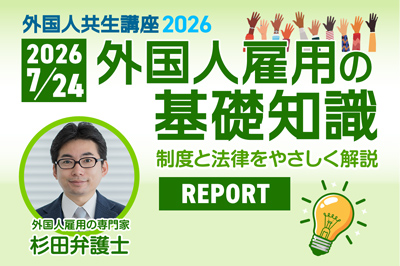
At JAC, we offer free "Foreigner Coexistence Courses" not only for foreign employees but also for Japanese employees.
This course will teach you the mindset needed to work with foreigners and the basics of cross-cultural communication, so please take advantage of it.
Foreigner coexistence course
To facilitate the smooth acceptance of foreign workers, we recommend also working on raising awareness among Japanese people.
This article also provides a detailed explanation of how to communicate with foreign workers.
What measures can be taken to ensure smooth communication with foreign workers?
Summary: Continuity and support are crucial for Japanese language education for foreign workers!
Japanese education for foreign workers is an essential initiative for preventing workplace troubles, improving operational efficiency, ensuring safety, and supporting the personal growth of foreign employees.
There are various educational options, from in-house training to external courses, but the important thing is to have a system that enables continued use and provide company-wide support.
Companies in the construction industry that accept Specified Skilled Worker are encouraged to take advantage of the "JAC Japanese Course" offered by JAC!
It is free to attend, with a wide range of courses tailored to your level and needs, supported by a professional team.
Additionally, by utilizing it together with the "Foreign Employee Coexistence Course" for Japanese employees, multicultural understanding throughout the workplace is deepened.
JAC answers various questions regarding the acceptance of Specified Skilled Worker in the construction industry.
Companies in the construction industry considering accepting Specified Skilled Worker are welcome to consult with JAC!
The author of this article
Japan Association for Construction Human Resources
Chief of Research and Development Department / Administration Department / Public Relations Department
Motoko Kano
(Kano Motoko)


Born in Aichi Prefecture.
He is in charge of public relations, research and investigation, and is the person behind social media.
We update our social media accounts daily with the desire to make people fall in love with Japan, to spread the appeal of construction from Japan to the world, and to ensure that Japan's construction industry continues to be the industry of choice around the world.
He is also engaged in research into the feasibility of implementing skills evaluation exam in Asian countries, and is conducting interviews with local organizations in each country.
Related articles
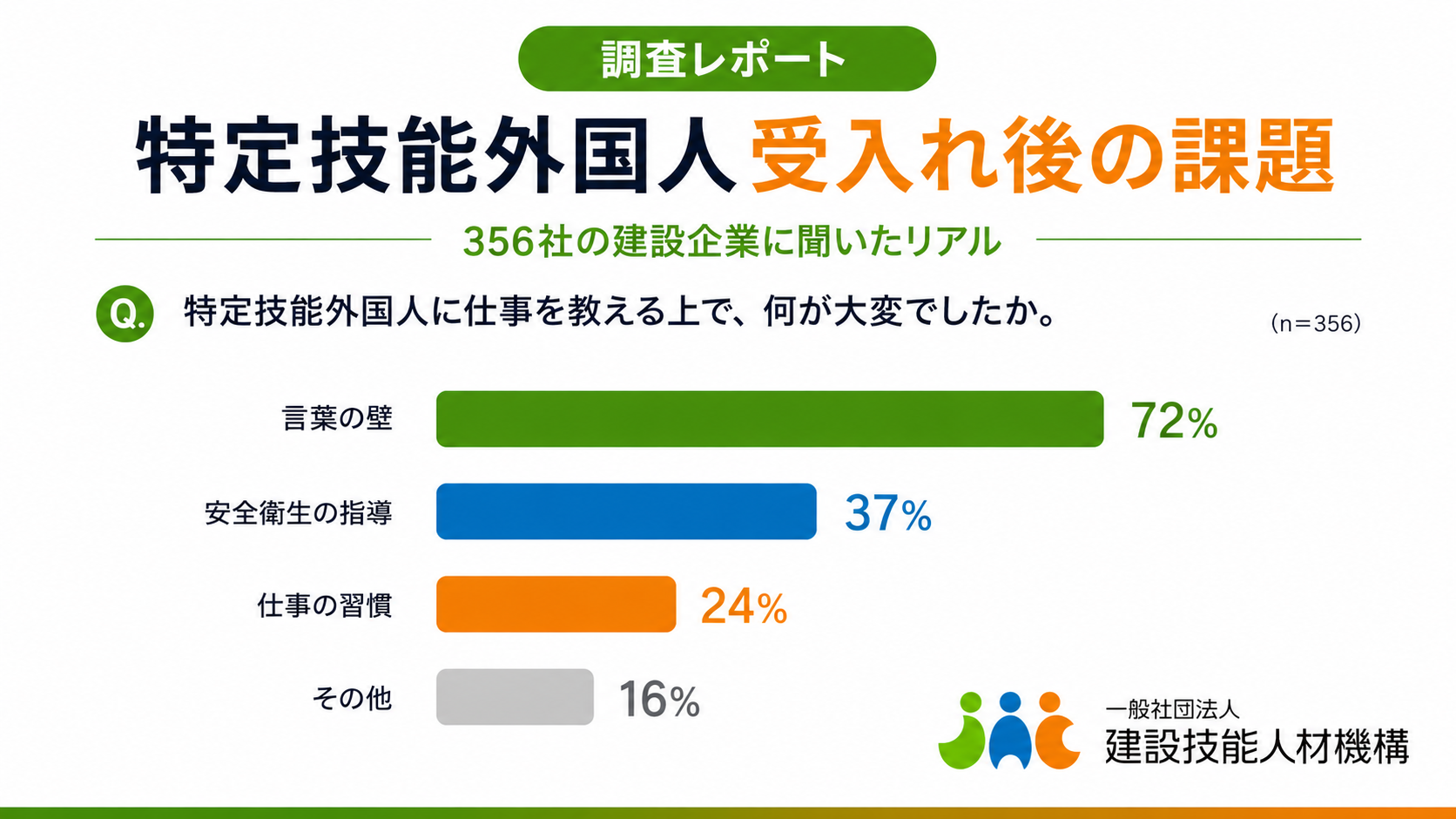
[Survey Report] Viewing from the Survey Perspective! Specified Skilled Worker Challenges After Acceptance
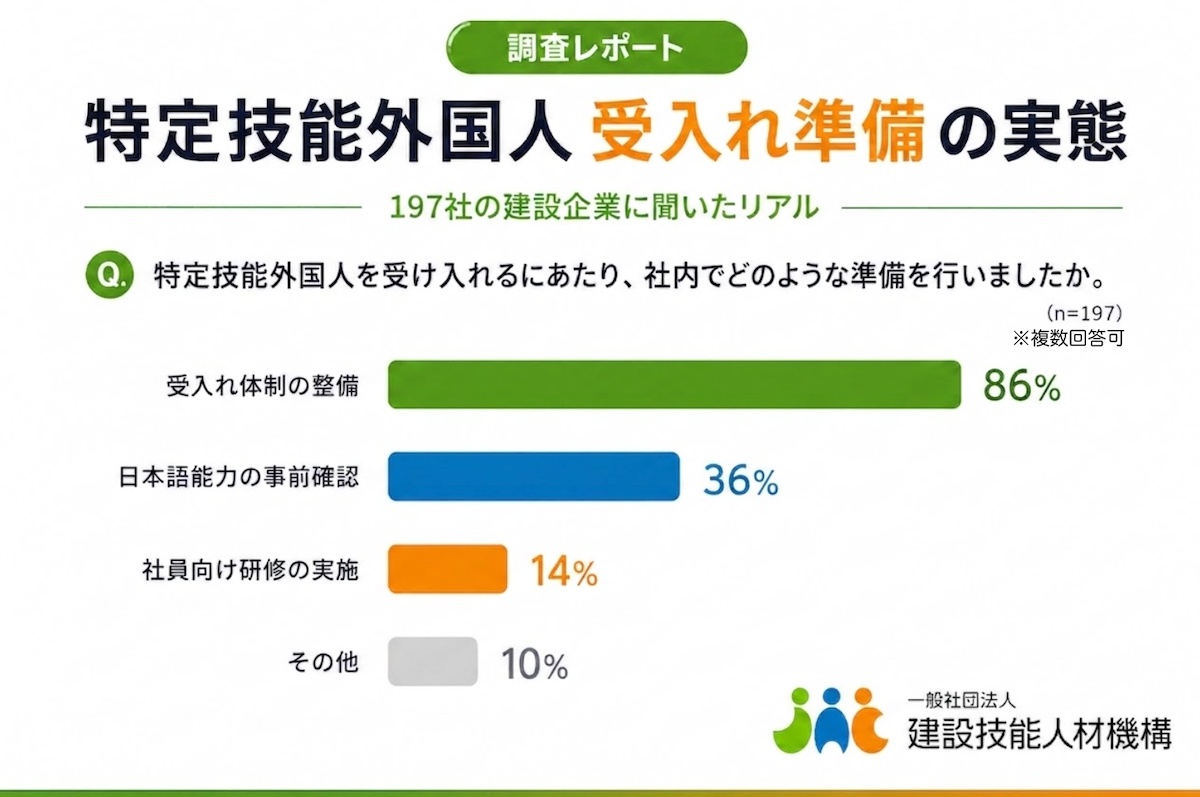
[Survey Report] Insights from Surveys! Specified Skilled Worker The Realities of Acceptance Preparation

What makes a workplace welcoming to foreigners? Key points for creating a workplace that companies should implement.

Check out the causes and safety measures for the three major disasters in the construction industry!